The Robots Taking Over the Battlefield’s Riskiest Jobs
Science fiction has depicted robots carrying rifles and other deadly weapons for a long time now, and that raises the question about how comfortable we should be with machines on the battlefield. Unfortunately for some, there are armed robots in service today, though the majority have been put to work for reasons other than combat.
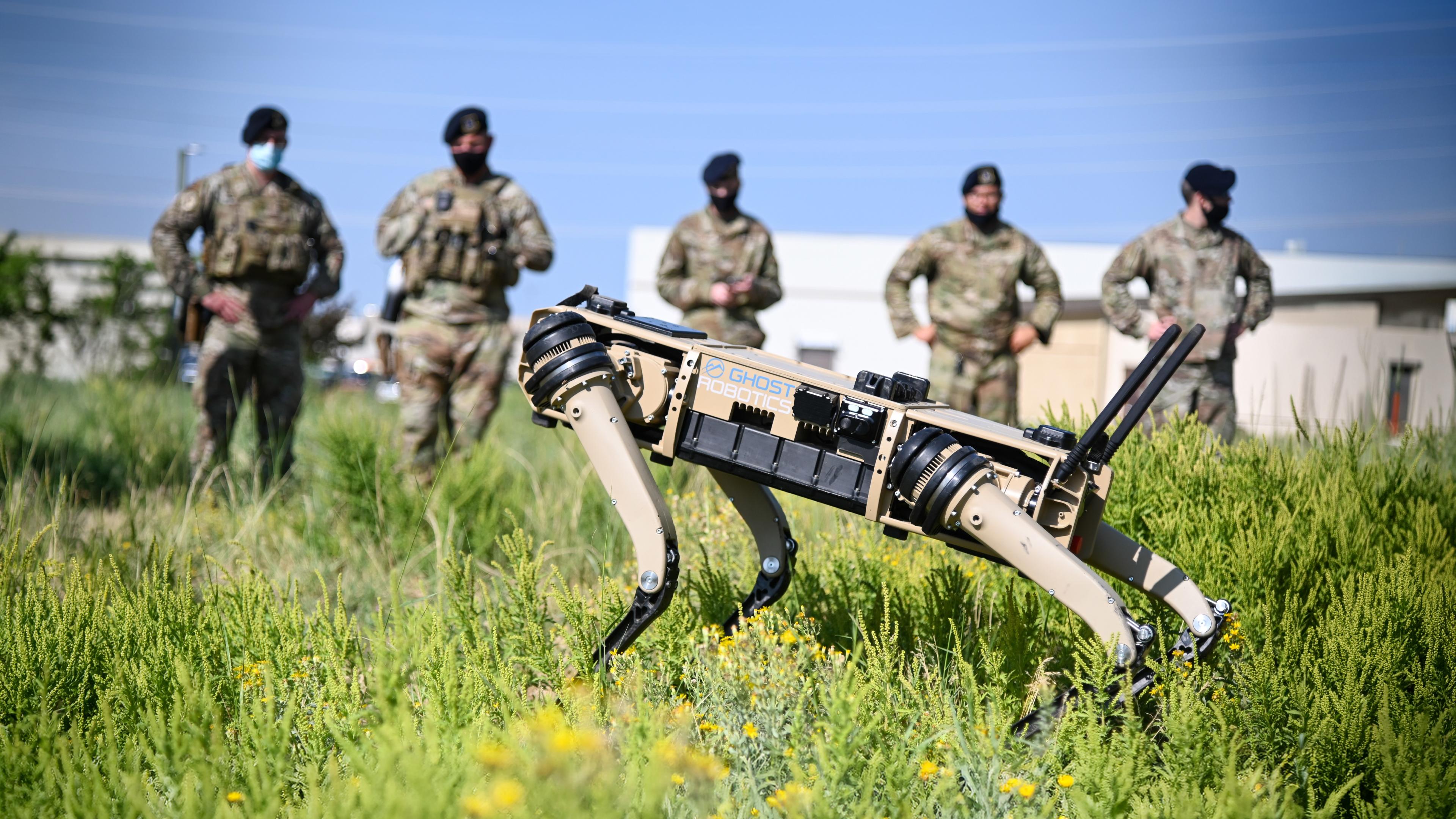
The subject of this article is the defense robots that are now at the disposal of soldiers to handle work that is either too laborious or simply “beneath” a human operator. There’s no doubt about how impressive an armed humanoid bot can be, and no one would argue about that, but for now we will put that aside. Let’s get started.
Frontline Robotics Frodo
Any non-combat duty on the front lines will demand a soldier to be on hand to support the troops in the field. With logistics robots, that is no longer always the case; they free up personnel for the kind of combat or support work that has to be done by a human. Take for example Frodo from Ukraine’s Frontline Robotics, an unmanned ground vehicle of the latest make, it was put on display as a UGV well suited to the task at hand, whether that means bringing in reinforcements in short order, resupplying or evacuating the injured.
With a top speed of 40 km/h and the ability to cover 150 km on a mission, Frodo is a capable machine. Its power comes from an individual motor for every one of its six wheels. The unit can be put in service with weapons, but logistics is where it is meant to excel. According to Frontline Robotics, the vehicle will see to it that as much as 400 kg of supplies are moved to forward positions “without exposing personnel to any unnecessary risk.”
Frontline Robotics Linza
While the drone one would normally buy is a matter of manual control, military models are increasingly being fitted with robot brains. It was not so long ago, some 20 years back, that unmanned aerial vehicles were the province of video games; now they are in the skies over Ukraine. The Linza UAV from Frontline Robotics is one example.
Linza is a logistics drone meant for reconnaissance. At 12 inches in size with a 15-kilometer tactical radius, it is well suited to put eyes on a target and can be called upon to drop bombs when necessary. It is also capable of hauling a four-kilogram payload.
Wild Hornets Queen Hornet
Then you have Wild Hornets, a Ukrainian maker with four models to its name. Of those, we are looking at the Queen Hornet, their logistics and bomber variant. The Queen Hornet can reach speeds up to 160 kilometres an hour and can handle a warhead of up to nine kilograms. But it is not only for bombing; it can also be used for logistics from as far as 20 kilometres out.
As warfare takes on a more mechanical and digitized character, it is only a matter of time before soldiers see these drones and others as a regular feature on the front lines. Russia has been at it already, putting its own UAVs in the field to put an end to Ukrainian production of the same. “Ukraine had planned to raise the number of drones used against Russia to 1,000 per day,” said Yuri Knutov, a military expert specializing in air defense
Boston Dynamics Spot
Whether it’s from TV shows or movies, most people have seen explosive ordnance disposal (EOD) specialists being put to work as they defuse a mine or bomb. It has been the province of men in their armor to do such a job, yet EOD robots have become more of a regular sight now. Boston Dynamics’ Spot can be repurposed for the job; an operator will have Spot make first contact, and from there decide on the course of action to neutralise the explosive.
Spot is more of a generalist robot, and it can easily be modified for disabling explosives. However, it wouldn’t compare well to a specialized robot. So how do soldiers deal with larger mines or more complex ordnance?
Shark Robotics Atrax
The Atrax from Shark Robotics is endowed with a greater number of EOD capabilities. In addition to disarming mines, it can put an end to improvised explosive devices (IEDs) and see to the disposal of bombs. Just like one would expect of Spot, there is a live video feed and the ability to manipulate objects. But the Atrax is in a class of its own when it comes to wire cutting; it is also equipped to jam signals in order for it to prevent any detonation.
There are no better means of bringing EOD robots into the military. The need for an effective way to dispose of explosives and limit casualties is necessary when one considers that IEDs are responsible for the bulk of the 357,619 civilian fatalities from explosives around the world during the ten years running from October 2010 to September 2020; and that is without accounting for those not put on record. A robot may come at a price but then again, there is no comparison with the value of a human life.
Sarcos Technology Robotic Loader Arm
One can only watch an artillery crew at work and appreciate the toll such massive rounds take on them. To relieve soldiers of that kind of burden, Sarcos Technology and Robotics Corporation (now known as Palladyne AI) put a robotic loader arm to the test with an M109 Paladin self-propelled howitzer. This arm was supposed to free up soldiers from the task, yet there has been no word from them on the matter since.
Elbit Systems Ro’em
An advanced robotic artillery battery called “Ro’em” was developed by Israel’s Elbit Systems. In a recent exercise, it was put to the test against Hezbollah. The unit requires no more than a three-man crew, and once an operator has picked out a target, it will load its own ammunition and fire eight shells per minute. With the help of its AI, Ro’em is a far quicker and more precise piece of equipment than the old artillery batteries.
The Ro’em has been a “major success,” said Lieutenant Colonel B, the one who put the system to the test. He also added, “The fire we conducted significantly advances the system’s capabilities and its integration into the Artillery Corps. This is history in the making after 50 years of waiting.”
Kuryer Robotic Mortars
The Kuryer is the name of a robotic mortar system that Russia has put in place, equipped with the Bagulnik-82. The automated turret does its own loading and was put through its paces with live ammunition in recent tests. Given the mortar’s ability to put out a quick succession of rounds without any manual intervention for reloading, it is possible for Russian forces to deliver suppressive fire without being near the front lines.
With the two sides at odds and each seeking to get the better of the other, Russia has put forward the Kuryer as its newest counter to the robotic armaments of Ukraine. Under the NRTK program, the Kuryer is designed to replace military personnel in high-risk operations. The name “Kuryer” in an umbrella term that covers a range of small tactical vehicles, and is not identified as a single model.
NORINCO Fuxi
Finally, there is the NORINCO Fuxi from China, a humanoid robot which the Chinese are putting forward for use in combat. The Fuxi is equipped with some formidable technology; this allows it to operate in formation and react to human motion inputs on the spot, according to one news article by People’s Daily Online.
For now, the Fuxi robots are being put to work for sentry duties, security purposes, or to take the place of personnel where conditions are dangerous.
More articles on this topic
215 articles ReportWhat it Really Costs to Own a Personal Assistant Robot at Home
 ReportRadioactive Mess? Better Call Spot
 ReportJapan's LOVOT Companion Robot Makes Abu Dhabi Healthcare Debut
 ReportTesla Starts Optimus Production, Targets First Commercial Deliveries in 2027
 ReportStrawberry-Harvesting Robots Learn to Pick Only Ripe Fruit
 ReportNVIDIA and Agile Robots Launch Humanoid Research Platform
 ReportThe Robots Giving Old Electric Vehicle Batteries a Second Life
 ReportUnderwater Robot Teams Take on the Problem of Seabed Waste
 ReportSmart Robotics to Boost Agriculture, Green Spaces, and Clean Tech
 ReportCould a Single AI Run Different Types of Robots?
 ReportAgility Robotics Co-Founder Reveals Why He Can't Love Digit 5
 ReportDetecting Gas, Braving Heat: This Robot is Built for Danger
BUSINESS NEWS WEEKLY LETTER
The Weekly Letter for Robotics Professionals, Summarizing the Most Important Industry Moves, Launches, Deals and Signals.