Underwater Robot Teams Take on the Problem of Seabed Waste
Teams of boats, drones and underwater robots can find and haul up the trash that sinks out of sight. It is interesting to know how they work, and where they still find challenges.

October 21, 2026 by Dr Maulik Vyas
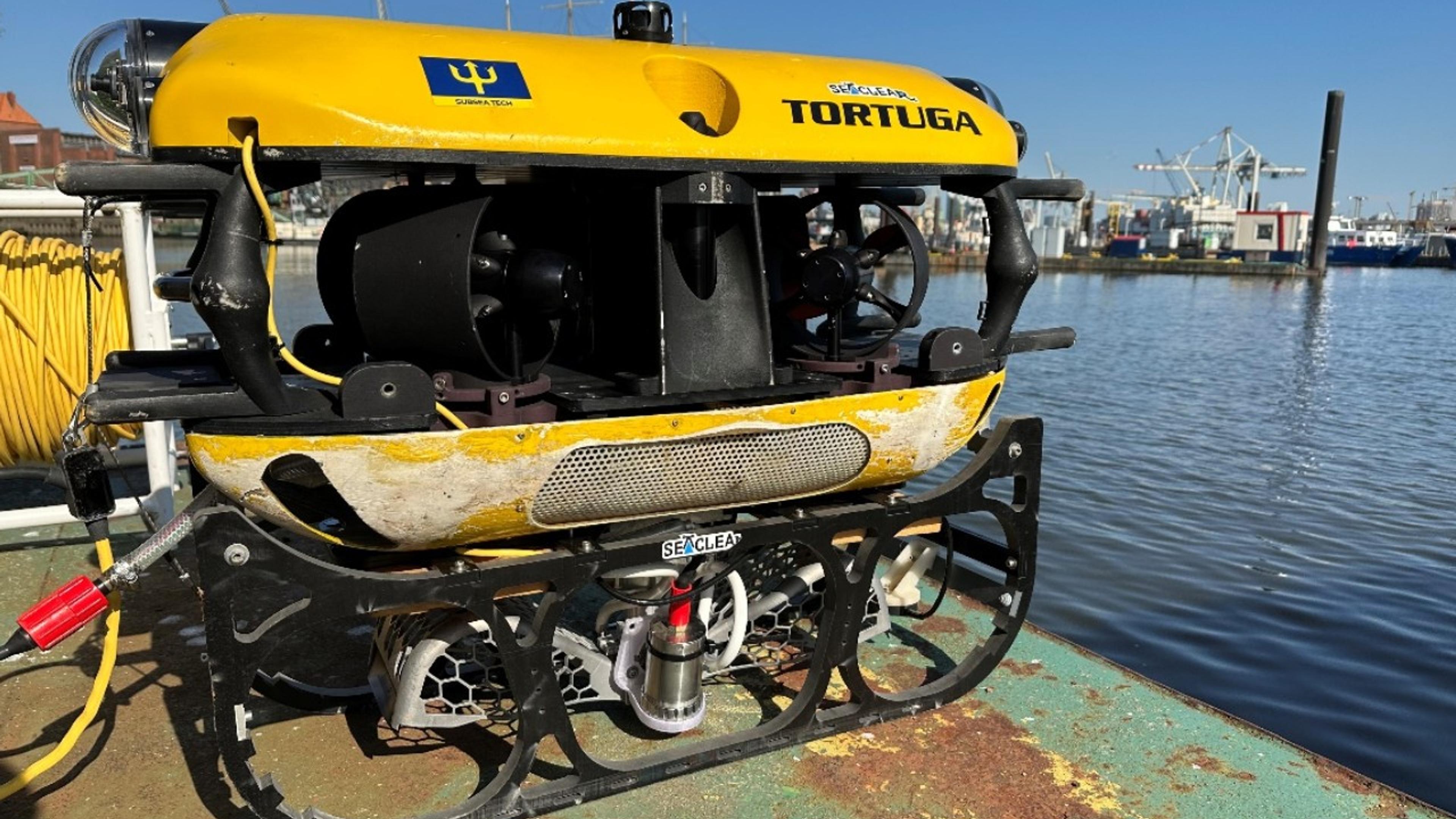
Most ocean cleanup talk is about the plastic you can see floating. But much of what we throw away doesn't float for long. It sinks, settles and stays, far out of reach of any net. So how do you clean what you can't see?
Why the seabed is the hard place to clean
Most ocean waste ends up on the bottom. One EU project description puts the total at 26 to 66 million tons, with about 94 percent of it on the seafloor. Bottles, tires, fishing nets and scrap metal all pile up down there, and some of it is surprising. Bicycles and e-scooters turn up in the mix.
Plastic doesn't stay in one piece either. Rather, it breaks into smaller particles and ultimately becomes microplastics, which work their way into food chains.
The usual fix is human divers. Divers are slow, costly and limited by depth and time underwater. Surface skimmers that grab floating plastic can't reach the stuff below. That gap is where robot teams come in, and one European project built a full team and put it through real tests.
A team, not a single robot
The project is called SeaClear, and the key idea is in its design. Instead of one machine doing everything, it uses a mixed crew of surface, underwater and aerial vehicles, each handling the job it's best at.
A boat acts as the mothership. It holds the control systems and provides power and data down cables to the underwater bots to keep them light and capable from the inside. Then, an aerial drone flies over to gauge the ocean surface and identify litter areas or hotspots. A small inspection robot (about 50 centimeters long in one version) scans the bottom. Finally, the larger collection robot sinks in for the pickup. It generally uses a gripper and a suction device.
One version of such a collector is built by researchers at the Technical University of Munich. The robot weighs 120 kilograms and sails with eight mini turbines. There is a layer of buoyancy foam that helps it keep hovering when the turbines stop; and, the litter it grabs into an autonomous dinghy works as a floating bin.
The robots also observe each other; when one changes position, the others register it and adjust without waiting for a human to give any command. However, a team still needs to check what it is looking at and that's where the Artificial Intelligence steps in.
How the robots tell trash from reef
Spotting a bottle on a clean white table is easy. Spotting one on a murky seabed, half buried in silt next to a rock, is another matter. The system relies on deep learning vision models, including a popular detection method called YOLO, trained on large sets of labeled underwater images. Sonar helps when the water is too cloudy for cameras, and the AI turns what it sees into a 3D picture to guide the grab.
The crucial part in the whole process is knowing what not to pick up! The robots are built and programmed to tell litter other than rocks, plants, fish and corals. Their collection halts automatically when marine life is spotted into the work zone. However, it is not that perfect. Low light, clouds of stirred-up sediment, and overlapping objects all are a big challenge to make the best identification. Hence, underwater communication and sensing are quite a big issue in their own right as the radio signals hardly travel deep into the water.
So how well does it all work in practice?
What these robots can do, and what they can't
Tests and trials are run in both clear and murky water. The results show real progress alongside clear limits: the collection robot may lift up to 7 kilograms, and the grabber may hold nearly the volume of two 2-liter soda bottles. The robots can work in waters up to about ten meters deep.
The project sets targets for itself: detect and categorize litter 80% of the time. Plus, collect it 90% of the time, and do it at 70% lower cost than what is spent on human divers. Nevertheless, these are the goals, not guaranteed results. So, we treat them as direction rather than proof.
The system also isn't fully autonomous. People still supervise it. Heavy items like tires or big chunks of metal are tougher, and in some cases, divers still have to go down to attach cables so the object can be hauled up. For now, think shallow coastal water and mid-sized trash.
Lost fishing gear is a different kind of problem, and the robots can help there too.
Ghost nets and other targets
Abandoned or lost fishing nets, known as ghost nets, are among the most stubborn threats to marine life. They keep trapping animals long after anyone stops using them, and they're hard to find because they blend into the bottom.
Researchers have tested a small surface vessel with side-scan sonar and onboard AI that recognizes net shapes from raw sonar data. In a demonstration with WWF Germany, test nets were laid out straight, curved and folded, to copy how real ones lie. The plan is for the robot to find the net and then guide a team of divers straight to it. Farther from shore, an underwater vehicle with sonar and a downward camera could do the same job.
The same detection tools hold promise for other seabed hazards, such as unexploded mines left over from wars. Sonar can already spot them, which is one reason this tech could matter beyond litter. Still, getting from a demo to everyday use takes more than good detection.
What would make these robots useful at scale
A few things stand between today's prototypes and routine cleanups. Deeper reach is one. Heavier lifting is another, since most seabed waste isn't a lone soda bottle. Longer battery life, cheaper hardware and rules for working around protected reefs and habitats all count too.
And cleanup alone won't fix it. Hauling trash off the bottom is far more expensive than keeping it out of the water in the first place. Robots are a repair tool, not a reason to relax about waste.
Robot teams won't empty the seabed on their own. But they show that boats, drones and underwater machines can share one job, from mapping the bottom to lifting trash off it. Deep, murky water is the real test.
More articles on this topic
211 articles ReportWhat it Really Costs to Own a Personal Assistant Robot at Home
 ReportNVIDIA and Agile Robots Launch Humanoid Research Platform
 ReportThe Robots Giving Old Electric Vehicle Batteries a Second Life
 ReportSmart Robotics to Boost Agriculture, Green Spaces, and Clean Tech
 ReportCould a Single AI Run Different Types of Robots?
 ReportAgility Robotics Co-Founder Reveals Why He Can't Love Digit 5
 ReportDetecting Gas, Braving Heat: This Robot is Built for Danger
 ReportRobots Can Do Physical Work, but Can Businesses Afford Them?
 ReportHumanoid Walks 560km in Nine-Day Durability Test
 ReportChina Targets Retail and Logistics in New Embodied AI Plan
 ReportWhat Happens When Robots Lose Their Internet Connection?
 ReportChina's Industrial Robot Output Surges 29% in Nine Months
BUSINESS NEWS WEEKLY LETTER
The Weekly Letter for Robotics Professionals, Summarizing the Most Important Industry Moves, Launches, Deals and Signals.