5 Robots That Can Make Learning More Fun In School
Introducing robots in schools is a great way to engage students and help them feel more excited in their classrooms.

October 13, 2026 by Manaal
Children love to dream and live in their own fantasy world. If there is one place though, where most children feel bored then that is a school. Introducing robots in schools is a great way to engage students and help them feel more excited in their classrooms.
A robot that dances can introduce coding. A robotic bee can teach a five-year-old how to follow instructions. And a colorful ball-shaped robot can help children practice recognizing emotions and taking turns. Here’s a lowdown of five robots that can make a meaningful difference in the education sector.
NAO: The robot that makes lessons more engaging
It can talk, gesture, walk and perform programmed movements. One of its biggest advantages is that it can convert an abstract lesson into something children can see and interact with. For example, instead of simply explaining what a computer programme does, teachers can show students how their instructions make NAO react and move. The robot can help a variety of age groups. While it can help students between the ages of four and six with vocabulary, counting and the concept of sharing through robot-guided games, older children can learn programming logic, human-robot interaction and artificial intelligence.
Moreover, students can programme NAO according to their preference. If they want it to speak or raise an arm in a certain way, they can immediately see if their instructions worked. And if the robot does something out of the ordinary, they can cross-question it, learn problem-solving and logical thinking.
BeeBot: Where children can become little coders
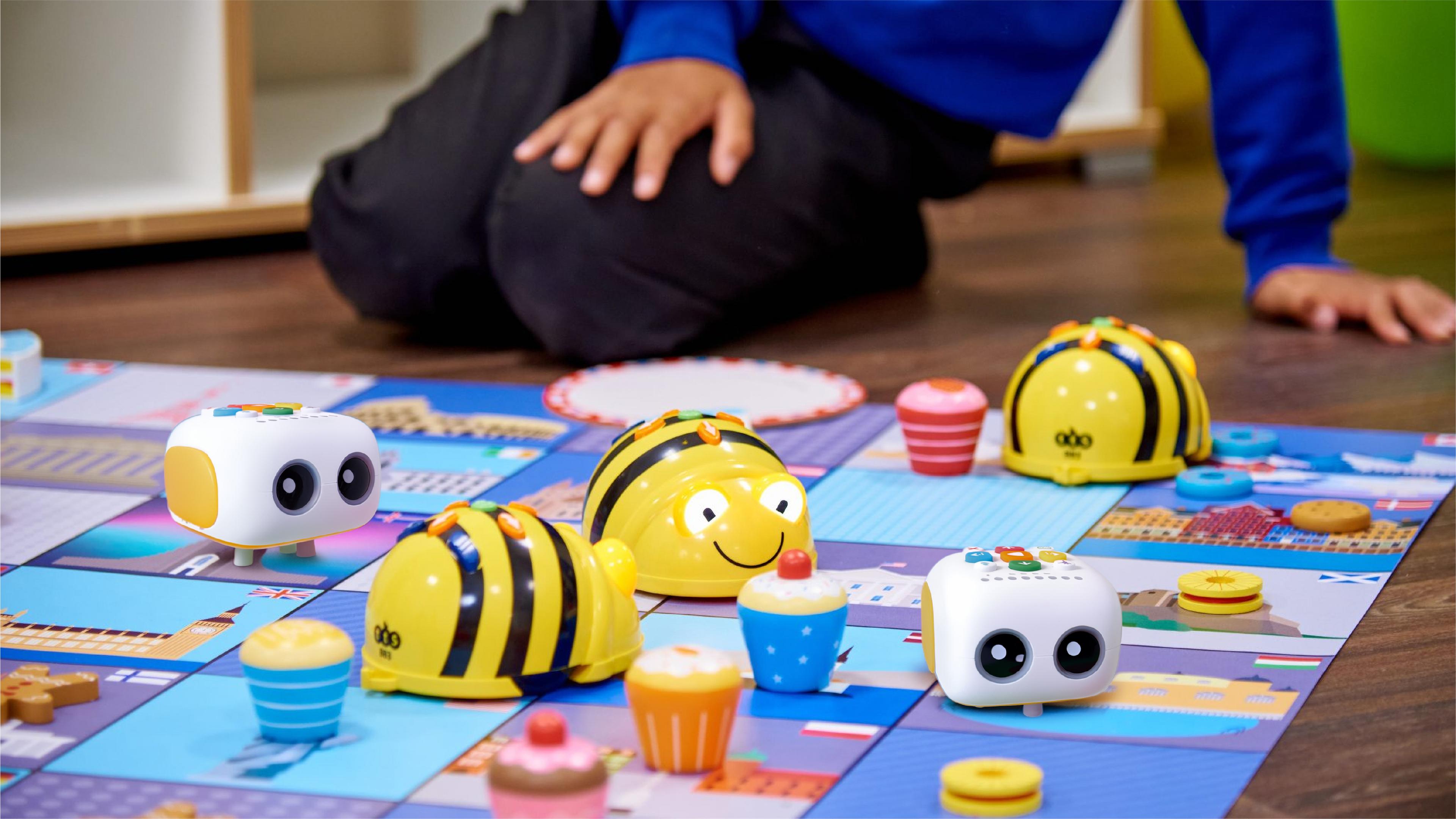
The robot was designed to introduce young kids to programming. Children can press directional buttons on the back of the BeeBot to navigate it. This teaches young kids to understand basic directions such as front, back, left or right.
Bee-Bot can also be used outside of coding lessons. For example, children could guide it across a number mat to practice addition, or across an alphabet mat to spell words.
Edison V3: From straight-forward games to hardcore programming
The robot is best for understanding concepts, mathematics, physics and problem-solving. Suitable for children between ages 4 and 16, its biggest plus is that the same robot can support progressively harder lessons as they grow up. While a child from the younger bracket can begin by making the robot move in simple directions, older children can write text-based codes to monitor its behaviour and sensors. Edison’s greatest benefit is that it can help young kids to understand technology through experimentation instead of rote-learning.
Temi: More connection amongst classrooms
The robot can connect students with people who cannot be physically present in the classroom on the day. For instance, a faculty member at a university in Dubai can arrange a virtual meetup with a professor at Harvard. Students can ask questions and interact through the robot instead of listening to a prerecorded conversation. This will help them stay focused and make the learning environment more fun and interesting.
Leki: For children with special needs
All children are different. Some are quieter, some have a shorter attention span, and some take longer to grasp concepts. Not all children find it easy to engage in discussions that take place in conventional classrooms, either. This is where Leki comes in. The robot uses light, movements, sounds and interactive games to help kids thrive in an academic environment. Children learn cognitive, communication and social skills.
Leki was designed specifically for experts working with children with neurodevelopmental conditions and other disabilities. Its features comprise different ways to keep students engaged. For example, in its Colour Bingo activity, the robot lights up in a specific colour and the child identifies the matching colour on an iPad. In Super Simon, children watch a sequence of lights and attempt to reproduce it. The activity is designed to exercise memory and concentration. In Dance Freeze, the robot moves to music and children stop moving when the music pauses. This can be used to practise listening, attention and movement control.
As the world continues to evolve, education must keep pace. By incorporating new technologies like robots into the academic curriculum, schools can make learning more interactive, engaging and accessible. After all, preparing children for the future starts with giving them the right tools today.
More articles on this topic
187 articles ReportWhat it Really Costs to Own a Personal Assistant Robot at Home
 ReportFour Humanoids Designed To Tackle Danger Zones
 ReportWhy Google's AI Made Spot Practise Using a Bin
 ReportTwo Tiny Robots Taking Heart Treatment from the Inside Out
 ReportPhysical Intelligence Opens Its Robot AI Models to Developers
 ReportAbu Dhabi’s New Robot Cooks Dinner Within Four Minutes
 ReportTry Before You Buy: Five Places to Test-Drive a Robot
 ReportGoogle AI Teaches Humanoid Robot to Play Cornhole by Watching Human Videos
 ReportYour Old Smartphone Could Soon Get a New Robotic AvatarReportWhy Google's AI Made Spot Practise Using a Bin
 ReportHumanoid Robots Are Learning to Navigate Obstacles Like Humans
 ReportWhat Happens When a Humanoid Robot Makes a Mistake?
BUSINESS NEWS WEEKLY LETTER
The Weekly Letter for Robotics Professionals, Summarizing the Most Important Industry Moves, Launches, Deals and Signals.