Strawberry-Harvesting Robots Learn to Pick Only Ripe Fruit
Pale shoulders, a red tip, a leaf in the way. That's all a strawberry robot has to go on before it decides to cut. Learn how this wonderful action happens.

October 22, 2026 by Dr Maulik Vyas
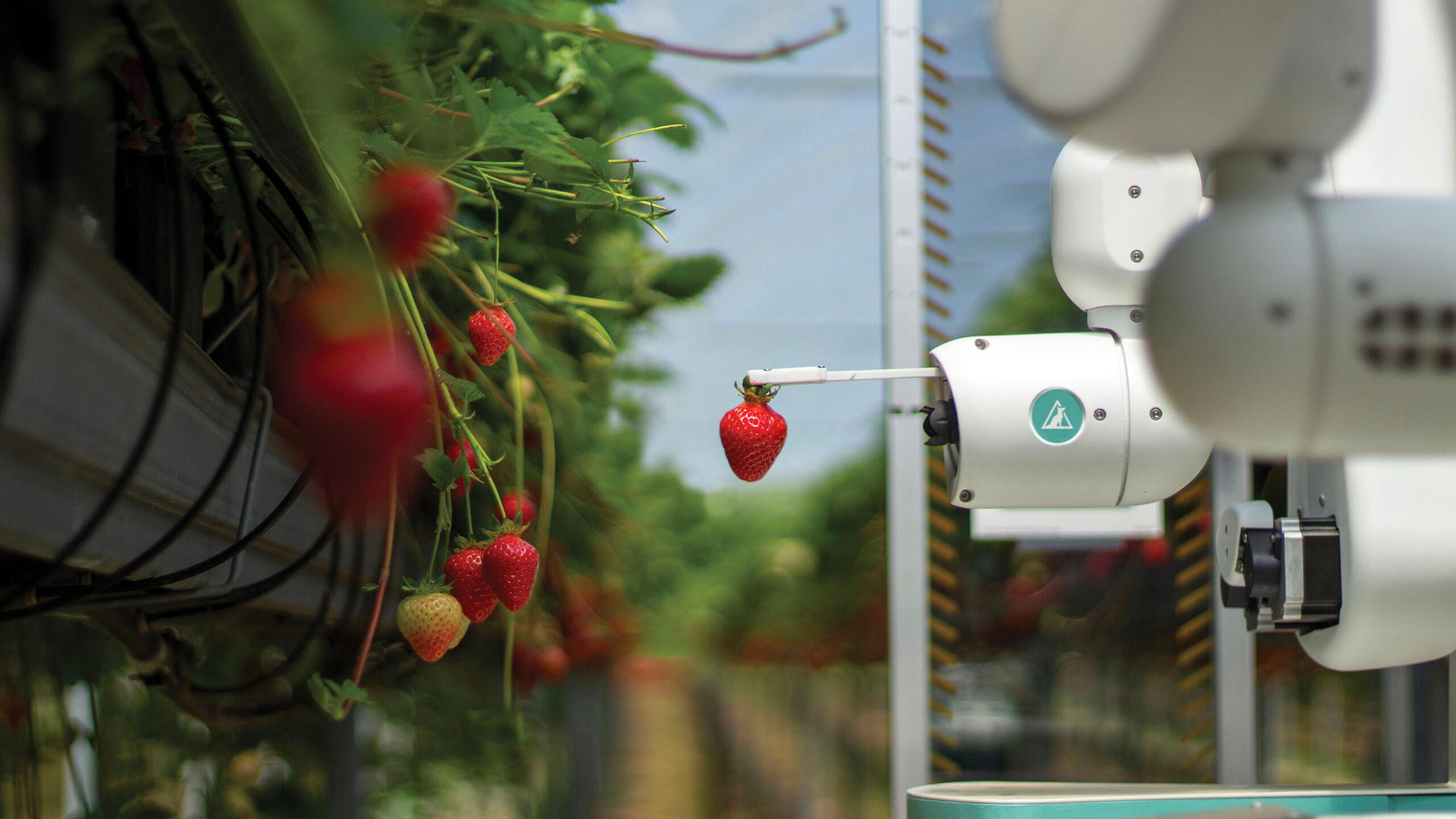
A strawberry will not get any sweeter once you pick it. Cut this berry too early and it stays sour. Cut one too late and it will bruise on the way to the shop. So, now hurries and worries are not an issue. Today, we have robots harvesting them to get the call right the first time.
What a ripe berry looks like to a machine
It will look a simple thing to describe ripeness in strawberries for most of the people unless they try to explain it! A strawberry’s color can be misleading. One side may be deep red while the area near the stem stays pale. A large berry isn’t always sweet, and a smaller one might be perfectly ripe. That’s why judging strawberries by their size, shape, or color alone doesn’t always work.
However, a robot can turn this glance into numbers and logic.
So, how does a strawberry look to an intelligent machine?
Well, most systems start with cameras. Dogtooth's robots carry dozens of them, and they photograph every berry on a plant. Once a berry is cut, another set of cameras takes a 360-degree view to check ripeness and weight and to look for up to 17 possible defects. Some research designs go further. They add multispectral imaging, which captures wavelengths human eyes can't see, and feed the images to machine learning that sorts berries into ripeness classes.
Ripe is whatever the grower says
There's no universal definition. One farm selling to supermarkets may want a certain depth of red, while another wants berries that survive a longer trip. So robots learn the standard from people.
In one project, data specialists compared pairs of strawberry images and labeled the ripeness level against strict grower specifications. The robot maker's machine learning models trained on those labels. The annotation firm reported a 30 percent accuracy improvement. That number comes from its own case study, so read it as a sign of direction and not a benchmark.
Good labels do heavy lifting here. Feed a model inconsistent examples and you get inconsistent picks.
The hard part is finding the berry
Spotting a ripe berry in a photo is one thing. Reaching it is another. High-yielding varieties tend to grow in dense clusters, with fruit tucked behind leaves and stems, and a lot of robot designs only cope with a lone berry sitting in the open.
A research system called Robofruit was built for the messy case. It has a picking head with two independent mechanisms nudging leaves and neighboring fruit out of the way. Additionally, there is a cutting unit that snips the stem without even touching the flesh. The robot has a vision system that checks on each berry and locates the picking point on the stem to rate ripeness. Tested on a commercial field and a research farm with three strawberry varieties, it judged ripeness with 95 percent accuracy. That's the team's own reported figure.
A gentle grip for picking the fruit
Strawberries are the fruits that bruise if you pick them wrong; hence, the robot grippers are built to avoid squeezing the fruit by all means. Octinion's Rubion has a pair of photonic sensors with a soft-touch gripper, and it sorts the berries by size or weight. It also packs them as it goes. Dogtooth's two-armed robots are built to cut the stem and place the berry in a punnet. On the other hand, anything that fails the defect check goes into a separate tray.
What matters here is cutting the stem instead of pulling the fruit. A bruised strawberry won’t stay fresh for long, and pulling one from the plant can affect the berries growing beside it. This small detail matters when designing anything that needs to handle delicate fruit, whether it’s an early lab prototype or a machine built for commercial use.
Why tabletop rows help
Many of ripe-fruit picking robots work in tabletop growing systems. Here, plants are kept on raised tables inside polytunnels. The fruit hangs at arm’s height, and the rows are predictable for the robot that rolls along on tracks. Hence, the camera angles, arm reach and navigation all get simpler.
There is a farm in northern Tasmania that brought in a fleet of 16 Dogtooth robots after a single machine trial. The robots were also built to keep the data from their images as it helped farms forecast yields and plan how many fruits need picking.
Open-field strawberries grown straight in the ground are tougher. Research concepts such as SHIVAA aim at those fields with small robots that work alongside human pickers.
What keeps them from spreading
A picking robot has to match the numbers a human crew already delivers. A machine with a worse picking quota than a person doesn't make economic sense, however clever its camera is. Cost is the other wall. Early prototypes were often too expensive for farms to use at scale.
Makers pitch the machines as an answer to the recruiting, training and housing work that comes with seasonal labor. That's the opening: farms that can't find enough pickers. Odd varieties and tricky clusters will likely stay with people for a while, with robots covering the repetitive picks and sharing the rows. In the core polytunnel, a camera judges a berry's color while a blade waits for the final decision. Once the judgment is right, the fruit on the shelf will taste like it was meant to.
More articles on this topic
215 articles ReportWhat it Really Costs to Own a Personal Assistant Robot at Home
 ReportRadioactive Mess? Better Call Spot
 ReportJapan's LOVOT Companion Robot Makes Abu Dhabi Healthcare Debut
 ReportTesla Starts Optimus Production, Targets First Commercial Deliveries in 2027
 ReportNVIDIA and Agile Robots Launch Humanoid Research Platform
 ReportThe Robots Giving Old Electric Vehicle Batteries a Second Life
 ReportUnderwater Robot Teams Take on the Problem of Seabed Waste
 ReportSmart Robotics to Boost Agriculture, Green Spaces, and Clean Tech
 ReportCould a Single AI Run Different Types of Robots?
 ReportAgility Robotics Co-Founder Reveals Why He Can't Love Digit 5
 ReportDetecting Gas, Braving Heat: This Robot is Built for Danger
 ReportRobots Can Do Physical Work, but Can Businesses Afford Them?
BUSINESS NEWS WEEKLY LETTER
The Weekly Letter for Robotics Professionals, Summarizing the Most Important Industry Moves, Launches, Deals and Signals.