Smart Robotics to Boost Agriculture, Green Spaces, and Clean Tech
Laser weeders, autonomous mowers and panel-installing machines are leaving the demo stage. Here's what they do today, what they cost, and where they still struggle.

October 21, 2026 by Dr Maulik Vyas
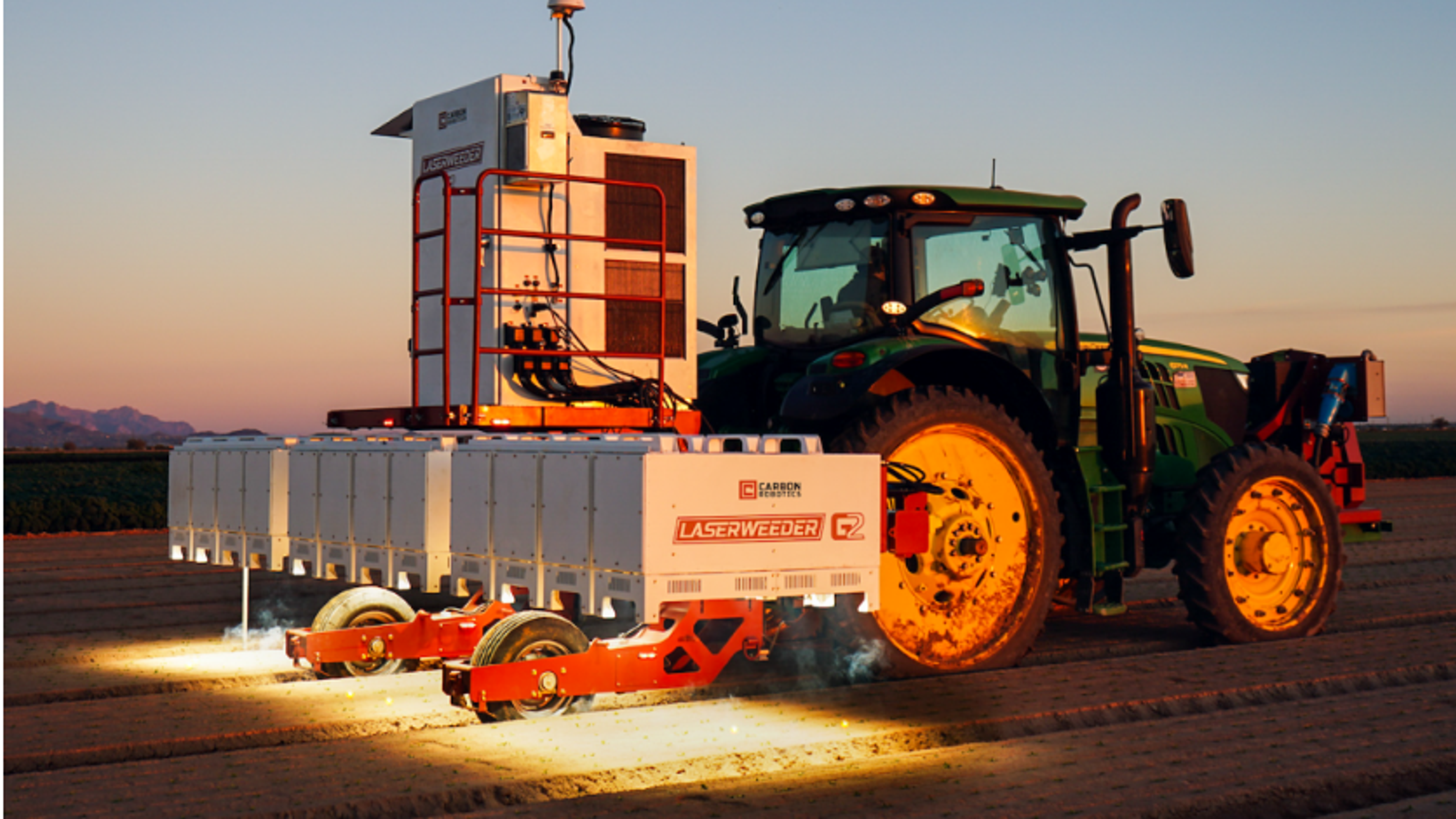
Picture a tractor rolling down a row of onions with no spray boom, no chemical smell and no crew bent over the soil. A laser rig does the weeding instead. Similar machines now mow city parks and bolt panels onto solar trackers, and the shift is picking up speed.
Three sectors share one problem: too few skilled workers for repetitive outdoor jobs. Robots are filling part of that gap, and the money is following. So what is actually working, and what still isn't?
Farms where lasers replace sprays
Carbon Robotics is the name Agritech people mention first. Its LaserWeeder uses AI-powered vision to tell crops from weeds, then burns out the weed's growth cells with a laser. The company says the machines run on hundreds of farms across 15 countries, and that its latest AI model was trained on about 150 million labeled plants. CEO Paul Mikesell has pointed out that clearing 10 billion weeds by hand would take 100 people ten years of nonstop work.
The results look good on paper. A Western Growers case study found California's Triangle Farms saw up to a 50% yield increase after one year. According to Business Research Insights, the global market for weeding robots may show a compound annual growth rate (CAGR) of 18.7%, from $3.08 billion in 2026 to $13.39 billion by 2035. And, it showed that North America dominates the market.
Payback is reported at one to three years, but there's a catch. These machines aren't plug-and-play. The same guide says they need testing in your own soil and crops, and that integration and setup can eat 15 to 20 percent of total deployment cost. Results also have to be measured over a full growing season.
Investors are betting it scales. Meticulous Report estimates laser weeding equipment at $0.22 billion in 2026, rising to $1.47 billion by 2036. Tractor-mounted units lead for now, since growers can use equipment they already own. Self-propelled robots are the fastest-growing group. Europe is moving too: Escarda Technologies was acquired by Berlin.Industrial.Group in 2026 to support series production. Naio Technologies in France and the Small Robot Company in the UK are also in the race.
Deployments are climbing as well. One 2026 guide count ground-based agricultural robots in the field up 47% year over year, from a small but accelerating base. That base is the part worth remembering.
Parks where mowers on the night shift
City parks have a staffing problem more than a grass problem. Husqvarna's Strix, a concept shown in 2023, was built around exactly that. The idea is a fleet of autonomous units that gather data from above, on and below ground, because urban green space upkeep is often limited by a lack of qualified labour. That data feeds a digital twin, letting cities test changes and new projects before committing.
Real machines are arriving faster than concepts. At the Saltex show, Toro, Husqvarna, Wessex International and Kress all launched robotic mowers for different scales of turf. One of them, the RoviMo, can mow a full-size football pitch in 2.5 hours and uses a 3D lidar scanner to work in populated areas.
Tree planting may be next. A 2026 student project on Carnegie Mellon's Robotics Institute site, called Project Canopy, maps a lot with lidar, camera, IMU and GPS data, drills a hole, and plants a seedling for city forestry teams. It's a prototype, not a product.
Ground reality is messier than a brochure. One academic study of urban mowers noted that some cases needed manual intervention after machines got stuck on shallow tree roots. Layout matters. Wide, simple lawns suit robots far better than cramped, bumpy ones.
The job list will change too. Industry writers expect new roles such as autonomous fleet managers and park resilience strategists as green space work shifts from upkeep to optimisation.
Clean tech for building and cleaning solar plants
Solar is where the numbers get big. AES introduced Maximo, an AI-driven installation robot that the company says installs panels in half the time and at half the cost of manual work. By the company's count, it had placed nearly 10 MW so far, with plans to help build up to 5 GW of backlog over three years.
Terabase Energy took a different route with its Terafab system. After reporting a 25% labour productivity gain on its first installation, the company finished testing Terafab version 2 on March 23, 2026, with commercial shipments next. It has also passed $200 million in total funding after a Series C round.
Newer entrants are testing other ideas. MIT-based startup Charge Robotics partnered with Solv Energy to pilot a portable factory system meant to make installation safer and more efficient on difficult terrain. In Australia, Luminous received AU$4.9 million in 2025 to deploy its LUMI robot at utility-scale plants.
Cleaning is the older story. Ecoppia's T4 robots work nightly without water or human operators, and they're solar powered. The company says that saves millions of gallons of water. On September 30, 2026, TrinaTracker added two more machines: Buildex for installation and Aurora for cleaning. Aurora can handle height offsets of up to 50 mm on tricky sites.
Most of these figures come from the companies selling the machines. Independent field data is still thin, so treat the headline savings as targets until more projects report back.
Where they still face challenges
Every one of these machines has a weak spot. Weeding robots have mostly been sold into leafy greens, brassicas and root vegetables. Park mowers want simple layouts. Solar machines have to cope with uneven ground and different tracker layouts.
Then there's cost. One industry outlook says laser weeders are unaffordable for most small and medium farms today. It expects price parity with herbicide programs in many row crops between 2030 and 2035. That's a forecast, not a promise.
People matter too. A municipal parks guide says departments need trained fleet technicians to keep robots running. The work doesn't vanish. It shifts.
The hardware works. The harder questions are money and trust. Can a mid-size farm, a city parks team or a solar contractor affords these machines, and will independent field data back up the makers' numbers?
More articles on this topic
210 articles ReportWhat it Really Costs to Own a Personal Assistant Robot at Home
 ReportThe Robots Giving Old Electric Vehicle Batteries a Second Life
 ReportUnderwater Robot Teams Take on the Problem of Seabed Waste
 ReportCould a Single AI Run Different Types of Robots?
 ReportAgility Robotics Co-Founder Reveals Why He Can't Love Digit 5
 ReportDetecting Gas, Braving Heat: This Robot is Built for Danger
 ReportRobots Can Do Physical Work, but Can Businesses Afford Them?
 ReportHumanoid Walks 560km in Nine-Day Durability Test
 ReportChina Targets Retail and Logistics in New Embodied AI Plan
 ReportWhat Happens When Robots Lose Their Internet Connection?
 ReportChina's Industrial Robot Output Surges 29% in Nine Months
 ReportInside San Francisco's Robot Housekeeping Experiment
BUSINESS NEWS WEEKLY LETTER
The Weekly Letter for Robotics Professionals, Summarizing the Most Important Industry Moves, Launches, Deals and Signals.