OrionStar LuckiBot Pro vs. UBTECH CADEBOT L100
The OrionStar LuckiBot Pro and UBTECH CADEBOT L100 are indoor delivery robots for transporting meals and other items. We compare them on the basis of payload and tray configuration, route clearance and speed, runtime and charging

October 30, 2026 by Business Desk Team
Introduction
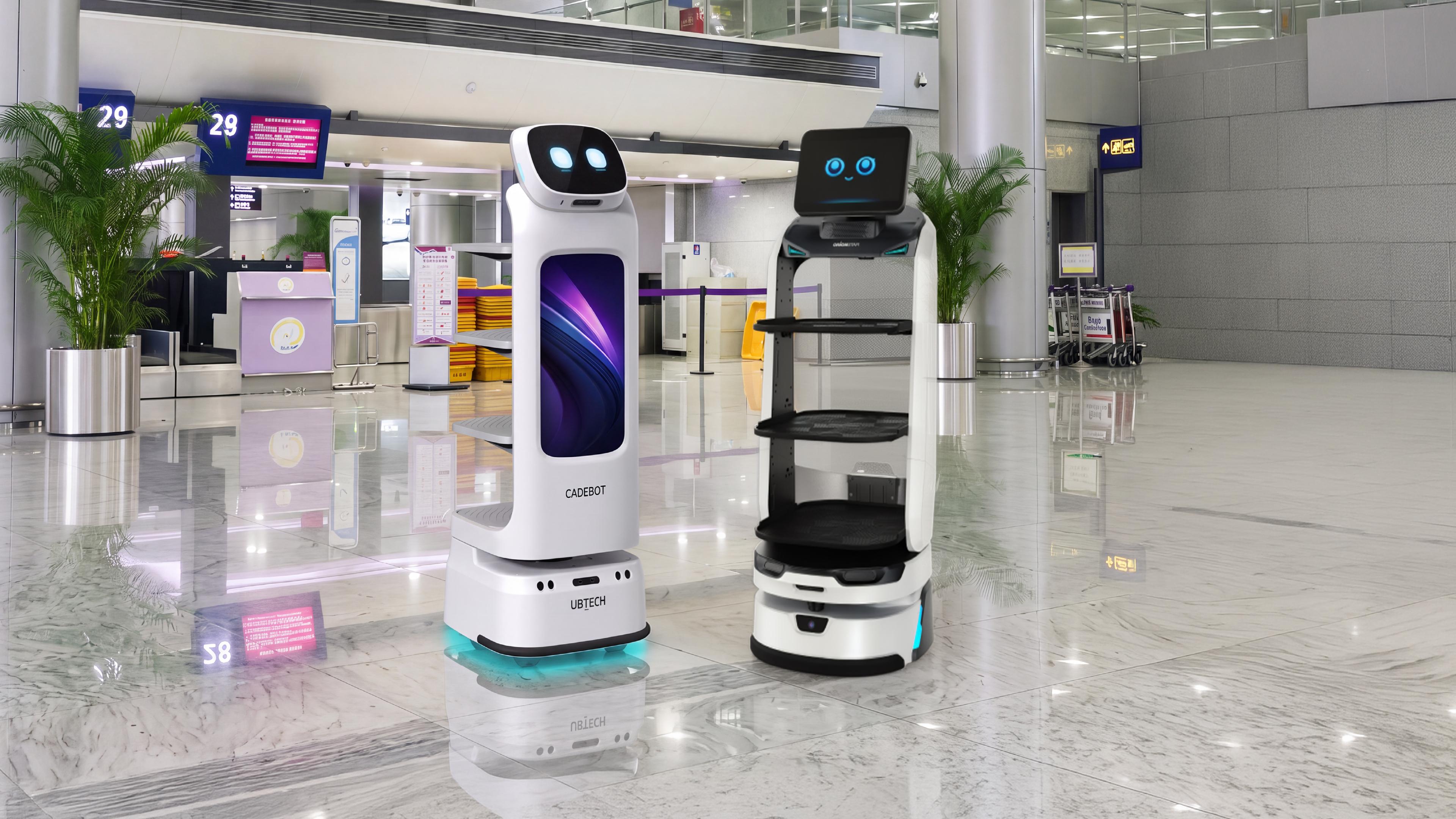
The OrionStar LuckiBot Pro and UBTECH CADEBOT L100 are indoor delivery robots for transporting meals and other items. Both offer multiple trays and automatic charging, but their recorded specifications highlight different priorities: carrying capacity for LuckiBot Pro and delivery combined with advertising for CADEBOT L100.
LuckiBot Pro lists a maximum total payload of 60 kg, with up to 15 kg per tray, and a typical runtime of 12 hours. CADEBOT L100 carries up to 40 kg across four trays and records up to eight hours of runtime.
CADEBOT L100 also includes a dedicated 21.5-inch advertising display and a recorded minimum passage width of 650 mm. No comparable passage-width figure is supplied for LuckiBot Pro, so its suitability for narrow routes needs checking.
At a Glance
| Metric | OrionStar LuckiBot Pro | UBTECH CADEBOT L100 |
|---|---|---|
| Robot type | Indoor delivery robot | Indoor delivery robot with advertising display |
| Use cases | Meal and item delivery | Meal and item delivery; promotional content |
| Maximum total payload | 60 kg, subject to tray configuration and load distribution | 40 kg |
| Tray configuration | Three or four adjustable trays | Four trays |
| Maximum load per tray | 15 kg | 10 kg |
| Minimum passage width | Not recorded in the supplied data | 650 mm |
| Runtime | Typical 12 hours | Up to eight hours |
| Charging time | Approximately 4.5 hours | Approximately four hours |
| Charging method | Automatic dock or cable | Automatic docking or charging adapter |
| Travel speed | Adjustable, 0.5–1.2 m/s | Adjustable, up to 0.8 m/s |
| Touchscreen | 14-inch Full HD touchscreen | 10.1-inch front touchscreen |
| Dedicated advertising display | Not recorded in the supplied data | 21.5-inch Full HD display |
| Price | Approximately US$15,000; estimated market price | US$8,280–10,000; recorded range |
How They Compare
Payload and tray configuration
LuckiBot Pro has the higher recorded total payload: 60 kg compared with CADEBOT L100’s 40 kg. Its trays support up to 15 kg each, while CADEBOT L100 records four trays carrying up to 10 kg each.
LuckiBot Pro’s maximum total capacity depends on the tray arrangement. Three trays rated at 15 kg each do not provide the full 60 kg capacity. Operators also need to check tray dimensions, item stability and load distribution before planning deliveries.
These figures describe carrying limits, rather than meals delivered per hour. Actual throughput depends on route length, loading time and staff handovers.
Route clearance and speed
CADEBOT L100 records a minimum passage width of 650 mm. That provides a useful starting point for assessing dining-room routes, although turns, chairs and moving customers also affect access.
LuckiBot Pro has no comparable clearance figure in the supplied data. Its higher payload therefore needs to be considered alongside a site assessment.
LuckiBot Pro records an adjustable cruising speed of 0.5–1.2 m/s, compared with a maximum of 0.8 m/s for CADEBOT L100. The higher speed ceiling may matter on longer routes, but usable speed depends on the operating environment.
Runtime and charging
LuckiBot Pro lists a typical runtime of 12 hours, while CADEBOT L100 advertises up to eight hours. These figures suggest different operating windows, but “typical” and “up to” are not equivalent test conditions.
Both support automatic charging and a wired alternative. CADEBOT L100 records approximately four hours to charge, compared with approximately 4.5 hours for LuckiBot Pro.
Displays and recorded pricing
LuckiBot Pro has a 14-inch Full HD touchscreen. CADEBOT L100 combines a 10.1-inch front touchscreen with a separate 21.5-inch Full HD advertising display, giving it a clearer documented role in delivery workflows that also carry promotional content.
CADEBOT L100’s recorded price range is lower than LuckiBot Pro’s estimated US$15,000 price. However, these figures are not equivalent quotations. Dock inclusion, software, installation, support and warranty should be checked before comparing purchase costs.
Summary
OrionStar LuckiBot Pro is the stronger candidate to examine when higher payload capacity is the priority. Its recorded advantages include a 60 kg maximum total load, 15 kg per tray and a typical 12-hour runtime. Route clearance remains a verification gap.
UBTECH CADEBOT L100 is the stronger candidate to examine for delivery combined with a dedicated advertising screen. Its 650 mm recorded passage requirement also provides a clearer starting point for assessing route suitability.
The choice should follow the narrowest operating route, required tray capacity and staff handover process. The supplied specifications do not establish which robot delivers more meals per hour.
More articles on this topic
95 articles ReportRichtech DUST-E S vs. Gausium Phantas
 ReportEngineAI SE01 vs. AGIBOT RAISE A1ReportRichtech DUST-E S vs. KEENON KLEENBOT C20
 ReportRobint Rhino vs. OrionStar CleaniBot S55 Pro
 ReportMammotion LUBA AWD vs. Sunseeker X7
 ReportMirokaï vs. temi
 ReportHusqvarna Automower vs. Mammotion LUBA
 ReportKEENON DINERBOT T10 vs. OrionStar LuckiBot Pro
 ReportPUDU BellaBot Pro vs. OrionStar LuckiBot Pro
 ReportPUDU FlashBot Max vs. PadBot W2
 ReportMirokaï vs. Aeolus Aeo
 ReportNexaro NR 1500 vs. ECOVACS DEEBOT PRO K1 VAC
BUSINESS NEWS WEEKLY LETTER
The Weekly Letter for Robotics Professionals, Summarizing the Most Important Industry Moves, Launches, Deals and Signals.