PUDU BellaBot Pro vs. OrionStar LuckiBot Pro
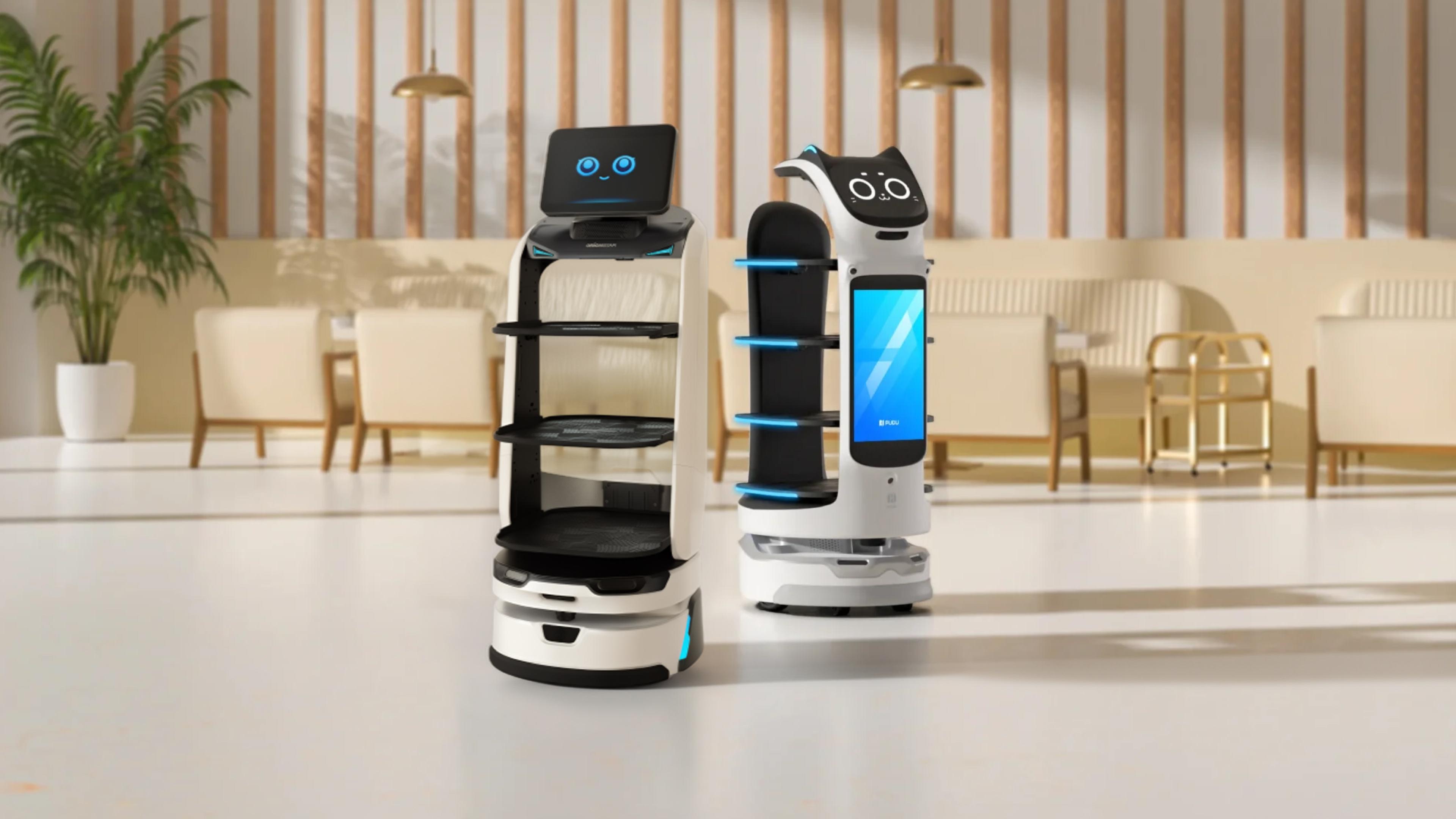
PUDU BellaBot Pro and OrionStar LuckiBot Pro are both restaurant service robots compared here on meal delivery capacity, navigation, customer interaction, advertising capabilities and deployment requirements.

October 29, 2026 by Business Desk Team
Introduction
PUDU BellaBot Pro and OrionStar LuckiBot Pro are Autonomous Restaurant Service Robots for meal delivery, interaction and promotion. The real question is which robot better meets your restaurant's service proposition, payload, and customer-facing experience-not how many units the manufacturer brags about.
Both incorporate four-tray delivery and cat-themed interaction, tray indicators, and dual service/advertising screens: BellaBot Pro is also designed for larger loads, with higher-lift delivery capability, a large (14-inch) touch screen, and voice and dish recognition. LuckiBot Pro's main focus is higher stated carrying capacity, with both cat-bots aimed at reducing repetitive delivery tasks - albeit from different angles.
At a Glance
| Metric | PUDU BellaBot Pro | OrionStar LuckiBot Pro |
|---|---|---|
| Robot type | Interactive, four-tray restaurant delivery AMR | AI-powered restaurant delivery and interaction robot |
| Best-fit use cases | Meal running, table service, guest engagement and visual advertising | Meal delivery, dish promotion, customer guidance and interactive service |
| Dimensions | 570 × 550 × 1,290 mm (W × D × H) | Approximately 558 × 525 × 1,375 mm (W × D × H; converted from US listing) |
| Machine weight | 55 kg | Approximately 59 kg (130 lb) |
| Load capacity | 40 kg total; 10 kg per tray | Up to 60 kg total; 15 kg per tray |
| Runtime / charging | Up to 11 h unloaded; 4.5 h charging | 12 h in a typical cruising scenario; 4.5 h charging with the robot switched off |
| Navigation / sensing | VSLAM+, marker and LiDAR SLAM; 2 forward-facing cameras, 3 RGB-D sensors and 1 radar listed on the official page | LiDAR, RGB-D/depth cameras and vision–laser sensor fusion; 240-degree obstacle recognition |
| Distinctive capabilities | 10.1-inch and 18.5-inch displays; tray lighting; multimodal interaction; 65 cm path clearance | 14-inch 1080p display; six-microphone array; dish-recognition camera; 360-degree ambient lighting; torsion-bar suspension |
| Key limitation / caveat | Published 11-hour runtime is unloaded; confirm actual endurance with a working payload | Runtime varies by operating conditions; confirm tray configuration and current regional specification |
How They Compare
Operational role
Purpose BellaBot Pro is designed to deliver meals, with an aspect of engaging with customers. Its feline look, touch and voice interactions, illuminated tray surface and onboard advertising display aim to make the robot part of the restaurant environment. Suitable for restaurants seeking food running and customer engagement combined.
Its advertised applications are food delivery and "outreach" (which includes promotion and guidance). LuckiBot Pro appears to be a delivery robot with additional interactive and promotional features. The horizontally oriented sizeable screen, speech, dish-recognition camera and ambiance lighting all seem geared to food delivery, promotion of dishes and guiding the customer, while the larger published payload might be attractive to restaurants moving heavier loads, assuming its tray configuration allows it.
Payload and Hardware
BellaBot Pro has four trays with a maximum load of 40kg, 10kg per tray. The tray size is 410 × 500mm. The weight of the robot is 55kg.
Total capacity is listed at 60kg for 3 or 4 trays with 15kg per tray. The listed weight is around 59kg. The ratings place LuckiBot Pro as the higher stated payload but for a real-world application one should also be aware of tray sizes, stacked height of items, liquid firmness and how frequently the robot will be maxed out.
Published data are manufacturer specifications only, not from a shared load or stability test.
Navigation and Deployment
BellaBot Pro Navigation VSLAM+ is used in conjunction with marker-based and LiDAR SLAM navigation. PUDU specifies a minimum path clearance of 65cm, and a system of obstacle detection using camera, RGB-D sensor and radar. Its small minimum clearance could prove advantageous where busy table areas have narrow aisles.
LuckiBot Pro uses laser and vision-based sensing for autonomous navigation and obstacle recognition. OrionStar describes a 240-degree obstacle-recognition system, depth sensing and a torsion-bar suspension designed to improve movement over varied floor conditions. The official US listing gives a cruising speed range of approximately 0.5–1.2 m/s, similar to BellaBot Pro's published 0.2–1.2 m/s range.
For both robots, it's good to estimate aisle width, turning room, spacing between tables, thresholds, and travel path from kitchen to dining. Make sure mapping, multi-robot support, software platforms and local service are available.
Customer Interaction and Advertising
BellaBot Pro uses its distinctive cat-inspired appearance, touch-sensitive interaction, voice features, tray lights and two displays: a 10.1-inch screen and an 18.5-inch advertising screen. PUDU also describes dish recognition and broadcast as a feature under development on its product page, so this capability should not be treated as universally available without confirmation.
The device also features a 14-inch 1080p display, six microphones and a dish recognition camera. There is voice interaction for noisy settings, as well as advertising and greeting/floor guidance modes. Details on which dish-recognition functions, languages and software options are enabled can be provided for the units being offered.
The better fit depends on the restaurant's priorities: a recognisable, playful service persona and dual-screen advertising, or a larger single display paired with voice-led interaction and dish-promotion features.
Runtime and Charging
BellaBot Pro is 11 hours under no load with charging time of 4.5 hours. The registered times of LuckiBot Pro are 12 hours under typical cruising and 4.5 hours under switch-off charging. OrionStar's product page mentions automatic charging-dock and cable-charging respectively.
There are different miles- and minutes-driven frangibility claims for these robots, so they aren't directly comparable as evidence of a longer run time during a restaurant shift. Payload, floor traffic, route length, idling time and charging habits all impact endurance in practice. Use a site trial to determine average completed delivery trips per shift, downtime and performance at normal meal loads.
Important Qualification
PUDU BellaBot Pro: Rated at 40 kg for four trays, with 10 kg maximum per tray. Eight hours of runtime is clarified as unloaded. Dish recognition and broadcast are described as under development on the official product page.
As shown in the US official page, total capacity is up to 60kg, 15kg on each tray, 12h in an ordinary cruising scenario. Read more about OrionStar regional materials that may include different dimensions, screen specifications, or runtime estimates; please verify the configuration for the market you are considering and the current datasheet.
Both robots: Manufacturer claims are not independently verified operating results. Test in your restaurant before purchasing, and ensure routes are clear, load is stable, software functions work, servicing arrangements and integration costs are understood.
Summary
Choose PUDU BellaBot Pro if the four-tray meal delivery, cat guest engagement, dual displays and published 65cm path-clearance requirement are suitable for the restaurant.
Choose OrionStar LuckiBot Pro if you're after a higher quoted payload capability, a larger 14-inch display, voice-based interactions and dish-promotion functions more closely aligned with the service workflow.
This is a relevant match, not a controlled performance ranking. Establish the specific configurations and demand on-site trials prior to publishing such claims of superiority.
This comparison is based on ROBOT24.com market-research data records and manufacturer-reported specifications rather than controlled performance testing.
More articles on this topic
94 articles ReportRichtech DUST-E S vs. Gausium Phantas
 ReportEngineAI SE01 vs. AGIBOT RAISE A1ReportRichtech DUST-E S vs. KEENON KLEENBOT C20
 ReportRobint Rhino vs. OrionStar CleaniBot S55 Pro
 ReportMammotion LUBA AWD vs. Sunseeker X7
 ReportMirokaï vs. temi
 ReportHusqvarna Automower vs. Mammotion LUBA
 ReportKEENON DINERBOT T10 vs. OrionStar LuckiBot Pro
 ReportPUDU FlashBot Max vs. PadBot W2
 ReportMirokaï vs. Aeolus Aeo
 ReportNexaro NR 1500 vs. ECOVACS DEEBOT PRO K1 VAC
 ReportNilfisk Liberty SC50 vs. PUDU CC1
BUSINESS NEWS WEEKLY LETTER
The Weekly Letter for Robotics Professionals, Summarizing the Most Important Industry Moves, Launches, Deals and Signals.