Mirokaï vs. temi
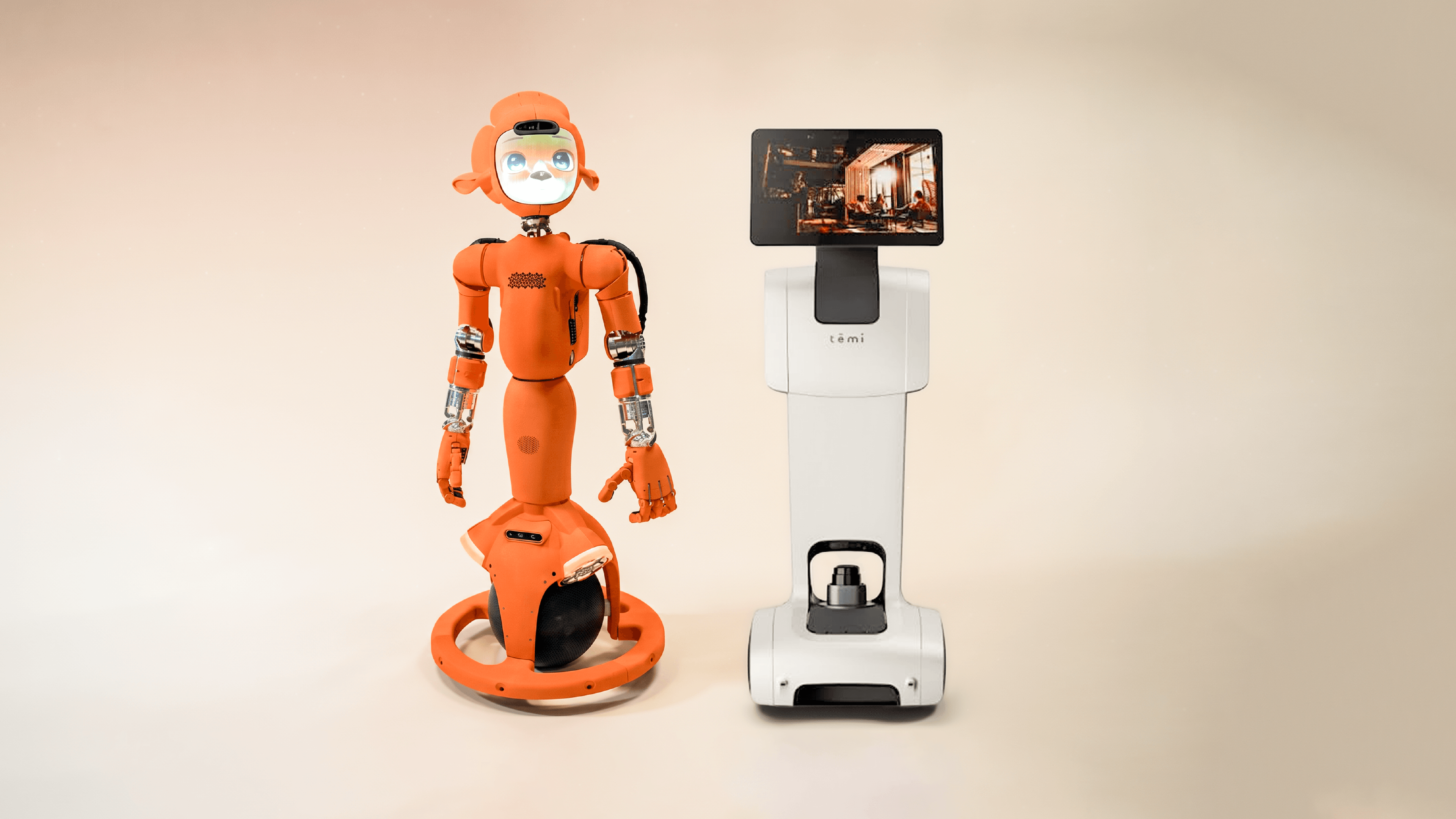
Mirokaï and temi are both social and assistive robots compared here on mobility, communication, programmable experiences, sensor capabilities and deployment requirements.

October 30, 2026 by Business Desk Team
Introduction
Mirokaï and temi are compared for social interaction, visitor engagement and assistive applications in shared indoor environments. The key question is whether an organization needs a character-led robot that combines conversation with physical assistance or a mobile assistant built around a touchscreen, video communication and software integrations.
Mirokaï, created by Enchanted Tools, focuses on expressive interaction, conversation based on context, sensing the environment, and intelligent object manipulation. temi, designed for autonomous mobile indoor navigation, voice interaction, video conferencing, and an open platform for 3rd party applications. Both have some similar functionality such as navigation and human interaction, but their hardware, interaction styles and intended workflows differ.
At a Glance
| Metric | Mirokaï | temi V3 |
|---|---|---|
| Robot type | Expressive social-assistance robot with manipulation capabilities | Mobile personal assistant and telepresence robot |
| Best-fit use cases | Healthcare, senior living, hospitality, retail, museums and visitor engagement | Video calls, reception, visitor guidance, personal assistance and app-based services |
| Dimensions / weight | Current official product page does not specify dimensions or weight | 100 × 35 × 45 cm (H × W × D); 12 kg |
| Mobility | Autonomous indoor navigation; designed for shared human environments | Two 50 W motors; zero-turn-radius manoeuvrability; speed up to 1 m/s |
| Communication | Multimodal AI for natural conversation and context-aware interaction | Voice interaction, speech recognition, text-to-speech, touchscreen and video calls |
| Sensors / perception | Enhanced vision and scene understanding; detailed sensor specifications are not listed on the cited official product page | 360° LiDAR, two depth cameras, RGB camera, IMU and six time-of-flight sensors |
| Manipulation / payload | AI-assisted grasping and carrying; exact payload rating is not stated on the cited official product page | Tray supports up to 3 kg, depending on assembly; intended for small items rather than heavy handling |
| Runtime / charging | Autonomous charging with a self-aligning dock; published runtime not specified on the cited official product page | Up to 8 hours per charge; autonomous docking and recharging |
| Software / customization | Character customization, from visual adaptations to more extensive character creation | temi OS, temi Center, built-in apps and an SDK for third-party application development |
| Key limitation / caveat | Detailed quantitative specifications and task-specific handling limits require confirmation | Primarily a mobile communication and assistant platform; tray capacity and software features depend on configuration |
How They Compare
Operational role: Mirokaï is designed to make human–robot interaction more expressive while supporting light assistance tasks. Mirokaï lists among its potential applications in social or public settings healthcare, assisted living, elder care, retail and visitor reception. In comparison to that, temi's stated focus areas are mobile communication, personal assistant, reception and remote presence. There is a difference: Mirokaï uses social capabilities for physical interaction, while advertised features of Temi strongly lean toward communication.
Mobility and navigation: Mirokaï is capable of autonomous navigation in the indoor environment. The Mirokaï manufacturer states, among other factors, adaptive navigation, a high awareness of the environment, operation near people, operation on carpets, operation near cables, and operation across interior thresholds. For temi, a 360° LiDAR, depth cameras, a standard RGB camera, an IMU, and time-of-flight sensors are specified, in addition to mapping, localization, obstacle avoidance, and path planning. The specified navigation accuracy of the market-version temi is 5 cm, relative to the specified system conditions.
Communication and engagement: Mirokaï's unique selling point is its expressive physical design and context-sensitive conversational interaction. Its manufacturer intends to use the robot for greeting, guiding, engaging and the presence of a companion. Temi features voice interaction, a 13.3in touchscreen, video calling, and an app-based interface - targeting appropriate use cases such as entertainment, personal companion, telepresence, delivery, remote consultation and content presentation. These different focuses appeal to different organizations who want a venue to cater to its visitors with a character-focused approach, or an organization requiring remote videoconferencing and touchscreen access as part of its workflow.
Physical assistance and payload: Mirokaï has AI enabled grasping and carrying capabilities, which is extending its use case far outside of conversation and exploration use cases. However, the official product page linked to doesn't specify a payload rating and cannot be directly used as a proxy for real claims about weightlifting or carrying capacity. As for its payload, temi has a published tray load of up to 3 Kg depending on assembly, so is aimed more at carrying small objects than large material handling.
Endurance and deployment: temi claims a run time of eight hours per charge, as well as returning to its docking station automatically. Enchanted Tools reports Mirokaï as being capable of its own charging and all-day operation with very little user intervention, but the official product page referenced above does not include any such use-time figure. Prior to deployment, organisations should check operational timings, charging patterns, Wi-Fi/cellular needs, app integrations, service and performance.
Important Qualification
Mirokaï: Current official product page lists features and application areas but no final specifications sheet of numbers for dimensions, weight, battery time or payload. Please ask for the actual deployment specification before ordering to compare on these numbers.
temi V3: The drive time of eight hours is a manufacturer-claimed maximum, not guaranteed based on continuous navigating, video calling or other intensive use. The 3 kg rated load of the tray depends on assembly.
Software and AI: Natural speech, facial or environment detection, and third-party integrations may require specific versions of software, as well as configuration, connectivity and deployment settings. Verify specific capabilities that are included and validated for your use case.
Performance claims: Neither robot should be declared the overall winner based on manufacturer descriptions alone. A meaningful evaluation should test interaction quality, navigation, task completion, accessibility, privacy and support requirements in the actual setting.
Summary
Choose Mirokaï when purposeful, character-oriented interaction that offers a small amount of physical support is important, especially in visitor-facing, healthcare or senior-living applications. Consider for temi, when a focus on mobile video communication, touchscreen operation, autonomous indoor navigation and third-party application development is required.
This is a functional suitability conclusion, not a performance-controlled ranking. Verify the specific hardware/software setup, prove the interaction and manipulation needs, and request an on-site demonstration before making superiority claims.
This comparison is based on ROBOT24.com market-research data records and manufacturer-reported specifications rather than controlled performance testing.
More articles on this topic
94 articles ReportRichtech DUST-E S vs. Gausium Phantas
 ReportEngineAI SE01 vs. AGIBOT RAISE A1ReportRichtech DUST-E S vs. KEENON KLEENBOT C20
 ReportRobint Rhino vs. OrionStar CleaniBot S55 Pro
 ReportMammotion LUBA AWD vs. Sunseeker X7
 ReportHusqvarna Automower vs. Mammotion LUBA
 ReportKEENON DINERBOT T10 vs. OrionStar LuckiBot Pro
 ReportPUDU BellaBot Pro vs. OrionStar LuckiBot Pro
 ReportPUDU FlashBot Max vs. PadBot W2
 ReportMirokaï vs. Aeolus Aeo
 ReportNexaro NR 1500 vs. ECOVACS DEEBOT PRO K1 VAC
 ReportNilfisk Liberty SC50 vs. PUDU CC1
BUSINESS NEWS WEEKLY LETTER
The Weekly Letter for Robotics Professionals, Summarizing the Most Important Industry Moves, Launches, Deals and Signals.