Mammotion LUBA AWD vs. Sunseeker X7
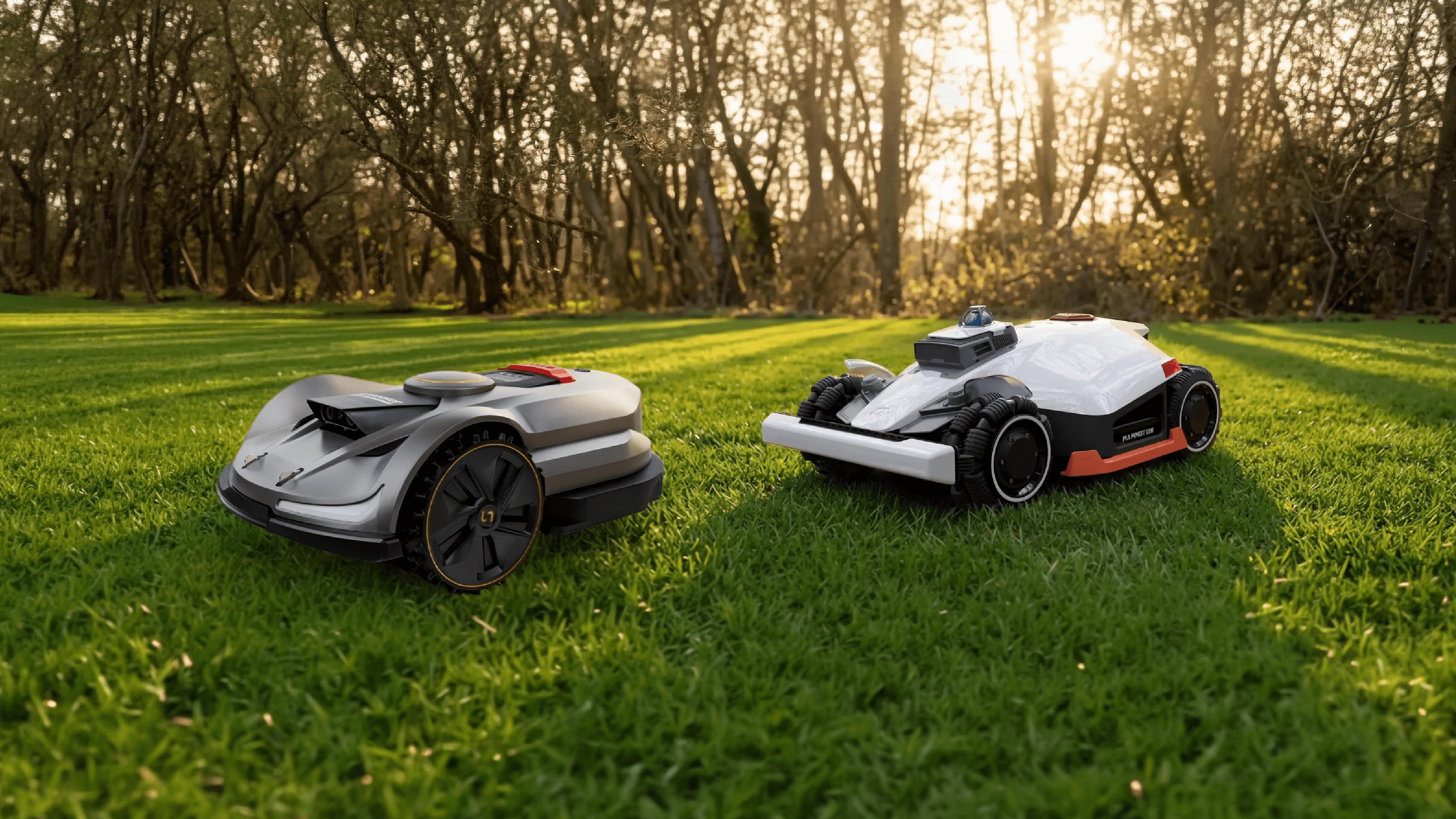
Mammotion LUBA AWD and Sunseeker X7 are both autonomous robotic lawn mowers compared here on terrain handling, lawn coverage, cutting performance, navigation technology and deployment requirements.

October 30, 2026 by Business Desk Team
Introduction
Mammotion LUBA AWD and Sunseeker X7 are wire-free robotic lawn mowers designed to automate grass cutting across complex residential lawns. Both use all-wheel drive, virtual boundary mapping and autonomous navigation, but their approaches to terrain handling, cutting systems and obstacle detection differ.
Mammotion LUBA AWD is positioned for demanding terrain, with a wide dual-disc cutting system and a published climbing capability of up to 75% on the original LUBA AWD 5000. Sunseeker X7 combines RTK-GNSS and visual SLAM navigation with AI-based obstacle recognition, a dual-disc cutting system and a stated climbing capability of up to 70%.
The key question is which mower best suits the lawn's area, slope, layout and grass conditions, not which manufacturer publishes the largest headline figure.
At a Glance
| Metric | Mammotion LUBA AWD | Sunseeker X7 |
|---|---|---|
| Robot type | Wire-free all-wheel-drive robotic lawn mower | Wire-free all-wheel-drive robotic lawn mower |
| Best-fit use cases | Complex lawns, sloping gardens and multi-zone properties | Medium-to-large lawns with varied terrain, obstacles and scheduled mowing requirements |
| Lawn coverage | Original range: 1,000–5,000 m², depending on model | X7: up to 3,000 m²; X7 Plus: up to 6,000 m² |
| Dimensions | 690 × 513 × 273 mm (L × W × H; original LUBA AWD) | Approximately 741 × 513 × 259 mm (L × W × H; X7-series specification) |
| Cutting system | Dual-disc system; 400 mm cutting width | Dual-disc system; 350 mm cutting width |
| Cutting height | 30–70 mm on original LUBA AWD models | 20–100 mm, app-adjustable |
| Maximum slope | Up to 75% (37°) on LUBA AWD 5000; lower on some variants | Up to 70% (35°) |
| Navigation / sensing | RTK-GNSS positioning and vision-based navigation; obstacle detection and avoidance | AONavi, combining RTK-GNSS and VSLAM; binocular Vision AI for obstacle recognition |
| Distinctive capabilities | All-wheel drive; 400 mm cutting width; multi-zone mapping; no perimeter wire | Recognition of more than 200 obstacle types claimed by manufacturer; rear-wheel steering; floating cutting disc; multi-zone mapping |
| Runtime / charging | Original models: approximately 2–3 h mowing per charge; charging time varies by model | Battery and charging specifications vary by X7 variant; confirm the exact model's technical sheet |
| Key limitation / caveat | Coverage, slope capability and zone limits vary by LUBA model | X7 and X7 Plus have different coverage capacities; RTK performance can depend on garden conditions |
How They Compare
Terrain handling and slope capability
Mammotion LUBA AWD is built for rough terrain and steep gradients. The all-wheel-drive system allows it to keep its grip on slippery ground and the original LUBA AWD 5000 is rated for up to 75% slopes (ca 37°). The original 3000 and 1000 models have a published maximum slope of only 65% (ca 33°).
Sunseeker X7 is equipped with four-wheel drive and tough tyres, and the manufacturer claims it can handle inclines of up to 70% (35°). The independent suspension at the front and rear-wheel steering are intended to enhance manoeuvrability over rough terrain and minimise impact on the turf while cornering.
The headline slope numbers are very close, and the LUBA AWD 5000 has the higher published max. Slope ability is going to vary with grass conditions, moisture, traction, slope length and in what direction you travel down the slope. A wet slope may be more difficult than a dry slope with the same incline.
Cutting performance and lawn coverage
LUBA AWD has a 400 mm dual-disc cutting capacity, as opposed to the X7's 350 mm cut width. With similar conditions, a bigger cut width means a larger area covered per pass. In reality, efficiency also depends on how the route has been mapped out, size and shape of the lawn and how many obstacles there are.
The AWD models have the same original range for LUBAs: up to 1,000 to 5,000 m² lawns, depending on the model. Sunseeker has the X7 for up to 3,000 m² yards, and the X7 Plus for as much as 6,000 m². These are recommended or maximum claimed mowings, not guaranteed mowings per day.
Another difference is on cut-height flexibility. The original LUBA AWD models usually range between 30-70mm, whereas the X7 is quoted with a 20-100mm range. This gives the X7 a larger adjustment range in theory, which might be handy when adjusting for seasonal growth or the desired lawn height.
Navigation and obstacle avoidance
LUBA AWD utilizes RTK positioning and vision-based navigation to create maps and navigate virtual boundaries without a perimeter wire. The LUBA AWD app displays mowing zones and schedules and designates no-go zones. When evaluating the first generation's RTK configuration and accuracy, consider the composition of the property, especially where trees, tall walls or narrow passages will influence positioning.
The Sunseeker X7 systems employ AONavi, a combination of RTK-GNSS satellite positioning and VSLAM visual navigation. Its Vision AI system with binoculars is designed to identify and avoid obstacles such as garden buildings, people, and pets. Sunseeker says it can identify over 200 different types of obstacle.
All systems aim to minimise boundary-wire laying, but system operation without wires still requires initial setup: mowing robots require precise site-mapping, appropriate conditions for placement and a defined no-go zone. Check out both robots around trees, garden furniture, tight corners and irregular boundaries before switching them on.
Mapping, zones and daily operation
Some LUBA AWD models can do multiple zones. The original LUBA AWD 5000 can do as many as 10 zones, the 3000 and 1000 can do less. For estate homes with front and back lawns or a few separate areas this is critical.
Sunseeker X7 supports virtual no-go zones, map editing and auto switching of working areas. Official product page mentions "various working zones" but check available no-go zones and range of individual zones using the specific X7 version and software.
Both allow for scheduled operation and auto return to base. The difference in practicality will come down to how reliably each copes with the layout of the garden, how easy maps are to edit, and if the mower can complete the cut required.
Battery life and maintenance
The original LUBA AWD 3000 and 5000 models list mowing time of approximately three hours per charge, while the original 1000 model lists approximately two hours. Charging times vary by model, with the larger variants generally requiring longer charging periods.
Sunseeker X7 specifications can be found here for the X7 and here for the X7 Plus. To make a comparison between Sunseeker X7 and Sunseeker X7 Plus, it is fair to use the battery capacity, runtime and charging capacity and times for the measured or compared model.
Both systems necessitate regular inspection and replacement of the blades, cleaning of the cutting deck and wheels, and charging station checks. Sunseeker provides water-washing assistance for its X7 series, but users should adhere to cleaning instructions for the specific model rather than presume pressure washing will work on everything.
Important Qualification
Mammotion LUBA AWD: Original series offered in several models. 75% slope rating is for original LUBA AWD 5000. Not all models. Check coverage, zone limitations, run time and cutting height for specific SKU.
Sunseeker X7: The X7 and X7 Plus differ in maximum lawn coverage and battery configuration. Do not attribute the X7 Plus's 6,000 m² coverage to the standard X7.
Two mowers: Manufacturer tests are not independent tests of cutting quality. Cutting quality varies according to slope, grass conditions, weather, obstacles, mapping and the state of the battery. When testing two or more models, compare them on the same lawn or in the same testing conditions.
Summary
Choose Mammotion LUBA AWD, if you need a wide cutting width, all-wheel-drive traction and if you encounter challenging terrain-- especially if your model's slope rating and zone capacity match your property.
Consider Sunseeker X7 if you prefer a machine with a broader spectrum of cutting height, RTK-plus-visual navigation, AI obstacle detection and its specific coverage configuration.
This is a genuine side-by-side comparison not a controlled performance hierarchy. If you are unable to see a true winner before publication, always check on the model variants, and ask the dealer to demonstrate the actual machine(s) on the type of ground you intend to use it on.
This comparison is based on ROBOT24.com market-research data records and manufacturer-reported specifications rather than controlled performance testing.
More articles on this topic
94 articles ReportRichtech DUST-E S vs. Gausium Phantas
 ReportEngineAI SE01 vs. AGIBOT RAISE A1ReportRichtech DUST-E S vs. KEENON KLEENBOT C20
 ReportRobint Rhino vs. OrionStar CleaniBot S55 Pro
 ReportMirokaï vs. temi
 ReportHusqvarna Automower vs. Mammotion LUBA
 ReportKEENON DINERBOT T10 vs. OrionStar LuckiBot Pro
 ReportPUDU BellaBot Pro vs. OrionStar LuckiBot Pro
 ReportPUDU FlashBot Max vs. PadBot W2
 ReportMirokaï vs. Aeolus Aeo
 ReportNexaro NR 1500 vs. ECOVACS DEEBOT PRO K1 VAC
 ReportNilfisk Liberty SC50 vs. PUDU CC1
BUSINESS NEWS WEEKLY LETTER
The Weekly Letter for Robotics Professionals, Summarizing the Most Important Industry Moves, Launches, Deals and Signals.