Mirokaï vs. Aeolus Aeo
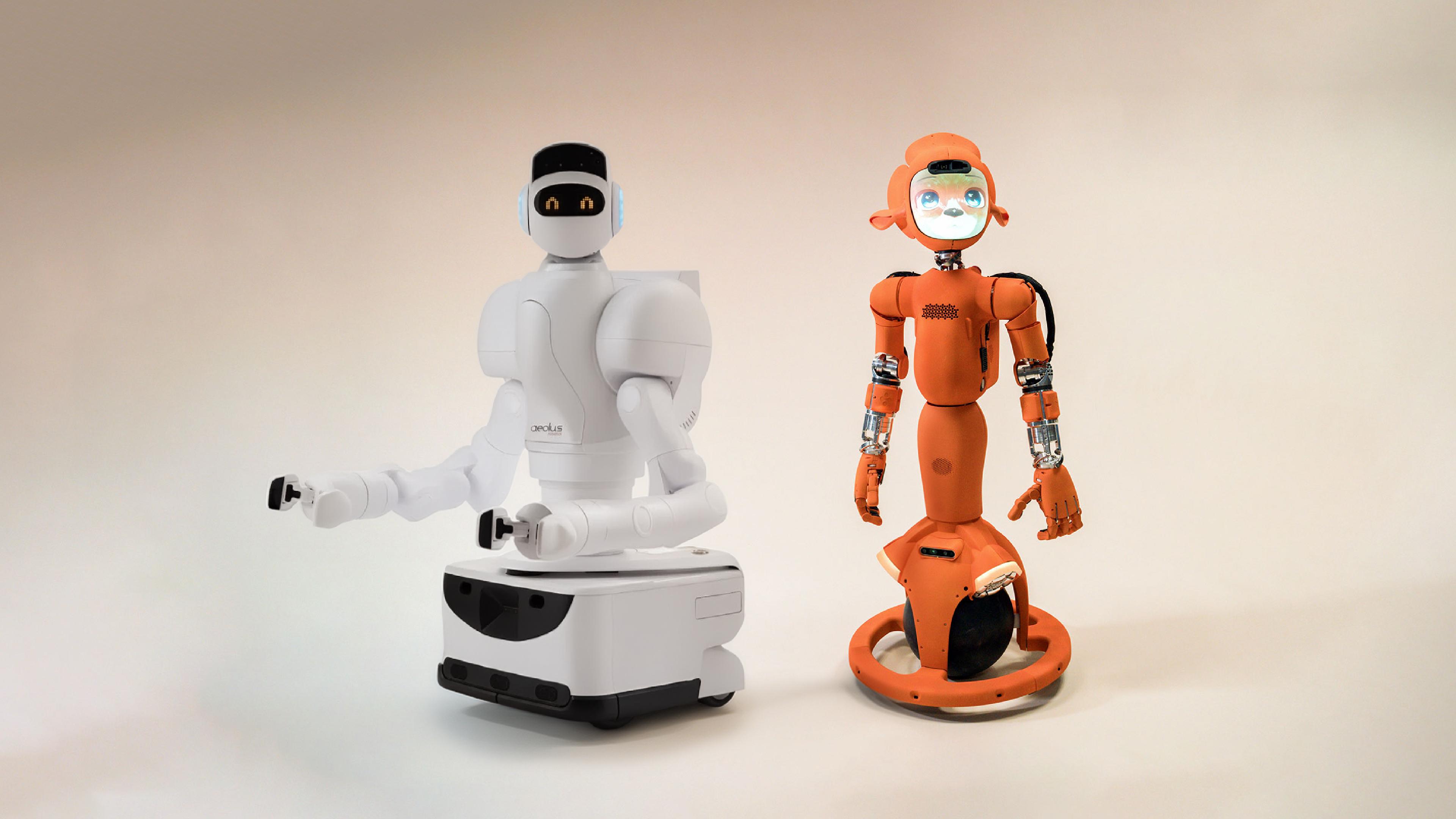
Mirokaï and Aeolus Aeo are two service robots discussed side-by-side in a comparative analysis of mobility, human-robot interaction, manipulation capabilities, sensor systems and facility deployment.

October 28, 2026 by Business Desk Team
Introduction
Mirokaï and Aeolus Aeo integrate autonomous mobility with physical interaction, however their documented competences suggest distinct service flows. Mirokaï is dedicated to light-supply delivery, reception, aid and human interaction through conversational AI and multimodal sensing. Aeolus Aeo is designed for double arm manipulation, facility-oriented tasks such as fetch-and-deliver, physical door and elevator opening, care monitoring and configuration-dependent UV-C disinfection.
The main difference being a socially interactive mobile assistant versus an automation of a dual-arm operation. Payload distribution, mode of operation and partial specifications prevent a factual comparison and lead to task- suitability being a justifiable comparator over a ranking over all features.
At a Glance
| Metric | Mirokaï | Aeolus Aeo |
|---|---|---|
| Robot type | Ball-bot mobile social service robot | Wheeled dual-arm service robot |
| Best-fit use cases | Healthcare support, reception, hospitality and retail engagement | Care facilities, hospitals, hotels, airports, schools and security operations |
| Dimensions | 123 cm tall; full dimensions not recorded | 1.83 × 2.0 × 1.32 m (H × W × L; as recorded, configuration unconfirmed) |
| Weight | 28–30 kg | Not recorded |
| Manipulation / capacity | Four-finger hands; 2 DOF per hand; 1.5 kg payload, allocation unspecified | Two 7-DOF arms with interchangeable end effectors; current record lists 2.9 kg per arm with flex gripper |
| Runtime / charging | 4–8 h; runtime asterisk unexplained; charging time not recorded | Approximately 9 h with flex gripper or 6.5 h with night-vision configuration; approximately 9 h to charge from 10–95% while powered on |
| Mobility / speed | Omnidirectional ball-bot; 0.83 m/s recorded, equivalent to approximately 2.99 km/h | Autonomous wheeled base; 95 cm/s (0.95 m/s) |
| Navigation / sensing | VSLAM; RGB, IR and ToF cameras; IMUs; torque sensors | Autonomous indoor navigation; vision/AI cameras, IR and optional 360° night-vision camera |
| Interaction | Multi-LLM integration, speech, face tracking and vision-language models | Two-way voice, live video and remote monitoring |
| Distinctive capabilities | Light-supply delivery, social engagement and visitor assistance | Dual-arm manipulation, physical door/elevator interaction, security patrol and optional UV-C disinfection |
| Remote management | Remote monitoring; OTA capability described as likely | Mobile ARMS app and remote monitoring |
| Price in Robot24 | Approximately US$30,000 | Not recorded |
| Key limitation / caveat | Speed entries conflict; payload allocation and runtime qualifier are unclear | Dimensions need confirmation; payload figures vary by generation and configuration |
Unfixed entries and configuration-dependent parameters are kept as qualifications and not as specifications.
How They Compare
Operational role: Mirokaï is located more precisely at the service-light delivery and human-facing level. Its registered functions combine mobility assistance and conversation-based interface, face tracking, vision language models, reception and visitor face-on as well as service level support. Aeolus Aeo is designed to perform physical tasks to a greater degree: its two arms can support the manipulation of the robot when the robot is making contact with the infrastructure of the building (doors, elevator buttons). Its functions are also listed for monitoring, patrolling and optionally disinfecting configurations.
Manipulation and payload: Mirokaï has a record payload of 1.5kg, with uncertain payload allocation and measurement conditions. Aeo's existing record has 2.9kg per arm with a flex gripper, while an earlier launch-generation entry had around 3.6kg per arm. These numbers should not be confused or read as directly comparable total-payload ratings. Different end-effectors, object shapes, and complexity of task can substantially influence practical manipulation capability.
Mobility and navigation: Mirokaï mentions the VSLAM navigation system listed with navigation techniques - autonomous & social navigation. Aeo states the work area base vehicle is mobile using a wheeled autonomous platform at work in indoor applications. Mirokaï states maximum recorded speed of 0.83 m/s is about 2.99 Km/h – the separate 3.2 Km/h entry is inconsistent, but Aeo states maximum recorded speed of 95 cm/s is approximately 0.95 m/s. Having the higher stated maximum speed does not necessarily relate to better navigation, obstacle avoidance or navigating well in crowds.
Runtime and charging: Mirokaï's run time is documented as 4-8 hours, but the asterisk following the number is not elaborated on. Aeo claims "about 9 hours with a flex gripper" and "6 1/2 hours in NV mode" with charging from 10% to 95% taking about nine hours while powered. That indicates the Aeo's duration depends on configuration, but the records available do not demonstrate a like test methodology. Endurance comparison requires a similar load, payload and duty cycle.
Sensing & interaction: Mirokaï's vision sensor suite, previously published, is permanently recording 8GB of data on RGB, IR and time-of-flight cameras, with IMUs and torque sensors. This is integrated with their social interaction and face-tracking, alongside vision-language and speech interaction, underscoring their focus on social interactions and even social support. Aeo features vision/AI cameras, IR sensing and (side-mount) 360° night-vision cameras, with live video, remote monitoring and two-way voice. The data is suggestive that there is a clear emphasis on social human-robot interaction with Mirokaï and a focus on 'remote' monitoring and a mix of carrying out physical tasks with Aeo, but cannot be used to determine which has better perception.
Facility integration and specialist functions: Aeo's record itemizes physical-open door and interact with elevator button, which could have some application in processes that involve moving between rooms or floors. Security patrol, Care monitoring and UV-C disinfection are also listed, but UV-C disinfection ability depends on configuration. Mirokaï's record appears more targeted toward light-supply injection, delivery and reception. Its full complement of facility-integration capability is not adequately documented in this snapshot to ascertain an equivalent door- or elevator-open function.
Important Qualification
Mirokaï's runtime qualifier is unexplained, the two known speed figures contradict, and payload count is not provided. Aeo's anomalously large, recorded dimensions also should be confirmed for the specific configuration, and its payload count was 16 on the previous launch gen record and 4 in this record. Lights such as night vision and UV-C Disinfection may require specific configurations. "NP" entries should not be assumed to mean capability not present.
Summary
Choose Mirokaï when light-supply delivery, reception, visitor reception and conversational interaction with a human are at the heart of your workflows. Alternatively turn to Aeolus Aeo when you need to perform a dual-arm operation, interact with physical doors and lifts, remotely monitor or supervise a specialized facility.
The records however only separate out their theoretical role more definitively than finding a numerical winner. Before releasing an absolute bill of performance, verify specific setups, payload definitions, runtime test conditions, size and access of specialist functions.
This comparison is based on ROBOT24.com market-research data records and manufacturer-reported specifications rather than controlled performance testing.
More articles on this topic
94 articles ReportRichtech DUST-E S vs. Gausium Phantas
 ReportEngineAI SE01 vs. AGIBOT RAISE A1ReportRichtech DUST-E S vs. KEENON KLEENBOT C20
 ReportRobint Rhino vs. OrionStar CleaniBot S55 Pro
 ReportMammotion LUBA AWD vs. Sunseeker X7
 ReportMirokaï vs. temi
 ReportHusqvarna Automower vs. Mammotion LUBA
 ReportKEENON DINERBOT T10 vs. OrionStar LuckiBot Pro
 ReportPUDU BellaBot Pro vs. OrionStar LuckiBot Pro
 ReportPUDU FlashBot Max vs. PadBot W2
 ReportNexaro NR 1500 vs. ECOVACS DEEBOT PRO K1 VAC
 ReportNilfisk Liberty SC50 vs. PUDU CC1
BUSINESS NEWS WEEKLY LETTER
The Weekly Letter for Robotics Professionals, Summarizing the Most Important Industry Moves, Launches, Deals and Signals.