KEENON DINERBOT T10 vs. OrionStar LuckiBot Pro
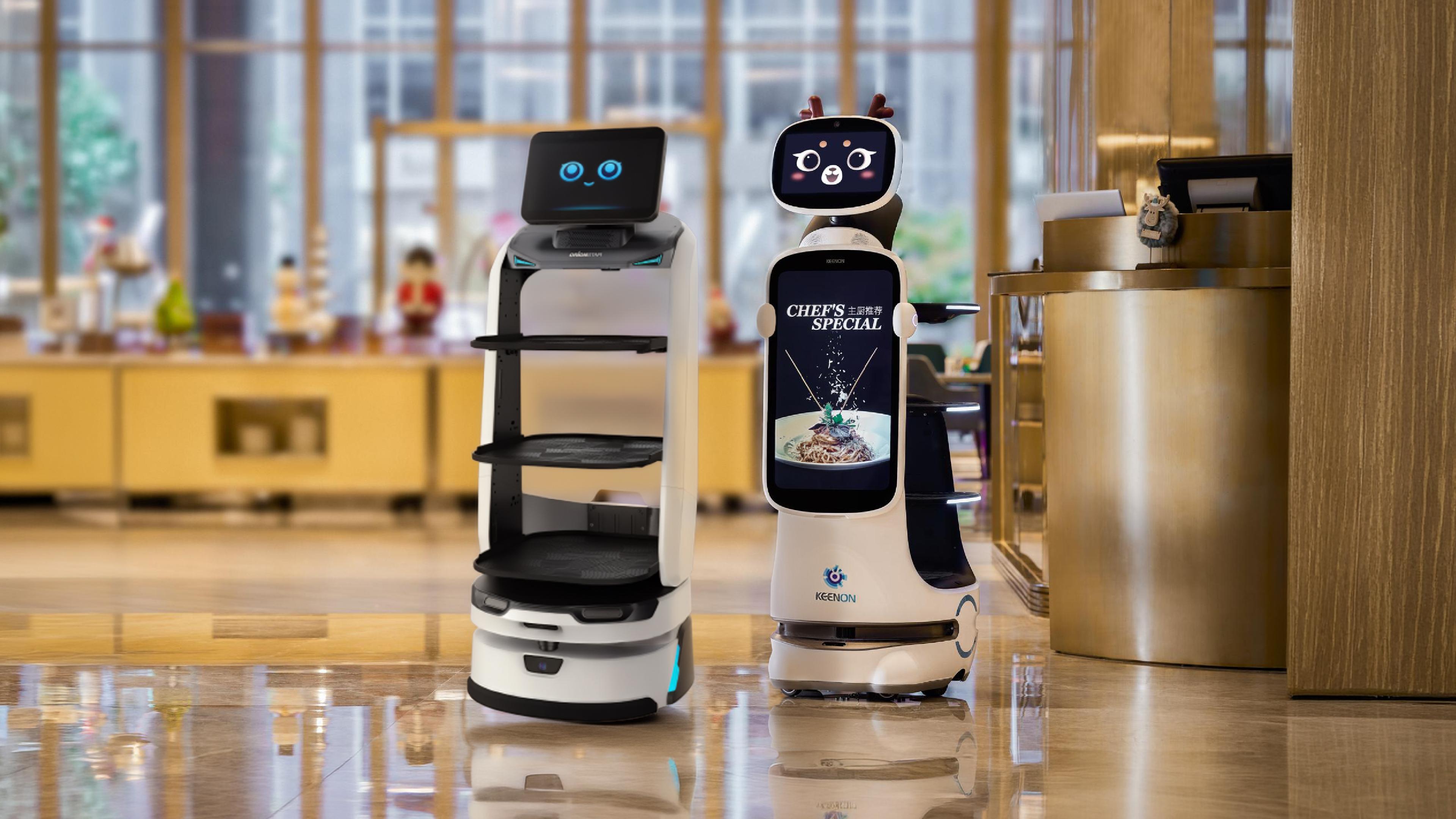
KEENON DINERBOT T10 and OrionStar LuckiBot Pro are both restaurant service robots compared here on meal delivery capacity, navigation, customer interaction, advertising features and deployment requirements.

October 29, 2026 by Business Desk Team
Introduction
KEENON DINERBOT T10 and OrionStar LuckiBot Pro are autonomous restaurant service robots built to help you improve meal delivery processes along with a touch of passenger support. A primary point to evaluate is how effectively each robot complements your restaurant's service flow, layout and payload needs not who has the biggest top line number.
T10 is four-layer delivery and comes with a large advertising screen, user tracking with the movement of the head, interactive buttons, AI assisted tray detection. The LuckiBot Pro is a higher capacity delivery robot with a claimed maximum payload of 60 kg, 14-inch Full HD display and voice interaction.
At a Glance
| Metric | KEENON DINERBOT T10 | OrionStar LuckiBot Pro |
|---|---|---|
| Robot type | Interactive restaurant delivery and advertising AMR | AI-enabled restaurant delivery and interaction robot |
| Best-fit use cases | Meal running, customer engagement, promotional content and self-pickup | Meal delivery, dish promotion, customer guidance and restaurant service |
| Dimensions | 486 × 555 × 1,399 mm (W × D × H) | 558 × 525 × 1,375 mm (W × D × H) |
| Machine weight | 58 kg | 59 kg |
| Load capacity | 40 kg total; approximately 10 kg per layer | Up to 60 kg total; 15 kg per tray |
| Runtime / charging | 9–12.5 h on the current KEENON product page; 5.5 h charging | 12 h in a typical cruising scenario; 4.5 h charging with the robot switched off |
| Navigation / sensing | VSLAM; four stereo-vision sensors, one RGB camera and 360° recognition listed on the official page | LiDAR, RGB-D depth cameras and vision–laser sensor fusion; 240° obstacle recognition |
| Distinctive capabilities | 23.8-inch advertising display; adaptive head movements; interactive buttons; tray detection; minimum passage width of 59 cm | 14-inch 1080p display; voice interaction; dish-recognition camera; ambient lighting; automatic charging dock |
| Key limitation / caveat | Runtime varies with conditions; confirm the display configuration and actual endurance for the supplied model | Published runtime is based on a typical cruising scenario; verify tray configuration and software features |
How They Compare
Operational role
DINERBOT T10 is intended as an integration of food delivery and guest engagement. Its big advertising screen, head movements, interactive buttons, audio messages, and tray detection are useful features for restaurants that want to leverage their delivery robot as a part of their guest experience and marketing program.
LuckiBot Pro is a more payload-focused solution but with some of the customer-facing features. It allows to carry multiple meal orders on its four trays, and its screen, voice and dish-recognition camera are there to support promotion and customer guidance. Based on the workhorse if restaurant load and trays requirements are based on the true customer load.
Payload and hardware
DINERBOT T10 Total load capacity published 40 kg (per layer) about 10 kg. Dimensions and 59 cm minimum passage-width specification are designed for restaurants with narrow aisles and tightly spaced tables.
The maximum total payload is given at 60 kg, and a per tray load of up to 15 kg for three- and four-tray arrangements. The listed weight is 59 kg, so just a kilogram heavier than the T10, in spite of its higher payload rating.
Total capacity is significant on paper, but capacity is not the only factor that impacts throughput. During a site trial verify tray sizes, load spread, the stability of the load of stacked dishes and an operating rhythm when the robot is nearing its full load.
Navigation & deployment
DINERBOT T10 employs VSLAM and a stereo-vision-based sensing platform. KEENON provides 360° recognition, obstacle detection and route planning plus multi-robot fleet management. Although 59 cm minimum passage width is published it can be an important planning data point, actual movement flexibility depends on obstacles, turning room and route configuration.
LuckiBot Pro uses LiDAR and depth-camera sensing for both autonomous navigation and obstacle detection. OrionStar highlights a 240° obstacle-recognition system on its US product page and adjustable cruising speeds of 0.5-1.2 m/s. Automatic charging-dock support could further minimize the labor-intensive function for operators to tend to each charging cycle.
Both systems: check aisle width, turning space, table placement, transition between floors, access and multi-robot interaction. Proximity of features described by manufacturer are not necessarily proof of the robotic solution performing at the standards you expect within all your restaurant conditions.
Customer interaction and advertising
The unique selling point for Dinerbot T10 is its 23.8-inch advertising display, alongside interactively activated buttons and head movements. KEENON has also mentioned tray detection and on-screen instructions, tray lights and voice prompts to assist customers in retrieving their order.
LuckiBot Pro is equipped with a 14 Full HD display, microphone array and a dish-recognition camera. Voice-led interaction and promotional applications are enabled but it is recommended to check for the specific recognition functions on the published model and software configuration ordered.
It's about how you want your visitors to experience the customer: DINERBOT T10 prioritizes the bigger advertising screen and more expressive interaction; LuckiBot Pro incorporates the smaller screen with the higher stated payload capacity and features based on voice and camera.
Runtime and charging
KEENON's existing product page specifies battery life as 9-12.5 hours and charging time as 5.5 hours. The data for: LuckiBot Pro specifies 12 hours in normal cruising conditions and 4.5 hours to charge when turned off.
These figures are not directly comparable endurance-test results. Payload, travel distance, congestion, idle time, interaction activity and charging behaviour can all affect the operating cycle. The useful measure for a restaurant is how many deliveries runs each robot completes during a representative shift, including time lost to charging and interruptions.
Important Qualification
KEENON DINERBOT T10: The official page lists a 40 kg total payload, 59 cm minimum passage width and 5.5-hour charging time. Battery-life claims vary by product material and operating conditions, so confirm the current regional specification.
OrionStar LuckiBot Pro: The US website states 60 kg total, 15 kg per tray and 12 hours while cruising. Check the specifications for the number of trays, if it is a US version and what software features are included.
Both robot models: Always check manufacturer-claimed specs and press articles. These are marketing and PR articles, rather than third-party independently verified tests. Validate route clearance, payload stability, customer interaction features, service availability and deployment costs before choosing a system.
Summary
Choose KEENON DINERBOT T10 when the priority is: Wide advertising screen Animated customer interaction Tray-detection with operation even in cramped aisles. Take a look at OrionStar LuckiBot Pro if a higher stated payload of 15 kg-per-tray handling, voice interaction and automatic charging capability are a better fit for the restaurant's flow.
This is a case study comparison, not a managed performance comparison. Validate exact configuration and get a live demo before making supremacy claims.
This comparison is based on ROBOT24.com market-research data records and manufacturer-reported specifications rather than controlled performance testing.
More articles on this topic
94 articles ReportRichtech DUST-E S vs. Gausium Phantas
 ReportEngineAI SE01 vs. AGIBOT RAISE A1ReportRichtech DUST-E S vs. KEENON KLEENBOT C20
 ReportRobint Rhino vs. OrionStar CleaniBot S55 Pro
 ReportMammotion LUBA AWD vs. Sunseeker X7
 ReportMirokaï vs. temi
 ReportHusqvarna Automower vs. Mammotion LUBA
 ReportPUDU BellaBot Pro vs. OrionStar LuckiBot Pro
 ReportPUDU FlashBot Max vs. PadBot W2
 ReportMirokaï vs. Aeolus Aeo
 ReportNexaro NR 1500 vs. ECOVACS DEEBOT PRO K1 VAC
 ReportNilfisk Liberty SC50 vs. PUDU CC1
BUSINESS NEWS WEEKLY LETTER
The Weekly Letter for Robotics Professionals, Summarizing the Most Important Industry Moves, Launches, Deals and Signals.