Unitree R1 vs. NOETIX N2
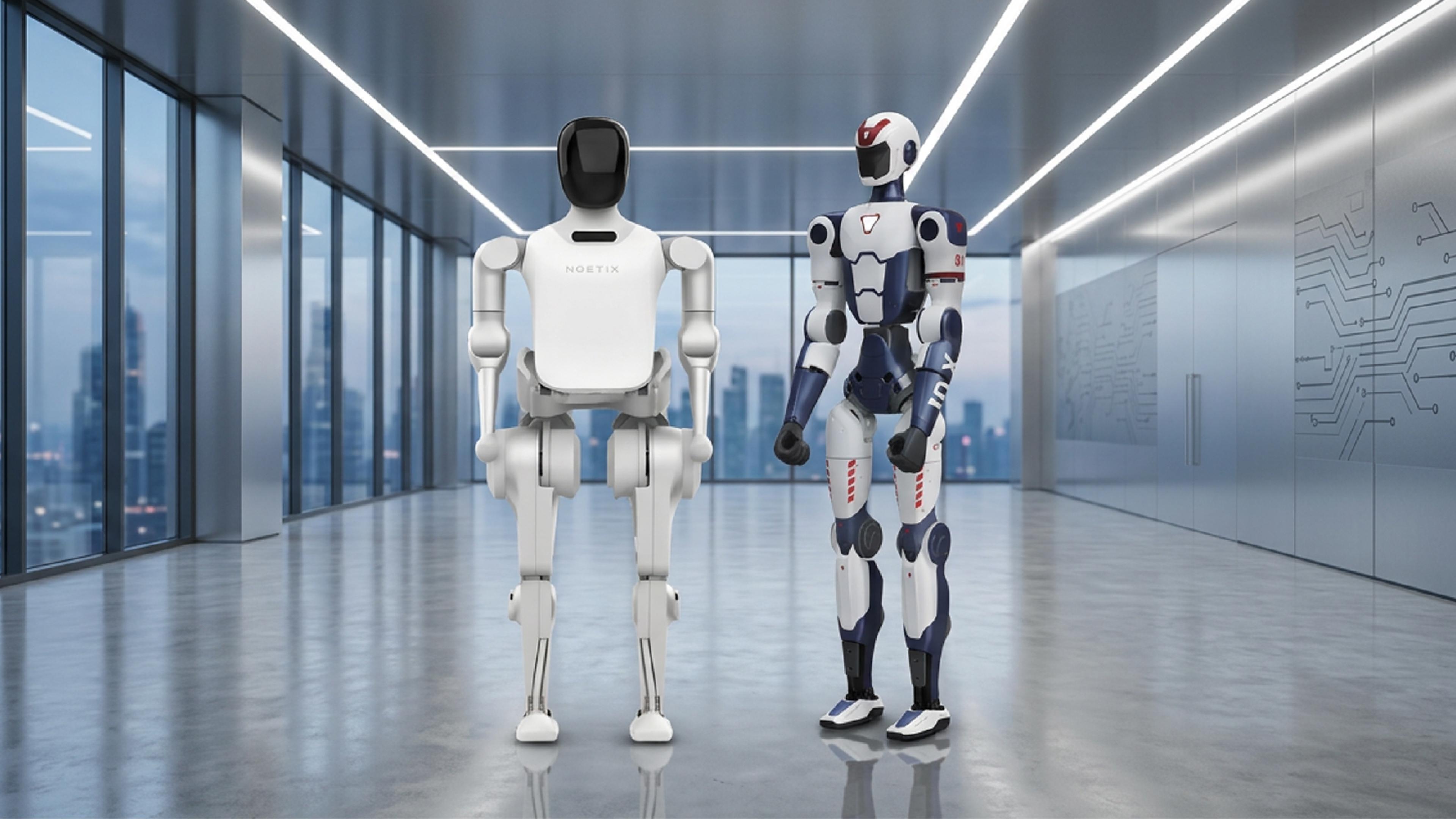
Unitree R1 and NOETIX N2 are compact bipedal humanoid robots designed for education, research and humanoid robotics development. We compare their physical dimensions, degrees of freedom, battery configurations, operating endurance and intended applications to examine how the two platforms differ.

November 10, 2026 by Business Desk Team
Introduction
Compact humanoid robots are becoming increasingly relevant to universities, robotics laboratories and developers exploring embodied AI and bipedal movement.
Compared with larger humanoid platforms, smaller robots can offer a more manageable physical format for experiments, demonstrations and educational activities. However, choosing a humanoid robot involves more than comparing its height or weight. Joint articulation, battery endurance, hardware configuration and software accessibility can all influence its suitability for research and development.
Unitree R1 and NOETIX N2 are two Chinese humanoid robots designed for research, education and experimentation with intelligent movement. Unitree R1 is a compact humanoid platform available in multiple configurations, including R1 Air, R1 and R1 EDU. These variants offer different degrees of freedom, allowing buyers to select a configuration based on their development requirements.
NOETIX N2 is a bipedal humanoid robot designed for education and research. Its compact structure, 18 degrees of freedom and quick-swap battery configuration make it relevant to projects involving humanoid locomotion and robotics development. Although both platforms are relatively small, their recorded specifications reveal differences in weight, articulation and operating endurance.
Based on ROBOT24.com market-research data records, this comparison examines their physical design, degrees of freedom, battery systems, runtime and suitability for different research applications.
| Height | 122 cm | 1180 mm |
|---|---|---|
| Weight | 25 kg | 30 kg |
| Battery | Quick-Release Lithium Battery | 48V 7Ah Quick-Swap Lithium Battery |
| Degrees of Freedom | 20 (R1 Air), 26 (R1), 26–40 (R1 EDU) | 18 DOF |
| Mobility Type | Humanoid | Bipedal Humanoid |
| Nationality | Chinese | Chinese |
| Runtime | Approximately 1 Hour | Up to 2 Hours |
| Typical use | Education & Training, Research & Development, Development Platform | Education & Training, Research & Development |
| Status | Commercial | Commercial |
How They Compare
Research and educational applications
Unitree R1 and NOETIX N2 are designed for educational and research environments where developers can explore humanoid movement and physical intelligence.
Unitree R1 is positioned for education, training and research and development. Its range of configurations makes it relevant to users with different hardware requirements, from introductory humanoid robotics projects to more advanced development.
NOETIX N2 is also intended for education and research, with a focus on bipedal humanoid robotics. Both platforms may support experiments involving walking, balance, movement coordination and robot control.
However, their suitability for a particular research project depends on the available development tools, software access and hardware configuration. The supplied records do not establish which platform provides broader programming access or more advanced research capabilities.
Physical dimensions and weight
Unitree R1 has a recorded height of 122 cm and weighs approximately 25 kg. NOETIX N2 stands 1,180 mm tall, equivalent to 118 cm, and weighs approximately 30 kg. R1 is therefore 4 cm taller and approximately 5 kg lighter than N2 based on the supplied figures.
These differences may influence how the robots are transported, handled and positioned during experiments. A lighter robot may be easier to reposition within a laboratory, while a heavier platform may have different structural and actuator characteristics.
However, weight alone does not determine stability, durability or movement performance. Joint configuration, actuator capabilities and weight distribution also influence how a humanoid responds during locomotion. Both robots have compact dimensions compared with many full-size humanoid platforms.
Degrees of freedom and articulation
One of the clearest differences between Unitree R1 and NOETIX N2 is their recorded degrees of freedom. Unitree R1 is available in multiple configurations. R1 Air has 20 degrees of freedom, the standard R1 has 26, and R1 EDU offers a recorded range of 26–40 depending on configuration. NOETIX N2 has 18 degrees of freedom.
Degrees of freedom describe the independently controllable movements available through a robot's joints. These movements may include articulation in the legs, arms, waist and other body sections. Based on the supplied figures, every listed R1 configuration has a higher degree-of-freedom count than N2.
Additional degrees of freedom can provide more possibilities for coordinated movement and articulation. However, a higher count does not automatically establish better locomotion or manipulation performance.
Joint torque, range of motion, actuator response and control software also influence how effectively a robot performs physical tasks. The exact R1 variant should therefore be identified when comparing articulation capabilities.
Bipedal mobility and movement
Both Unitree R1 and NOETIX N2 use a humanoid body configuration designed for bipedal movement. Bipedal locomotion requires continuous coordination between joints, sensors and control systems to maintain balance.
For educational and research applications, this provides opportunities to study walking behavior, posture control and coordinated motion. R1's different hardware configurations may support different levels of movement experimentation.
N2's 18-degree-of-freedom structure provides another platform for investigating humanoid locomotion. However, the supplied comparison table does not include walking speeds, maximum climbing angles or terrain-adaptation specifications.
It is therefore not possible to determine which robot has the higher movement speed or greater terrain-handling capability from the available records. Researchers should assess demonstrated locomotion performance and supported control functions for the specific models being considered.
Battery configuration
Both robots use lithium battery systems designed for replacement. Unitree R1 has a quick-release lithium battery. NOETIX N2 uses a 48V, 7Ah quick-swap lithium battery. The N2 specifications correspond to a nominal battery energy capacity of approximately 336 Wh, calculated from the supplied voltage and amp-hour rating.
However, the supplied records do not provide a directly comparable battery capacity for R1. Quick-release and quick-swap battery arrangements may help researchers replace depleted batteries between experiments or demonstrations.
This can be relevant in laboratories and classrooms where multiple sessions take place throughout the day. However, the ease of battery replacement, charging requirements and availability of spare batteries should be confirmed for each platform.
Operating endurance and runtime
Unitree R1 has a recorded operating runtime of approximately one hour. NOETIX N2 has a stated runtime of up to two hours.Based on these figures, N2 has the longer published maximum operating duration. This may be relevant to educational sessions, demonstrations and research experiments that require extended operation.
R1's recorded one-hour runtime may be suitable for shorter experiments or development activities, depending on the workload. However, runtime can vary according to movement intensity, computing requirements, joint activity and periods of inactivity.
The supplied figures do not establish whether both robots were tested under identical conditions. The two-hour N2 figure should therefore be treated as a stated maximum rather than a guarantee of continuous active operation. Organizations should request runtime information for the exact tasks they intend to perform.
Hardware configuration and development flexibility
Unitree R1's multiple variants are an important consideration for research buyers. The R1 Air, standard R1 and R1 EDU configurations offer different recorded degrees of freedom. This allows developers to consider hardware options based on their project requirements.
The EDU configuration's recorded range of 26–40 degrees of freedom may be relevant to projects requiring additional articulation. NOETIX N2 has a recorded 18-degree-of-freedom configuration. Its fixed specification provides a different hardware profile for educational and research applications.
However, the supplied data does not establish which robot offers greater software customization or more extensive access to low-level controls. Development flexibility depends on the available SDKs, APIs, documentation and supported computing systems. These details should be verified before selecting a platform for advanced research.
Classroom and laboratory deployment
Both robots have education and training among their listed applications. Compact humanoids may be used in classrooms to demonstrate robotics concepts such as balance, motion planning, joint control and coordinated movement. Their physical form also provides opportunities for students to observe how humanoid robots translate software commands into movement. Unitree R1's range of configurations may be relevant to educational institutions with different levels of technical expertise.
NOETIX N2's compact design and recorded battery endurance may also support classroom demonstrations and research activities.However, neither robot's suitability for a particular educational setting can be determined from its dimensions or runtime alone. Institutions should consider safety procedures, supervision requirements, maintenance, technical support and access to teaching resources.
Commercial status and availability
Both Unitree R1 and NOETIX N2 have commercial status in the supplied comparison records. However, commercial status does not necessarily establish identical purchasing arrangements or immediate availability.
Different hardware configurations may have different prices, delivery schedules and technical-support arrangements. For Unitree R1, buyers should confirm whether the required capabilities are included in R1 Air, standard R1 or R1 EDU.
For NOETIX N2, buyers should verify the available hardware package, software access and battery options. Research institutions should also consider warranty coverage, replacement parts and documentation before purchasing either platform.
More articles on this topic
144 articles ReportRichtech DUST-E S vs. Gausium Phantas
 ReportEngineAI SE01 vs. AGIBOT RAISE A1ReportRichtech DUST-E S vs. KEENON KLEENBOT C20
 ReportPUDU PuduBot 2 vs. OrionStar LuckiBot Pro
 ReportUnitree G1 vs. EngineAI PM01
 ReportKEENON DINERBOT T11 vs. PUDU KettyBot Pro
 ReportAGIBOT D1 Pro vs. Unitree Go2 Pro
 ReportKEYi Tech Loona vs. WEILAN BabyAlpha A2
 ReportPUDU BellaBot Pro vs. KEENON DINERBOT T11
 ReportBear Robotics Servi Plus vs PUDU BellaBot Pro
 ReportUnitree G1 vs. AGIBOT X2
 ReportPUDU KettyBot Pro vs. Bear Robotics Servi Q
BUSINESS NEWS WEEKLY LETTER
The Weekly Letter for Robotics Professionals, Summarizing the Most Important Industry Moves, Launches, Deals and Signals.