AGIBOT D1 Pro vs. Unitree Go2 Pro
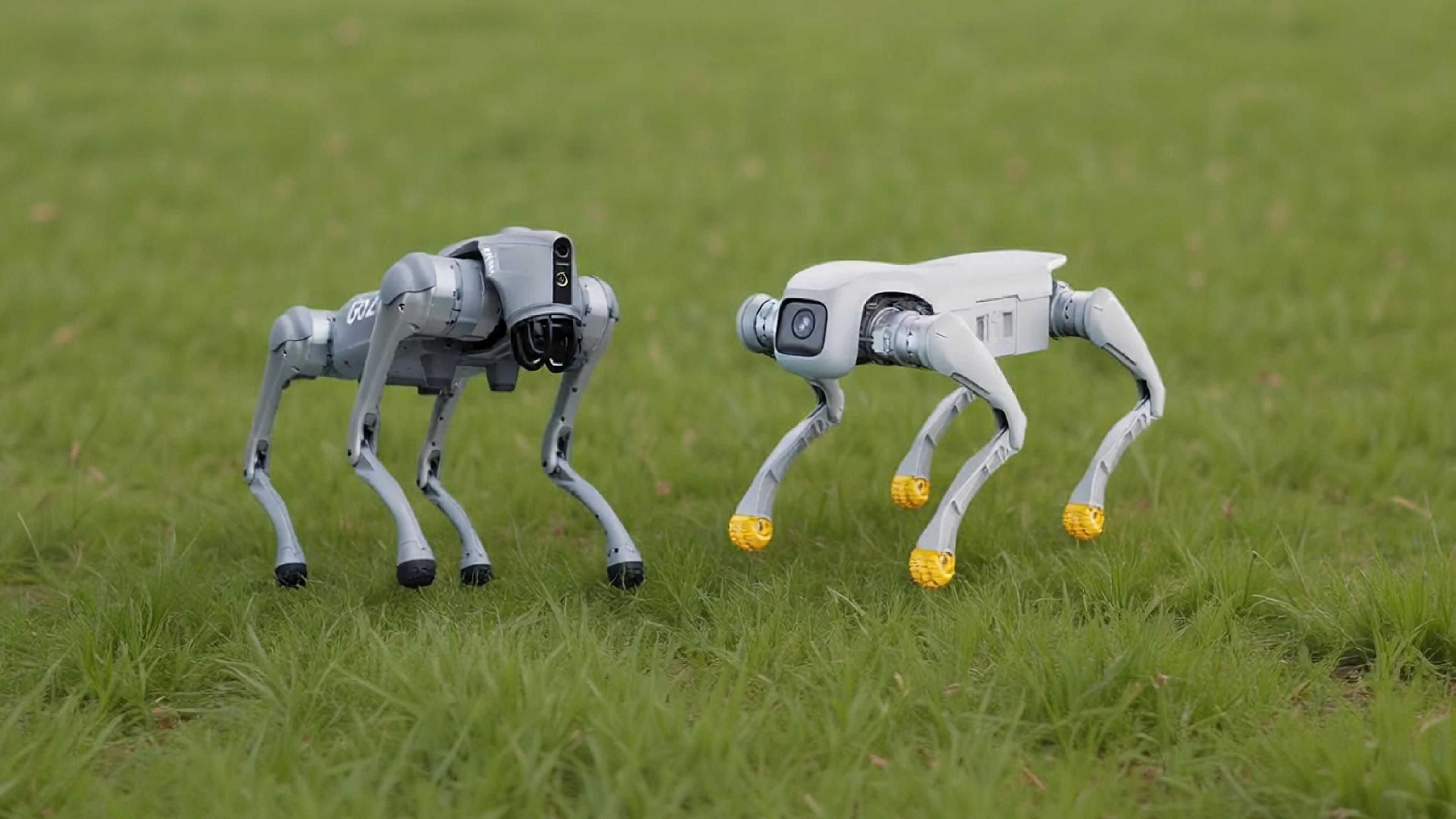
AGIBOT D1 Pro and Unitree Go2 Pro are both industrial and research quadruped robots compared here on locomotion, joint torque, maximum speed, navigation capabilities, remote operation and autonomous deployment.

November 12, 2026 by Business Desk Team
Introduction
AGIBOT D1 Pro and Unitree Go2 Pro are compared as full-size bipedal humanoid robots that are commercially intended to be able to walk around in the industrial, research, and security sector. AGIBOT D1 Pro and Unitree Go2 Pro is listed as having 12 degrees of freedom and a speed of 3.5 m/s but they have different paths for their navigation and different modes of operation.
In the supplied record, AGIBOT D1 Pro is defined as a remotely operated quadruped with automatic gait adaption. EngineAI SE01 is listed at 170 cm and 55 kg, with 32 degrees of freedom. These differences affect deployment considerations, but degrees of freedom and body weight alone do not establish manipulation capability or real-world task performance.
At a Glance
| Metric | AGIBOT D1 Pro | Unitree Go2 Pro |
|---|---|---|
| Robot type | Remote-operated quadruped | AI quadruped robot |
| Best-fit use cases | Education, training, security, surveillance and industrial operations | Research, development, manufacturing, industrial operations, security and surveillance |
| Degrees of freedom | 12 total; 3 per leg | 12 |
| Dimensions | Standing: 635 × 360 × 420 mm; lying: 675 × 435 × 145 mm (L × W × H) | Crouching: 760 × 310 × 200 mm |
| Maximum joint torque | 48 N·m | 45 N·m |
| Maximum speed | 3.5 m/s | 3.5 m/s; up to 5 m/s in Rage Mode |
| IMU | Standard | Yes |
| Navigation | Remote operation with automatic gait adaptation; autonomous navigation unverified | Autonomous navigation listed |
| Commercial status | Commercially available | Commercially available |
| Key limitation / caveat | Autonomous navigation not verified in the supplied record | 5 m/s Rage Mode is a special operating claim, not necessarily a sustained working speed |
How They Compare
Operational role: AGIBOT D1 Pro is claimed to be a remotely controlled quadruped, with automatic gait adaptation, thus the operator becomes part of the control loop. Unitree Go2 Pro: autonomous navigation-implying a different use model where the robot would be performing navigation missions (its provided specs do not clarify the degree of auto-route planning, obstacle avoidance or unattended operations).
Locomotion and mechanical configuration: Both robots have 12 degrees of freedom, with AGIBOT citing three per leg. D1 Pro states a maximum joint torque of 48Nm to Go2 Pro's 45Nm: a slight difference on the published maximum torque numbers alone does not prove a superior ability to move, carry a payload and perform in the environments you are targeting.
Speed and mobility: Both units have a published maximum speed of 3.5 m/sec, with Unitree also claiming a maximum of 5 m/sec in Rage Mode. That number should be regarded as a special-mode maximum and not an expectation of typical use, but a real-world comparison between the different robots would have to take into account unit speed under load, turning capability, braking, obstacle negotiation and travelling on rough terrain.
Physical configuration: AGIBOT offer a stand and lie height (Go2 Pro supplied record only have crouch height). These records are different postures, so this shouldn't be considered as overall footprint comparison. Check each robot deployed dimension clearance before planning to use doors, corridors or tool/lab areas.
Navigation and deployment: The clearest difference reported is navigation. The table at: presents the listed navigation capabilities. Go2 Pro is listed as having autonomous navigation, while D1 Pro is listed as remotely operated with automatic gait adaptation; remote navigation of D1 Pro cannot be confirmed. Automatic gait adaptation relates to gait control and differs from autonomous navigation. For either platform, consider mapping, obstacle detection, route planning, remote supervisor control and safe behaviour during a hands-on demonstration.
Important Qualification
AGIBOT D1 Pro: The record you are given does not confirm autonomous navigation. The record shows specification figures of 48 Nm maximum joint torque and 3.5 m/s maximum speed. These are not performance-test figures.
Unitree Go2 Pro: The 5m/s Rage Mode figure is a special mode maximum. The record provided does not specify the duration of this speed nor the mode of operation.
Both models: Payload capacity, battery life, charging duration, terrain restrictions, sensor layout and ingress protection ratings are not covered in the provided side-by-side data. Verify before making any deployment or endurance claims.
Summary
Choose AGIBOT D1 Pro, if an autonomous quadruped with auto gait adaptation and the flexibility to perform anywhere in the education, training, surveillance, or industrial workflow is key. Consider Unitree Go2 Pro if autonomous navigation listed as a feature is important, plus high speed in Rage Mode.
Both models have 12-DOF configuration and a given standard maximum speed of 3.5 m/sec. D1 Pro has a marginally higher called-out maximum joint torque, and Go2 Pro has a more well-documented autonomy statement and a higher special-mode maximum speed. These do not establish an unambiguous winner in performance. Confirm configurations, limits and software before claiming superiority. Query possible customer field trials.
This comparison is based on ROBOT24.com market-research data records and manufacturer-reported specifications rather than controlled performance testing.
More articles on this topic
144 articles ReportRichtech DUST-E S vs. Gausium Phantas
 ReportEngineAI SE01 vs. AGIBOT RAISE A1ReportRichtech DUST-E S vs. KEENON KLEENBOT C20
 ReportPUDU PuduBot 2 vs. OrionStar LuckiBot Pro
 ReportUnitree G1 vs. EngineAI PM01
 ReportKEENON DINERBOT T11 vs. PUDU KettyBot Pro
 ReportKEYi Tech Loona vs. WEILAN BabyAlpha A2
 ReportPUDU BellaBot Pro vs. KEENON DINERBOT T11
 ReportBear Robotics Servi Plus vs PUDU BellaBot Pro
 ReportUnitree G1 vs. AGIBOT X2
 ReportPUDU KettyBot Pro vs. Bear Robotics Servi Q
 ReportUnitree GO2-W vs. MagicLab MagicDog-W
BUSINESS NEWS WEEKLY LETTER
The Weekly Letter for Robotics Professionals, Summarizing the Most Important Industry Moves, Launches, Deals and Signals.