Bear Robotics Servi Plus vs PUDU BellaBot Pro
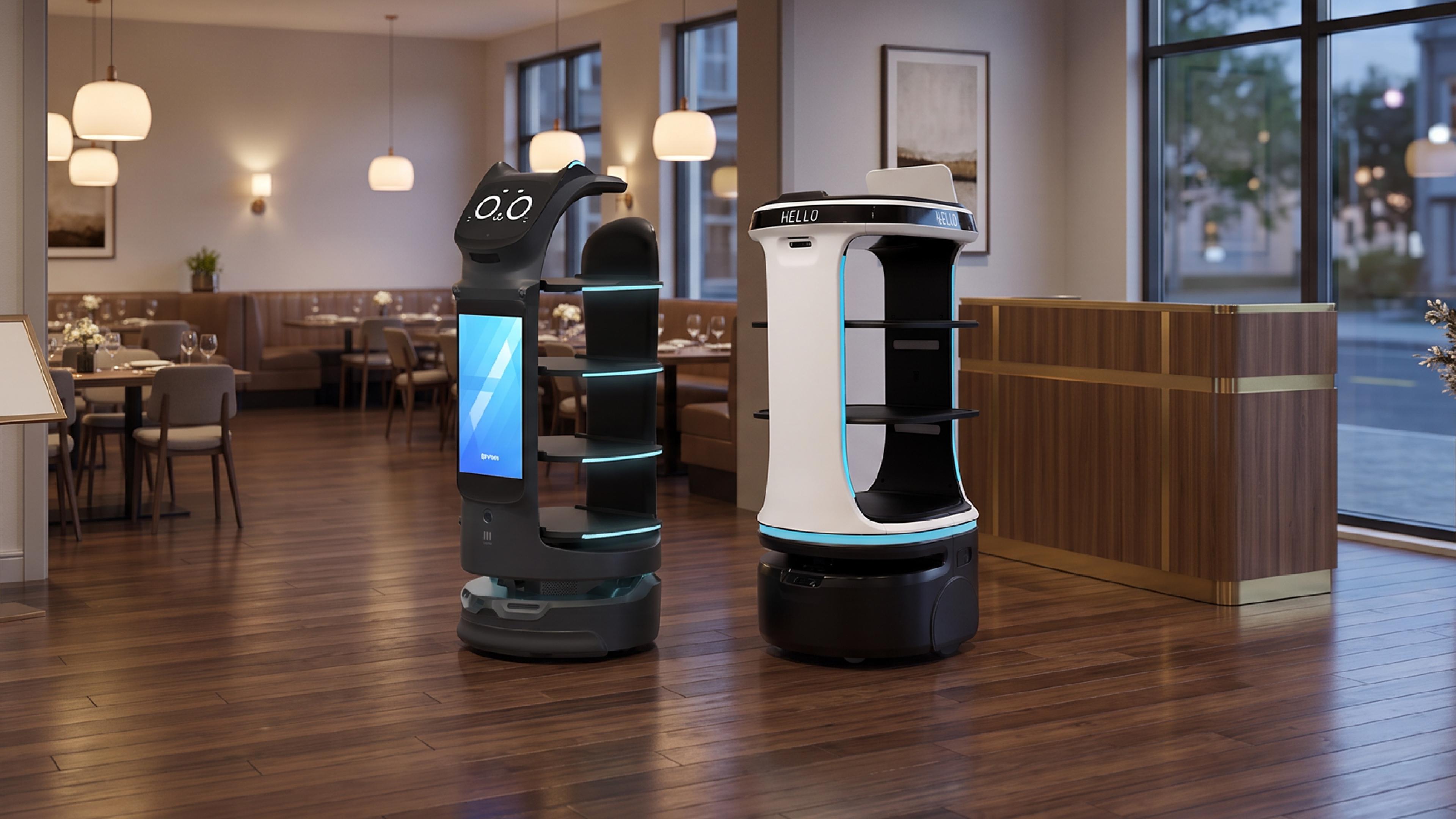
PUDU BellaBot Pro and KEENON DINERBOT T11 are commercially available autonomous service robots designed for food delivery, customer interaction and indoor commercial operations. We compare their navigation capabilities, minimum passage widths, movement speeds, charging times, operating endurance and connectivity to examine their suitability for different service environments.

November 11, 2026 by Business Desk Team
Introduction
Autonomous service robots are increasingly being used in restaurants, retail environments and other commercial facilities to support repetitive transport tasks and customer-facing operations.
These robots can move between designated locations, transport items and assist staff with routine service activities. However, their effectiveness depends on how well they navigate the spaces in which they operate.
A robot designed for spacious restaurant dining areas may face different challenges from one operating in narrow corridors or crowded retail environments.
PUDU BellaBot Pro and KEENON DINERBOT T11 are two Chinese autonomous service robots developed for indoor commercial applications.
BellaBot Pro combines autonomous delivery with customer interaction and promotional capabilities. It is designed for restaurants and other venues seeking to integrate transport functions with interactive service.
DINERBOT T11 focuses on compact navigation and service operations in environments where passage width is an important consideration.
Both robots support LiDAR, Wi-Fi connectivity and over-the-air software updates. However, their recorded specifications reveal differences in movement speed, operating endurance, charging time and minimum passage width.
Based on ROBOT24.com market-research data records, this comparison examines their navigation, mobility, operating requirements and suitability for different commercial applications.
At A Glance
| Availability | Commercially Available | Commercially available |
|---|---|---|
| Charging Time | Approximately 4 hours | Approx. 4.5 Hours |
| LiDAR | Yes | Yes |
| Maximum Speed | 1.2 m/s | 1.2 m/s |
| Nationality | American | Chinese |
| OTA Updates | Supported | Supported |
| RGB Cameras | Yes | Yes |
| Runtime | 8–12 hours | Up to 20 Hours |
| Touchscreen Interface | Yes | Yes |
| Wi-Fi | Yes | Yes |
| Typical use | Food Service | Healthcare, Retail & Showroom Operations, Food Service |
| Status | Commercial | Commercial |
How They Compare
Commercial applications and operational focus
PUDU BellaBot Pro and KEENON DINERBOT T11 are designed to support indoor service operations, but they emphasize different aspects of commercial automation.
BellaBot Pro is positioned for food delivery, customer interaction and promotional activities. Its manufacturer describes delivery, recycling, cruising, guiding and birthday-service modes, allowing operators to adapt the robot to different customer-facing workflows.
These capabilities may be relevant to restaurants, hospitality venues and retail facilities seeking to combine routine transport with customer engagement. DINERBOT T11 emphasizes delivery and promotional functions in environments with restricted aisle space.
Its compact design and navigation system are intended to support movement through narrow passages while avoiding obstacles.Both robots may reduce the need for staff to make repetitive transport trips. However, their practical value depends on the tasks being automated, the available floor space and the volume of service activity.
Navigation and obstacle avoidance
According to the provided records of comparison, both BellaBot Pro and DINERBOT T11 offer LiDAR. The manufacturer of BellaBot Pro further describes the combination of navigation using visual SLAM, markers and LiDAR SLAM.
The environmental sensing features include the presence of cameras at the front, RGB-D and radar for obstacle detection. For DINERBOT T11, there is a focus on visual navigation as indicated by KEENON with five stereo vision sensors and VSLAM fusion for narrow area navigation. Furthermore, there is an emphasis on multimodal 3D vision for obstacle detection in crowded environments. The two robots have been designed to navigate past obstacles such as furniture, people, and other items. Nevertheless, this does not automatically mean that their navigation performance is better due to the difference in sensor configuration.
The factors that influence obstacle avoidance include sensor configuration, software, path planning and operating environment. Businesses need to test both robots in their working environment.
Minimum passage width and narrow-aisle navigation
Minimum passage width is among the most crucial factors in comparing these two robots. According to the provided data, BellaBot Pro requires a minimum passage width of 70 cm, whereas DINERBOT T11 requires a minimum passage width of 49 cm.
Thus, from the provided information, we can conclude that T11 is engineered to work through much narrower aisles. This factor may prove useful in small-sized restaurants and stores with furniture located at a short distance from each other. Having a low passage width requirement increases the quantity of routes that a robot can follow inside the facility.
Nevertheless, the minimum passage width is not the only factor that defines a robot's accessibility. The turning radius, clearance between obstacles, floor conditions, and furniture placement also have an impact on this issue. At the same time, these figures need to be verified according to the information provided by the manufacturers, since the official product page indicates different clearance for BellaBot Pro.
Maximum speed and efficiency of movement
BellaBot Pro has a maximum movement speed of 1.2 m/s. DINERBOT T11 has a maximum speed of 1.0 m/s. From these numbers, it can be seen that BellaBot Pro is the faster robot.
This could matter for larger establishments in which robots have greater distances to cover to reach the delivery points. Still, maximum speed cannot determine efficiency of delivery. In restaurant and retail spaces, robots will have to slow down or even stop when coming across customers, employees or other obstructions. A robot with faster speed will not necessarily make more deliveries during the time of operation.
DINERBOT T11 with narrower clearance will provide another advantage in confined areas. For companies, the important criterion is the speed at which each robot can perform a delivery task.
Runtime and Operating Endurance
According to the presented comparative information, BellaBot Pro operates for up to 20 hours. DINERBOT T11 operates for about 10 to 13.5 hours. This indicates the difference in maximum time of operation which needs to be confirmed through manufacturer's materials.
Operational endurance can affect how the business schedules the assistance of robots during various services such as lunch or dinner. Increased endurance of the robot can decrease the frequency of recharging of the robot. Nevertheless, operational endurance can be affected by the work load of the robot.
Factors such as travel distance, speed of travel, cargo weight, interactions with customers, and non-operating periods can affect the use of battery of the robot. Thus, maximum runtime figures provided in published sources should not be considered as guaranteed uninterrupted active period of the robot.
Charging time and operational planning
BellaBot Pro has a recorded charging time of approximately 4.5 hours. DINERBOT T11 has a recorded charging time of approximately 5.5 hours. Based on the supplied figures, BellaBot Pro has the shorter stated charging duration.
This difference may influence how operators schedule charging between service periods. For restaurants operating across several meal services, charging requirements can affect when a robot is available. However, charging time should be evaluated alongside battery capacity, runtime and charging procedures.
The supplied records do not establish whether the figures were measured from identical starting battery levels. Businesses should confirm the applicable charging conditions before comparing operational availability.
Food delivery and service processes
BellaBot Pro is made for food delivery and food service activities. The producer mentions several operating models such as delivery and recycling; these could help organize food delivery in the restaurants. The robot is equipped with customer interaction features that aim to facilitate the process.
DINERBOT T11 is a delivery robot, however, it is made with attention to narrow spaces in restaurants. Such small size may be helpful when there are difficulties with movement of large-size service robots through the dining space.
KEENON mentions tray detection and shock-absorbing chassis; it could assist in the stable delivery of food. It can be concluded that both robots use a different approach to food delivery. BellaBot Pro combines food delivery with interactive features while T11 makes an emphasis on movement and food delivery.
Retail and showrooms
Both of these robots have potential uses in retail and showroom settings, in relation to their commercial role.These robots can be applied for promotional activities, customer interaction or the movement of appropriate goods. BellaBot Pro has advertising screens and interactive capabilities that can help with customer interaction.
Similarly, DINERBOT T11 is promoted as having promotional features, including a screen and custom interactions. However, having promotional features does not ensure identical customer engagement capabilities.The screen capabilities, content management capabilities and system integrations can determine the success of each robot in retail settings. Companies should consider these factors independently of the robots' transportation capabilities.
Healthcare applications
Healthcare is included among the recorded application categories for both robots. In healthcare environments, autonomous service robots may be considered for nonclinical transport tasks, depending on facility requirements.
Potential applications can involve moving suitable items between designated indoor locations. However, a robot's commercial service capabilities do not automatically establish its suitability for clinical operations. Healthcare facilities may have additional requirements involving hygiene, access control, safety and integration with existing workflows. The supplied records do not establish whether either platform meets specific healthcare certifications or clinical transport requirements. Organizations should therefore verify application-specific suitability before deployment.
Wi-Fi and software updates
According to the provided data, both BellaBot Pro and DINERBOT T11 feature Wi-Fi connectivity and OTA updates. Wi-Fi technology could be used for robot-communication and coordination between robots and appropriate management system. OTA updates would allow delivering supported software updates without the necessity to perform an update manually.
This functionality could be useful for businesses that use a fleet of robots. However, having Wi-Fi connectivity and OTA update capability does not create equal capabilities for fleet management. Provided data does not contain any direct comparison in terms of software interfaces, policies and third-party integration. It is necessary to check the compatibility of selected robot with existing business systems.
Commercial availability and deployment
Both BellaBot Pro and DINERBOT T11 are commercially available according to the supplied comparison records.Their commercial positioning makes them relevant to organizations evaluating service automation rather than research-only platforms.However, purchasing arrangements may vary by region and distributor.
Installation, mapping, staff training, maintenance and technical support can also influence deployment requirements. For restaurants and retail facilities, a site assessment should establish whether the robot can navigate the intended routes and perform the required tasks. Businesses should also confirm warranty coverage, spare-part availability and ongoing support.
Summary
The PUDU BellaBot Pro and KEENON DINERBOT T11 are commercial autonomous service robots designed for indoors logistics and consumer-facing tasks. The BellaBot Pro could be interesting for companies that need a robot to deliver food, interact with customers and promote the business. The maximum speed of 1.2 m/s and 4.5 hours charging time could be important factors when considering this robot for commercial use.
The DINERBOT T11 robot could be useful in facilities with limited space because of its ability to pass aisles as narrow as 49 cm mentioned by the manufacturer. The comparison shows that both robots work with LiDAR, Wi-Fi and OTA updates. The decision will depend on the task the robot will perform, the size of the floor area, operational life, customer interaction and integration needs.
The comparison is made on the basis of ROBOT24.com market research records and the information provided by manufacturers without conducting performance tests. The runtime, passage width, charging and navigation capability need to be verified from the current specifications of the manufacturer.
More articles on this topic
144 articles ReportRichtech DUST-E S vs. Gausium Phantas
 ReportEngineAI SE01 vs. AGIBOT RAISE A1ReportRichtech DUST-E S vs. KEENON KLEENBOT C20
 ReportPUDU PuduBot 2 vs. OrionStar LuckiBot Pro
 ReportUnitree G1 vs. EngineAI PM01
 ReportKEENON DINERBOT T11 vs. PUDU KettyBot Pro
 ReportAGIBOT D1 Pro vs. Unitree Go2 Pro
 ReportKEYi Tech Loona vs. WEILAN BabyAlpha A2
 ReportPUDU BellaBot Pro vs. KEENON DINERBOT T11
 ReportUnitree G1 vs. AGIBOT X2
 ReportPUDU KettyBot Pro vs. Bear Robotics Servi Q
 ReportUnitree GO2-W vs. MagicLab MagicDog-W
BUSINESS NEWS WEEKLY LETTER
The Weekly Letter for Robotics Professionals, Summarizing the Most Important Industry Moves, Launches, Deals and Signals.