PUDU PuduBot 2 vs. OrionStar LuckiBot Pro
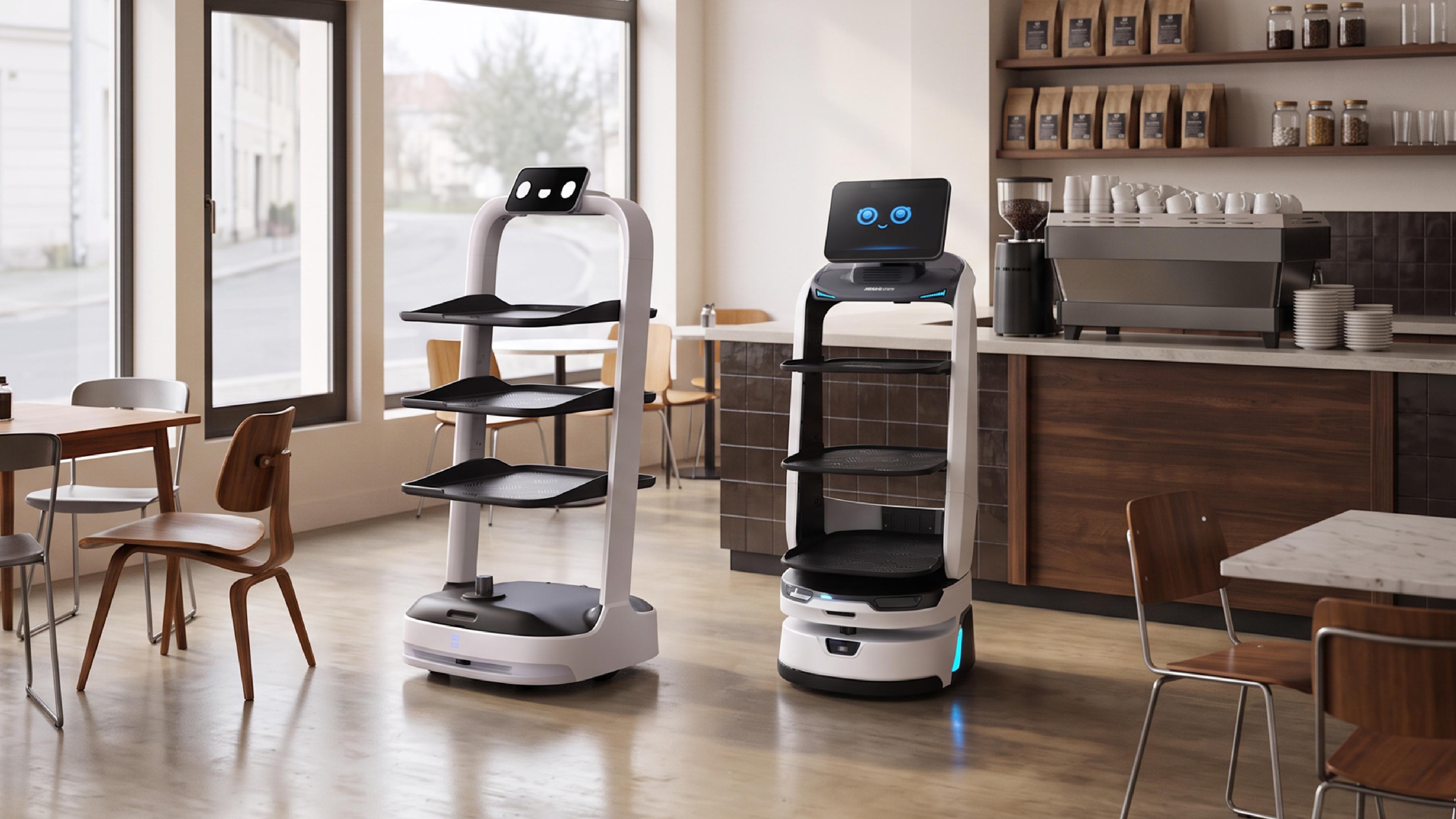
PUDU PuduBot 2 and OrionStar LuckiBot Pro are commercial autonomous delivery robots designed to transport food and other items in indoor environments. We compare their navigation capabilities, tray dimensions, charging systems, operating endurance, physical size and connectivity to examine their suitability for restaurants, hospitality venues and other commercial facilities.

November 12, 2026 by Business Desk Team
Introduction
Autonomous delivery robots are becoming an increasingly practical option for businesses looking to reduce repetitive transport tasks. In restaurants, these robots can carry meals from kitchens to dining areas. In hospitality venues, they can assist with internal deliveries, while other commercial facilities may use them to move suitable items between designated locations.
However, choosing the right delivery robot involves more than comparing its appearance or carrying capacity. Tray dimensions, navigation capabilities, operating endurance and charging arrangements can all influence how effectively a robot supports daily operations.
PUDU PuduBot 2 and OrionStar LuckiBot Pro are two Chinese autonomous delivery robots designed for commercial environments. PuduBot 2 is positioned for food service, healthcare and manufacturing or industrial operations. Its recorded specifications include autonomous navigation, multiple charging options and a relatively large tray surface.
LuckiBot Pro is designed for general delivery, food service and hospitality applications. It combines autonomous navigation with automatic docking and wireless connectivity. Both robots support autonomous navigation, OTA software updates and Wi-Fi connectivity.
However, their recorded specifications reveal differences in physical dimensions, tray size, charging time and operating endurance. Based on ROBOT24.com market-research data records, this comparison examines their delivery capabilities, navigation, charging arrangements and suitability for different commercial workflows.
At A Glance
| Autonomous Navigation | Yes | Yes |
|---|---|---|
| Availability | Commercial model presented by PUDU Robotics; obtain configuration, local sales and delivery terms through PUDU or its distribution channel. | Commercially Available |
| Charging Method | Wired + Autonomous Charging | Automatic Dock + Cable |
| Charging Time | 4 h | 4.5 hours |
| Dimensions | 580 × 535 × 1290 mm | 558 × 525 × 1375 mm |
| Nationality | Chinese | Chinese |
| OTA Updates | Supported | Supported |
| Runtime | 12 h (No Load), 15 h (Full Load), Up to 24 h Maximum | 12 hours (Typical) |
| Tray Size | 520 × 432 mm | 500 × 420 mm |
| Wi-Fi | Yes | Yes 2.4/5 GHz |
| Typical use | Food Service, Healthcare, Manufacturing & Industrial Operations | Generic Deliveries, Food Service, Hospitality |
| Status | Commercial | Commercial |
How They Compare
Commercial application and operational considerations
PuduBot 2 and LuckiBot Pro are both robots intended to transport items autonomously indoors in commercial settings. PuduBot 2 is widely used in a variety of applications which include restaurant services, healthcare, and industry/manufacturing operations.
Such environments may need items to be moved around repeatedly by robots from one place to another. LuckiBot Pro is generally aimed at delivering services such as general deliveries, restaurants services and hospitality.
These applications may involve delivering meals, beverages, and other suitable items to various service points. Both PuduBot 2 and LuckiBot Pro can be considered in repetitive delivery processes; however, their appropriateness will depend on the items delivered and operational needs of the facility. The provided application categories do not guarantee the capability of each robot to undertake all tasks related to that industry.
Autonomous navigation
Both PuduBot 2 and LuckiBot Pro have autonomous navigation capabilities. With autonomous navigation, a robot is able to navigate the pre-defined route path without being steered by an individual each time the robot is required to navigate.
Autonomous navigation in restaurants will enable the robot to make repetitive deliveries from kitchens to dining rooms and vice versa. For commercial properties, autonomous navigation will assist the robot to transport the products to different points defined.
Autonomous navigation alone cannot ensure the same navigation performance. Aspects such as route planning, obstacle detection, mapping abilities and navigating around obstacles will impact on reliability. No comparable information is provided about the sensors and their range or navigation technology in the provided information.
Physical dimensions and workspace requirements
PuduBot 2 measures 580 × 535 × 1,290 mm. LuckiBot Pro measures 558 × 525 × 1,375 mm. Based on these figures, PuduBot 2 is approximately 22 mm wider and 10 mm deeper than LuckiBot Pro.
LuckiBot Pro is approximately 85 mm taller. These differences may influence how the robots fit into restaurant dining areas, corridors and service spaces. LuckiBot Pro's slightly smaller recorded footprint may be relevant to facilities with limited floor space.
However, physical dimensions alone do not establish which robot can navigate narrower passages. Turning radius, obstacle clearance and minimum passage requirements are also important.
The supplied records do not include directly comparable minimum passage widths. Businesses should therefore assess the complete operating footprint of each robot before deployment.
Tray size and carrying surface
PuduBot 2 has a recorded tray size of 520 × 432 mm. LuckiBot Pro has a recorded tray size of 500 × 420 mm. Based on these dimensions, PuduBot 2 provides a slightly larger carrying surface per tray.
Its rectangular tray area is approximately 2,246 cm², compared with approximately 2,100 cm² for LuckiBot Pro. This represents an area difference of approximately 7%.
A larger tray surface may be useful when transporting wide plates, serving dishes or other items that require additional space. However, tray area does not establish maximum carrying capacity. The supplied records do not include directly comparable payload limits or tray counts. A larger tray also does not necessarily allow a robot to transport more items if weight restrictions or spacing requirements apply.
Businesses should evaluate the actual objects they intend to transport rather than relying on tray dimensions alone.
Food-service delivery
Both robots have food service among their listed applications. In restaurants, autonomous delivery robots can assist staff by transporting prepared meals and other items between designated locations.
PuduBot 2's recorded tray dimensions may be relevant to businesses using larger serving dishes. LuckiBot Pro's compact footprint and delivery-oriented design may also suit restaurant workflows.
However, the number of meals transported per journey depends on more than tray size. Tray configuration, load distribution, payload capacity and the size of individual dishes all influence carrying efficiency. The supplied records do not establish which robot can carry more meals during a single trip.
Restaurants should conduct loaded demonstrations using their actual serving equipment.
Operating endurance and runtime
PuduBot 2 has several runtime figures in the supplied records: 12 hours without a load, 15 hours with a full load and a maximum of up to 24 hours. LuckiBot Pro has a recorded typical runtime of 12 hours.
These figures require careful interpretation because they describe different operating conditions. PuduBot 2's stated maximum of up to 24 hours suggests the possibility of extended operation under particular conditions.
However, the supplied records do not explain the circumstances under which that maximum is achieved. The stated 15-hour full-load runtime also exceeds the 12-hour no-load figure, which is unusual without additional information about the test conditions.
LuckiBot Pro's 12-hour typical runtime provides a different type of endurance measure. It should not be directly compared with PuduBot 2's maximum figure without confirming equivalent workloads.
Actual operating endurance can vary according to travel distance, payload, speed, route conditions and periods of inactivity. Businesses should request runtime information based on representative delivery workloads.
Charging process
The robots feature both automatic charging solutions and cable charging systems. The PuduBot 2 has both autonomous charging system and wired charging in the accompanying documentation.
LuckiBot Pro is equipped with automatic docking charging and cable charging system. Automatic charging might help in reducing the necessity of manual connection of the robot after each operation cycle. In case if the business uses the robot constantly during the day, it may assist in optimizing the charging process.
Nevertheless, automatic charging does not mean that the robot manages all aspects of the operation schedule by itself. Docking station, charging availability and software settings might affect the performance of the automatic charging.
Charging time
The charging time of PuduBot 2 is 4 hours. The charging time of LuckiBot Pro is around 4.5 hours. Therefore, based on the above times, PuduBot 2 has the lesser stated charging time by about 30 minutes.
This could prove to be significant when it comes to planning the charging period within the business. However, just charging time does not mean that there is higher operational availability.
In addition to this, the duration of battery life, charging methods, and how often the robot is utilized all play a role in determining the operational time for deliveries. The figures above do not show if the robots were charged from the same level of charge.
Wi-Fi connectivity
Wi-Fi connectivity is offered by both PuduBot 2 and LuckiBot Pro robots. Regarding LuckiBot Pro, the available information states that it is compatible with 2.4 GHz and 5 GHz Wi-Fi.
PuduBot 2 is stated to have Wi-Fi capability, but no specific frequency range is indicated. This wireless connectivity could enable communication with compatible management systems.
A networked environment can become an important aspect for robot fleets. However, no identical capabilities concerning fleet management or remote monitoring can be assumed from the available documentation
OTA software updates
Both robots support over-the-air software updates. OTA updates allow compatible software changes to be distributed without requiring every update to be installed manually.
For commercial robots, software maintenance may be relevant to navigation functions, system stability and supported features. However, OTA support does not establish identical update schedules or software capabilities. The supplied records do not specify how updates are managed or whether they require an active service agreement. Organizations should confirm the manufacturers' software-support policies.
Healthcare and Industrial Use Applications
PuduBot 2 has two potential applications: healthcare and industry. For healthcare establishments, robotic delivery devices might be recommended for moving proper nonclinical products between specified points.
For industrial settings, robotic devices may assist with repetitive internal delivery operations. Nevertheless, such applications may be accompanied by further requirements for safety and compatibility.
The provided information does not prove that PuduBot 2 satisfies any certification for such fields of use. So, one should treat the provided application categories as mere intended usages. The category of applications for LuckiBot Pro consists of delivery, hospitality, and food service. Such listing does not mean that this robot is limited to the mentioned purposes only.
Hospitality and general deliveries
Among the applications listed for LuckiBot Pro is hospitality and general deliveries. In venues providing hospitality services, autonomous robots could help transport appropriate things around different service points.
The food service positioning of PuduBot 2 might also apply to the hospitality industry, particularly when it comes to delivering meals. Unfortunately, no information provided proves that either robot can independently move through elevators, open doors, or access secured zones.
This function can be added through integrations or may not be available with a particular setup. It is important to make a distinction between general indoor deliveries and more complex building-wide ones.
Commercial availability and deployment
Both robots are commercially available in the provided sources. LuckiBot Pro is commercially available.
PuduBot 2 is referred to as a commercially available robot; its setup, sales, and delivery conditions will be defined through PUDU Robotics or their distribution chain. It is important for business consideration.
Commercial product does not imply immediate availability of all its setups everywhere. Deployment can also involve mapping of the site, setting up of charging, training of personnel, etc.
For the purchase of one of the robots, it is recommended to clarify its availability locally, warranty terms, provision of spare parts and maintenance services.
Summary
Pudu PuduBot 2 and OrionStar LuckiBot Pro are commercial autonomous robots that deliver food and perform various indoor transportation operations. PuduBot 2 could be a good choice for businesses interested in autonomous delivery robot with increased size of the tray and reduced charging time.
Additionally, it supports multiple applications such as healthcare and manufacturing/industrial. OrionStar LuckiBot Pro is a robot which could be interesting for companies searching for an autonomous delivery robot for food service and hospitality industry and general transportation. The 12 hours of run time, auto-docking system and Wi-Fi (2.4 and 5 GHz) are the features which must be taken into account.
Both robots provide autonomous navigation, automatic charging system and Wi-Fi OTA update capability. The final choice will depend on the type of cargo, available area, schedule, charging options and additional integration needs.
Comparison is performed according to ROBOT24.com market research records and not based on performance tests. Runtime, tray capacity, navigation performance and availability must be confirmed by manufacturer's documents.
More articles on this topic
144 articles ReportRichtech DUST-E S vs. Gausium Phantas
 ReportEngineAI SE01 vs. AGIBOT RAISE A1ReportRichtech DUST-E S vs. KEENON KLEENBOT C20
 ReportUnitree G1 vs. EngineAI PM01
 ReportKEENON DINERBOT T11 vs. PUDU KettyBot Pro
 ReportAGIBOT D1 Pro vs. Unitree Go2 Pro
 ReportKEYi Tech Loona vs. WEILAN BabyAlpha A2
 ReportPUDU BellaBot Pro vs. KEENON DINERBOT T11
 ReportBear Robotics Servi Plus vs PUDU BellaBot Pro
 ReportUnitree G1 vs. AGIBOT X2
 ReportPUDU KettyBot Pro vs. Bear Robotics Servi Q
 ReportUnitree GO2-W vs. MagicLab MagicDog-W
BUSINESS NEWS WEEKLY LETTER
The Weekly Letter for Robotics Professionals, Summarizing the Most Important Industry Moves, Launches, Deals and Signals.