KEYi Tech Loona vs. WEILAN BabyAlpha A2
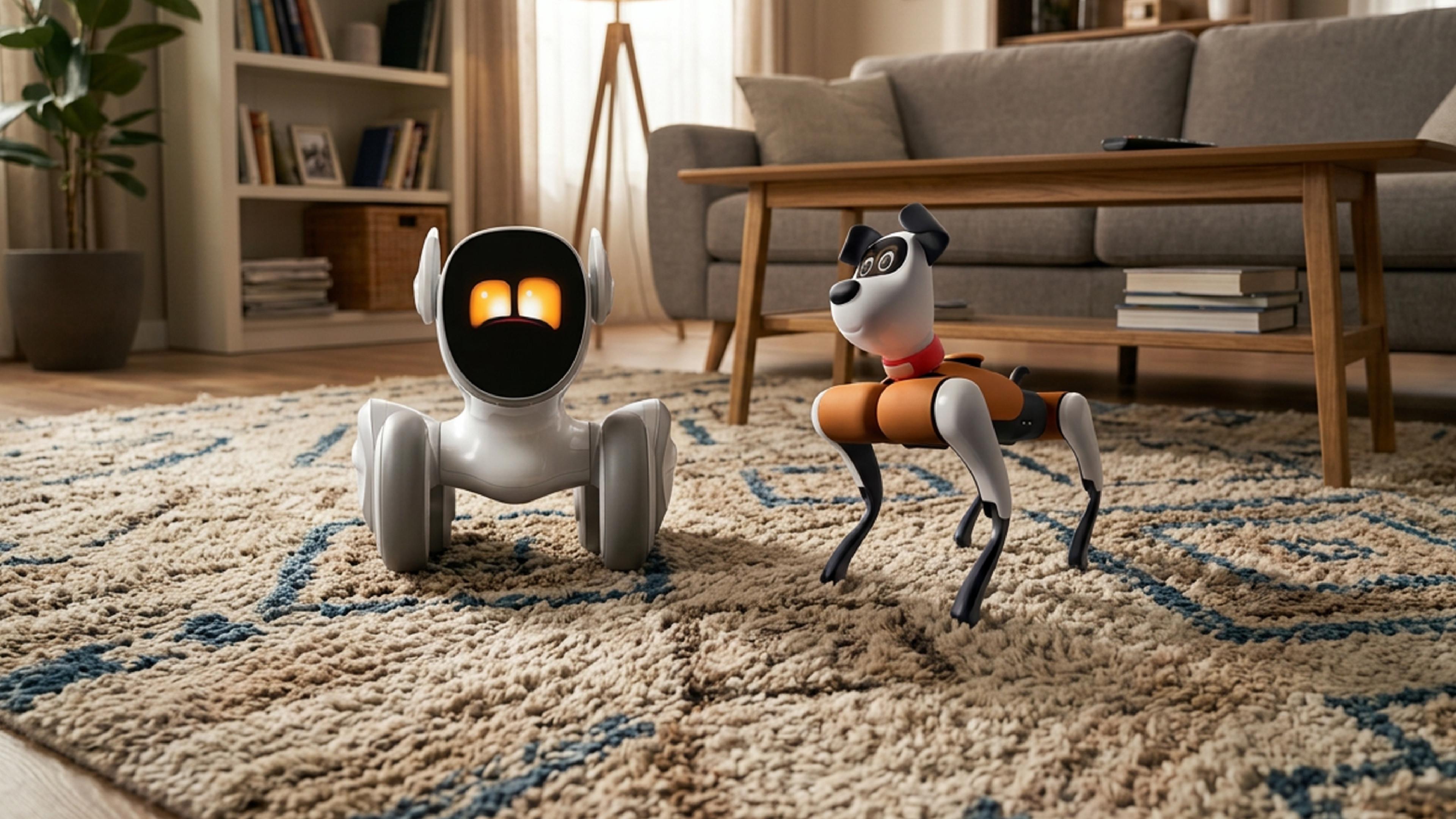
KEYi Tech Loona and WEILAN BabyAlpha A2 are commercially available companion robots designed for home interaction and educational activities. While Loona uses a four-wheel drive system, BabyAlpha A2 adopts a quadruped design. We compare their mobility, face recognition, cameras, mobile app support, connectivity and battery endurance to examine their suitability for different users.

November 11, 2026 by Business Desk Team
Introduction
Companion robots bring interactive robots into the houses, providing experiences of movement, vision and reaction. The main difference from the industrial robots developed for production purposes is that the companion robots are mainly aimed at interaction, entertainment and engagement with users.
Capabilities may be based on facial recognition, reaction to commands, indoor navigation and educational activity. Chinese companies KEYi Tech and WEILAN created robots Loona and BabyAlpha A2 for such uses. Loona is a wheeled small-sized robotic companion combining animated facial features and movement interaction.
BabyAlpha A2 has completely different design, featuring four-legged body of robotic companion, providing animal-like experience. It claims to be used in home assistance, education and elderly care. Both robots have face recognition, RGB camera, application for phone and Wi-Fi connectivity.
Mobility devices and operational endurance differ significantly between the two robots. This paper compares robots based on the data collected by ROBOT24.com market research company.
At A Glance
| Availability | Commercially Available | Commercially available |
|---|---|---|
| Face Recognition | Yes | Yes |
| Mobile App | Yes | Yes |
| Mobility | Four-Wheel Self-Balancing Drive | Quadruped |
| Mobility Type | Wheeled UGV | Quadruped |
| Nationality | Chinese | Chinese |
| RGB Camera | Yes | Yes |
| Runtime | Approximately 2–4 hours (usage dependent) | Approximately 60 minutes |
| Wi-Fi | Yes | Yes |
| Typical use | companionship, Education & Training, Home Assistance | Home Assistance, Education & Training, Elderly Care |
| Status | Commercial | Commercial |
How They Compare
Companionship and everyday interaction
KEYi Tech Loona and WEILAN BabyAlpha A2 offer different ways to use technology in the form of robotics, based on the physical nature of their designs. Loona focuses on mobility, expressions and interactions with people.
The robot's small wheeled body can move around indoor spaces and respond to people and the environment around it. This means that the device can be interesting for families that need an interactive robotic companion.
BabyAlpha A2 has a quadruped structure of a four-legged animal. The physical characteristics of the robot allow for a different way of interaction through movement and body positioning as part of the companionship process. While both robots can be interesting for those who enjoy interactive technologies, each of them is suitable depending on the user's preferences. Neither platform should be regarded as a replacement for human interaction.
Mobility and physical design
The most distinctive feature of the Loona and BabyAlpha A2 robots is their mobility systems. Loona is equipped with a four-wheel self-balancing drive and belongs to the category of wheeled unmanned ground vehicles.
BabyAlpha A2 is a quadruped robot that can move using its four articulated legs. Wheeled mobility is a convenient feature for navigating relatively smooth indoor environment surfaces. Due to Loona's design, it is possible for the robot to move in the home setting without having to use the coordinated movements of the legs like walking robots.
The quadruped design of BabyAlpha A2 offers a particular type of mobility that includes coordinated movements of its legs. It might be of interest to those users who are concerned about the animals-inspired robotics.
However, the quadruped design does not guarantee better terrain capabilities of the robot. No information on the speed and slopes overcoming is provided in the supplied records.
Movement and home navigation
Both robots are designed for interactive use in indoor environments. Loona's wheeled system may be suited to homes with relatively open floor areas and smooth surfaces. BabyAlpha A2's legged configuration introduces different movement characteristics.
For either robot, the ability to navigate a home depends on more than its drive system. Furniture placement, floor transitions, obstacles and available space can all influence movement. The supplied records do not establish whether the robots offer equivalent autonomous navigation, obstacle avoidance or mapping capabilities.Their mobility systems should therefore be evaluated according to the intended home environment.
Face recognition and user interaction
Both Loona and BabyAlpha A2 support face recognition according to the supplied comparison records. Face recognition can help a robot identify or distinguish people during supported interactions. For companion robots, this capability may contribute to a more personalized experience.
Loona's interactive design makes visual recognition relevant to its ability to respond to people.BabyAlpha A2 also includes face recognition among its recorded capabilities. However, the presence of face recognition does not establish identical recognition accuracy or functionality.
Performance may depend on lighting conditions, camera placement, software and the number of users supported. The supplied records do not specify recognition limits or whether the robots provide equivalent personalization features. Users should also review the manufacturers' privacy and data-handling policies when using camera-based recognition in the home.
RGB cameras and visual perception
Both robots are equipped with RGB cameras. RGB cameras capture color images and can provide visual information for supported recognition and interaction functions. For companion robots, cameras may be used to detect people, recognize objects or support interactive activities, depending on the software.
Loona's camera is part of its interactive robotic system. BabyAlpha A2 also has an RGB camera listed among its capabilities. However, the supplied records do not provide camera resolution, field of view or image-processing specifications.
It is therefore not possible to determine which robot has the more capable visual system based on the available information. The practical value of the camera depends on the software functions it supports.
Battery life and operational times
Operational life is among the most evident distinctions between the two robots. Loona has an average operational life that ranges from two to four hours. The BabyAlpha A2 has an average operational life that ranges from 60 minutes.
From the above statistics, Loona has a longer operational time. This could mean that Loona would be more useful in houses where people require longer sessions. For instance, the approximately one-hour operational time for BabyAlpha A2 might be better suited for shorter sessions. However, operational time can differ based on how active the robot is, its functions and periods when it is idle.
It is not clear whether the supplied information was gathered when both robots were subjected to similar situations. Also, charging time, battery life, and charging mechanisms have not been compared. All these need to be verified first.
Mobile app support
Both Loona and BabyAlpha A2 support mobile applications. Companion robot apps can provide an interface for compatible settings, controls and interactive functions.
Loona's mobile app support is relevant to its connected companion experience. BabyAlpha A2 also includes mobile app functionality in the supplied records. However, the presence of an app does not establish identical capabilities.
Available functions may include configuration, interaction controls or software-related features, depending on the platform. The supplied data does not specify which functions are available through each app. Users should confirm smartphone compatibility, supported operating systems and available controls before purchase.
Wi-Fi connectivity
Both robots support Wi-Fi connectivity. Wireless connectivity can support communication with compatible devices and connected services. For companion robots, it may also be relevant to software features and app-based interactions. However, Wi-Fi support does not automatically establish identical cloud functionality or remote-access capabilities.
The supplied records do not specify supported Wi-Fi standards, connectivity requirements or offline functionality. These details may be important for households that prefer devices with limited internet dependence. Users should confirm which features require an active internet connection.
Education and training applications
Both Loona and BabyAlpha A2 have education and training among their listed applications. Interactive robots can provide opportunities to introduce users to robotics concepts such as sensors, movement, recognition and automated behavior. Loona's wheeled design and expressive interactions may be useful for demonstrating how a robot responds to visual information and user input.
BabyAlpha A2's quadruped structure offers a different opportunity to observe coordinated robotic movement. Its legged configuration may be particularly interesting to users learning about robot locomotion.
However, the supplied records do not establish the availability of programming interfaces, educational curricula or developer tools. These features should be verified before selecting either robot for structured robotics education.
Home assistance capabilities
Home assistance appears among the recorded applications for both robots. However, the term can describe a wide range of functions.
For companion robots, home assistance may involve interaction, reminders, information or other software-supported activities. It should not automatically be interpreted as the ability to perform physical household chores.
The supplied records do not establish whether either robot can manipulate household objects, transport meaningful loads or carry out domestic tasks independently. Their home-assistance capabilities should therefore be assessed according to specific manufacturer-documented functions.
Elderly care applications
BabyAlpha A2 has elderly care included among its listed applications. Interactive companion robots may be considered for engagement and recreational activities involving older adults.
However, elderly care is a broad category that can involve significantly different levels of responsibility. The supplied records do not establish whether BabyAlpha A2 provides medical monitoring, emergency response, fall detection or other safety-critical functions.
Its elderly-care positioning should not be interpreted as evidence of clinical capability. Any use in a care environment should be evaluated against the specific needs of users and the robot's verified functions.
Loona's supplied application categories focus on companionship, education and home assistance rather than elderly care. This difference reflects their recorded positioning, not necessarily a complete account of every supported use case.
Commercial availability and ownership considerations
Both Loona and BabyAlpha A2 are listed as commercially available. Their commercial status makes them relevant to consumers and organizations considering interactive companion robots. However, availability may vary by region and product configuration. Potential buyers should consider charging requirements, replacement parts, technical support and software maintenance.
For connected companion robots, the availability of software updates and continued support for mobile applications may also influence long-term ownership. The supplied records do not provide directly comparable information about warranty coverage, repair arrangements or software-support periods. These details should be verified with the manufacturers.
Summary
KEYi Tech Loona and WEILAN BabyAlpha A2 are commercially available companion robots designed for home interaction and educational applications.
Loona may appeal to households seeking a compact wheeled robotic companion focused on playful interaction and engagement. Its four-wheel drive, face recognition, RGB camera and recorded runtime of approximately two to four hours provide a combination of mobility and interactive features.
BabyAlpha A2 offers a different experience through its quadruped design. Its four-legged mobility, face recognition and approximately 60-minute recorded runtime make it relevant to users interested in animal-like robotic interaction.
Both robots support mobile apps, Wi-Fi connectivity and camera-based recognition. Their listed applications overlap in home assistance and education, while BabyAlpha A2 also includes elderly care among its recorded uses.
The choice depends on whether users prefer wheeled or legged mobility, the desired interaction experience, operating endurance and the specific functions supported by each platform.
This comparison is based on ROBOT24.com market-research data records rather than controlled performance testing. Runtime, recognition capabilities, mobility performance and application-specific functions should be verified against current manufacturer documentation before drawing conclusions about overall performance.
More articles on this topic
144 articles ReportRichtech DUST-E S vs. Gausium Phantas
 ReportEngineAI SE01 vs. AGIBOT RAISE A1ReportRichtech DUST-E S vs. KEENON KLEENBOT C20
 ReportPUDU PuduBot 2 vs. OrionStar LuckiBot Pro
 ReportUnitree G1 vs. EngineAI PM01
 ReportKEENON DINERBOT T11 vs. PUDU KettyBot Pro
 ReportAGIBOT D1 Pro vs. Unitree Go2 Pro
 ReportPUDU BellaBot Pro vs. KEENON DINERBOT T11
 ReportBear Robotics Servi Plus vs PUDU BellaBot Pro
 ReportUnitree G1 vs. AGIBOT X2
 ReportPUDU KettyBot Pro vs. Bear Robotics Servi Q
 ReportUnitree GO2-W vs. MagicLab MagicDog-W
BUSINESS NEWS WEEKLY LETTER
The Weekly Letter for Robotics Professionals, Summarizing the Most Important Industry Moves, Launches, Deals and Signals.