Unitree G1 vs. AGIBOT X2
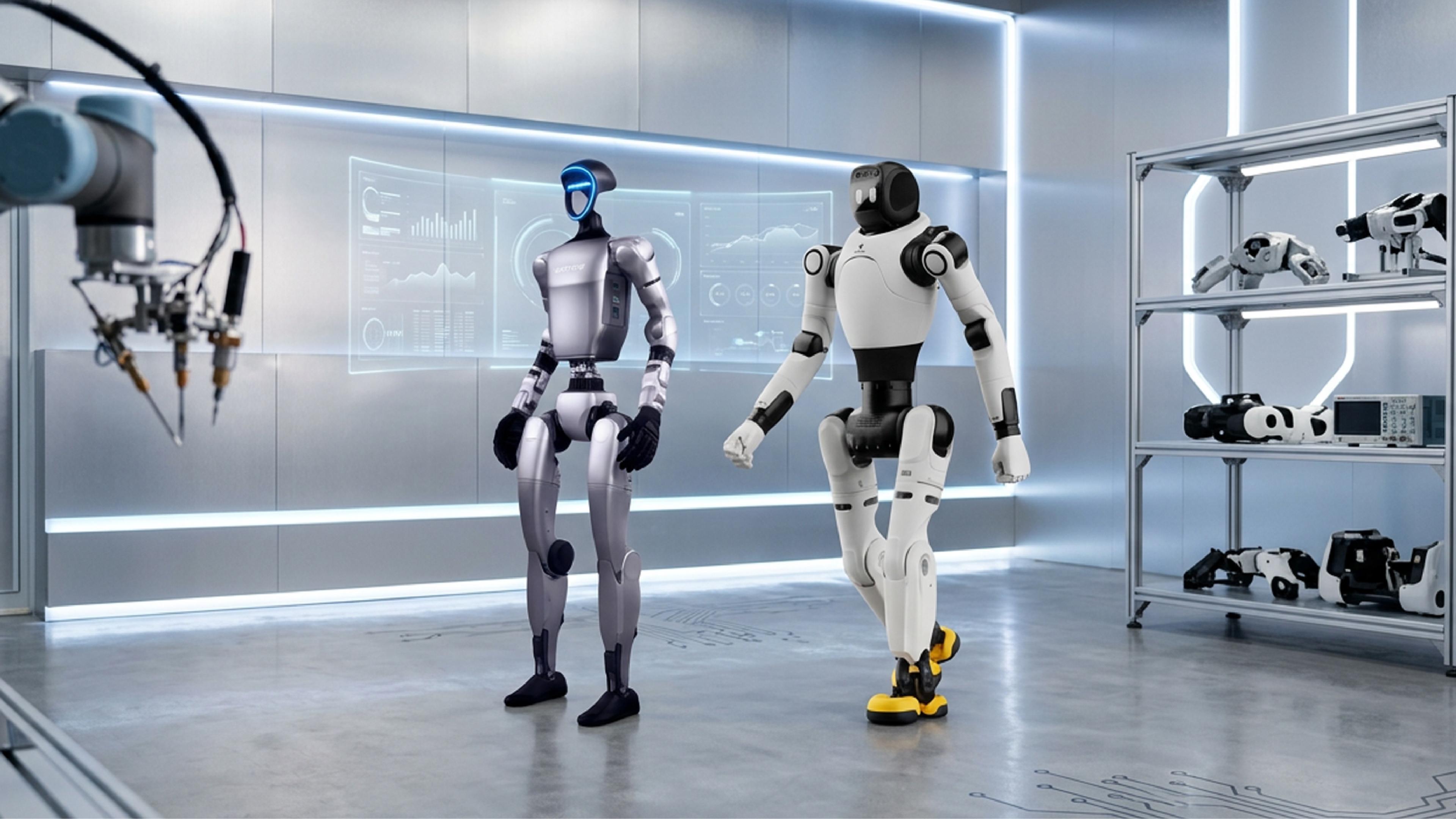
Unitree G1 and AGIBOT X2 are compact bipedal humanoid robots developed for research, education and embodied AI applications. We compare their physical dimensions, walking speeds, degrees of freedom, battery configurations and more

November 10, 2026 by Business Desk Team
Introduction
Compact humanoid robots are becoming increasingly relevant to universities, robotics laboratories and developers working on embodied artificial intelligence.
These platforms allow researchers to explore how robots walk, maintain balance, interact with their surroundings and perform coordinated movements. However, choosing the right humanoid involves more than comparing walking speed or the number of joints. Battery endurance, connectivity, software accessibility and hardware configurations can all influence how effectively a robot supports different projects.
Unitree G1 and AGIBOT X2 are two Chinese humanoid robots designed for bipedal movement and intelligent interaction. Unitree G1 is positioned for research, education and industrial AI development. Its configurable degrees of freedom, wireless connectivity and documented operating endurance make it relevant to organizations exploring humanoid robotics.
AGIBOT X2 focuses on education, training and research and development. Its compact design, articulated body and recorded walking speed make it relevant to developers studying humanoid locomotion and physical intelligence. Although both robots have similar heights and weights, their recorded specifications reveal differences in battery information, connectivity, articulation and operating endurance.
Based on ROBOT24.com market-research data records, this comparison examines their physical design, locomotion, degrees of freedom, connectivity and suitability for different research applications.
At A Glance
| Availability | Commercially Available | In production |
|---|---|---|
| Battery | 9000 mAh | Integrated |
| Connectivity | Wi-Fi 6, Bluetooth 5.2 | Bluetooth, Pro/Ultra optional 4G/5G module, Wi‑Fi |
| Degrees of Freedom | 23–43 | Estimated 40+ |
| Height | 127 cm | 130 cm |
| Locomotion | Bipedal | Walking |
| Microphone Array | Yes (EDU Versions) | Yes |
| Mobility Type | Humanoid | Bipedal Humanoid |
| Nationality | Chinese | China |
| OTA Updates | Supported | Supported |
| Runtime | ~2 Hours | Not Publicly Disclosed |
| Terrain Adaptation | Yes | Yes |
| Walking Speed | 2 m/s | 5.4 km/h |
| Weight | 35 kg | 35–37 kg depending on variant kg |
| Typical use | Research & Development, Education & Training, Industrial & AI Development | Education & Training, Research & Development |
| Status | Commercial | Commercial |
How They Compare
Research, education and development applications
Unitree G1 and AGIBOT X2 are designed for overlapping applications in humanoid robotics research and education. Unitree G1 is positioned for research and development, education and training, and industrial AI development. Its configurable hardware makes it relevant to developers exploring locomotion, manipulation and embodied intelligence. AGIBOT X2 is associated with education, training and research and development.
Its humanoid structure and walking capabilities may support experiments involving coordinated movement, human-robot interaction and robot control. Both platforms may be relevant to institutions studying how intelligent software can control physical robotic systems.
However, their suitability for a particular project depends on the available hardware configuration, programming interfaces and intended experiments. The listed applications do not establish that either robot can independently perform every task associated with those fields.
Physical dimensions and weight
Unitree G1 has a recorded height of 127 cm and weighs approximately 35 kg. AGIBOT X2 stands 130 cm tall and weighs approximately 35–37 kg, depending on the variant. X2 is therefore approximately 3 cm taller, while the two robots have broadly similar recorded weights.
Their compact dimensions may be relevant to laboratories and educational facilities where larger humanoids would require more operating space.However, similar height and weight do not necessarily indicate similar mechanical performance.
Joint configuration, actuator capabilities, weight distribution and structural design all influence how a humanoid moves. The exact X2 variant should also be confirmed when evaluating its physical specifications.
Walking speed and locomotion
Unitree G1 has a recorded walking speed of 2 m/s, equivalent to approximately 7.2 km/h. AGIBOT X2 has a recorded walking speed of 5.4 km/h, equivalent to approximately 1.5 m/s.
Based on these figures, G1 has the higher stated walking speed.This difference may be relevant to research involving humanoid locomotion, movement efficiency and dynamic control.
However, walking speed alone does not establish overall mobility performance. The ability to turn, recover balance, navigate obstacles and maintain stability during different movements also affects how effectively a humanoid operates.
The supplied records do not establish whether the walking-speed figures were measured under identical conditions. Direct testing would therefore be needed to compare sustained movement performance.
Degrees of freedom and articulation
Unitree G1 has a recorded range of 23–43 degrees of freedom, depending on its configuration. AGIBOT X2 has an estimated 40 or more degrees of freedom. Degrees of freedom describe the independently controllable movements available through a robot's joints. These may include articulation in the arms, legs, waist and hands, depending on the hardware configuration. G1's range reflects differences between available configurations.
X2's recorded figure suggests a relatively high level of articulation, although it is identified as an estimate rather than a confirmed configuration-specific specification. The figures should therefore not be treated as directly comparable without confirming how each manufacturer counts its joints.
A higher degree-of-freedom count does not automatically establish better movement or manipulation capabilities. Joint torque, range of motion, control precision and software also influence performance.
Terrain adaptation and movement control
Both Unitree G1 and AGIBOT X2 have terrain adaptation recorded among their capabilities. Terrain adaptation can involve adjusting movement and posture when encountering changes in the walking surface.
For bipedal humanoids, this requires coordination between the legs, joints and balance-control systems. G1's locomotion capabilities are relevant to research involving dynamic movement and stability. X2's walking and terrain-adaptation capabilities may support similar experiments involving humanoid mobility.
However, the supplied records do not specify directly comparable slope limits, obstacle-handling capabilities or terrain classifications.Terrain adaptation should not automatically be interpreted as the ability to navigate every type of uneven surface or outdoor environment. These capabilities should be evaluated through demonstrations conducted under the intended operating conditions.
Battery configuration
Unitree G1 has a recorded battery capacity of 9,000 mAh. AGIBOT X2 is listed as having an integrated battery. The supplied records therefore provide different types of battery information. G1's figure describes electrical charge capacity, while X2's entry identifies its battery configuration without specifying capacity. Battery capacity expressed in milliamp-hours cannot be converted into watt-hours without knowing the battery's nominal voltage.
As a result, the available information does not support a direct comparison of battery energy capacity. Developers should confirm charging requirements, battery accessibility and replacement procedures for the exact configurations being considered.
Operating endurance and runtime
Unitree G1 has a recorded operating runtime of approximately two hours. AGIBOT X2's runtime is not publicly disclosed in the supplied comparison records. This means the available data does not support a direct comparison of operating endurance. G1's stated runtime may be relevant to educational demonstrations, research sessions and development activities.
However, actual battery endurance can vary depending on movement intensity, computing workload, joint activity and periods of inactivity. The absence of a published X2 runtime should not be interpreted as evidence of shorter or longer operating endurance. Organizations should request workload-specific runtime information before selecting either platform.
Wireless connectivity
Both robots support wireless connectivity, although their recorded configurations differ. Unitree G1 supports Wi-Fi 6 and Bluetooth 5.2. AGIBOT X2 supports Wi-Fi and Bluetooth, with optional 4G/5G connectivity modules listed for Pro and Ultra variants. Wi-Fi connectivity may support communication with development systems, data transfer and connected applications.
Bluetooth may be relevant to local device connections and compatible peripherals. The optional cellular connectivity listed for X2 may provide additional communication options in configurations where the module is installed.
However, connectivity specifications alone do not establish differences in software accessibility or remote-control capabilities. Developers should verify supported communication protocols and configuration-specific connectivity features.
Microphone arrays and interaction
Both robots have microphone arrays recorded among their capabilities. For Unitree G1, the supplied records specify microphone-array support in EDU versions. AGIBOT X2 has a microphone array listed without a variant restriction in the supplied table.
Microphone arrays can support audio capture and may be used in applications involving voice interaction or sound processing. These capabilities may be relevant to educational demonstrations and research into human-robot interaction. However, the presence of a microphone array does not establish identical speech-recognition performance.
Microphone placement, audio processing, software and environmental noise can all influence the quality of interaction. The exact supported functions should be confirmed for each robot configuration.
OTA updates and software maintenance
Both Unitree G1 and AGIBOT X2 support over-the-air updates according to the supplied records. OTA updates can allow manufacturers to distribute software improvements without requiring every update to be installed manually.
For research and development platforms, software updates may introduce changes to robot functions, system stability or supported capabilities. However, OTA support does not necessarily establish identical update policies or access to development tools.
The supplied records do not provide directly comparable information about SDKs, APIs, operating systems or low-level actuator access. Organizations should confirm how software updates are managed and whether they affect custom development environments.
Industrial AI and educational applications
Unitree G1 has industrial and AI development among its listed applications, alongside research and education. This makes it relevant to developers investigating how humanoid robots can perform physical tasks in structured environments.
AGIBOT X2 is positioned primarily for education, training and research and development in the supplied records. Its compact humanoid form may support experiments involving locomotion, interaction and intelligent movement. However, these application categories should not be confused with independently verified task performance.
The ability to carry out a particular industrial or educational activity depends on the robot's software, hardware configuration and level of autonomy. Task-specific demonstrations and development documentation are important when evaluating either platform.
Commercial availability and configurations
Unitree G1 is recorded as commercially available. AGIBOT X2 is listed as being in production. Both robots have commercial status in the supplied records. However, production status and commercial availability describe different aspects of product maturity.
A robot may be in production without every configuration being immediately available for purchase. Similarly, a commercially available platform may have different ordering arrangements for standard and developer-oriented configurations.
Organizations should confirm current pricing, delivery schedules, software access and technical support for the exact models being considered. For G1, this includes distinguishing standard and EDU configurations. For X2, it includes confirming the specifications and availability of its different variants.
Summary
Unitree G1 and AGIBOT X2 are compact bipedal humanoid robots designed for research, education and embodied AI development. Unitree G1 is worth considering for developers seeking a commercially available humanoid platform with configurable articulation and documented wireless connectivity. Its recorded walking speed of 2 m/s, approximately two-hour runtime and 23–43 degrees of freedom across configurations provide a range of specifications relevant to research applications.
AGIBOT X2 may appeal to developers exploring humanoid locomotion, education and human-robot interaction. Its recorded height of 130 cm, weight of 35–37 kg and estimated 40 or more degrees of freedom reflect a different hardware profile. Both robots support terrain adaptation, microphone arrays, wireless connectivity and OTA updates, subject to their respective configurations.
The choice depends on the intended research application, required articulation, movement capabilities, operating endurance and access to development tools. This comparison is based on ROBOT24.com market-research data records rather than controlled performance testing. Walking speed, degrees of freedom, runtime, connectivity and commercial availability should be verified against configuration-specific manufacturer documentation before drawing conclusions about overall performance.
More articles on this topic
144 articles ReportRichtech DUST-E S vs. Gausium Phantas
 ReportEngineAI SE01 vs. AGIBOT RAISE A1ReportRichtech DUST-E S vs. KEENON KLEENBOT C20
 ReportPUDU PuduBot 2 vs. OrionStar LuckiBot Pro
 ReportUnitree G1 vs. EngineAI PM01
 ReportKEENON DINERBOT T11 vs. PUDU KettyBot Pro
 ReportAGIBOT D1 Pro vs. Unitree Go2 Pro
 ReportKEYi Tech Loona vs. WEILAN BabyAlpha A2
 ReportPUDU BellaBot Pro vs. KEENON DINERBOT T11
 ReportBear Robotics Servi Plus vs PUDU BellaBot Pro
 ReportUnitree G1 vs. AGIBOT X2
 ReportPUDU KettyBot Pro vs. Bear Robotics Servi Q
BUSINESS NEWS WEEKLY LETTER
The Weekly Letter for Robotics Professionals, Summarizing the Most Important Industry Moves, Launches, Deals and Signals.