PUDU KettyBot Pro vs. Bear Robotics Servi Q
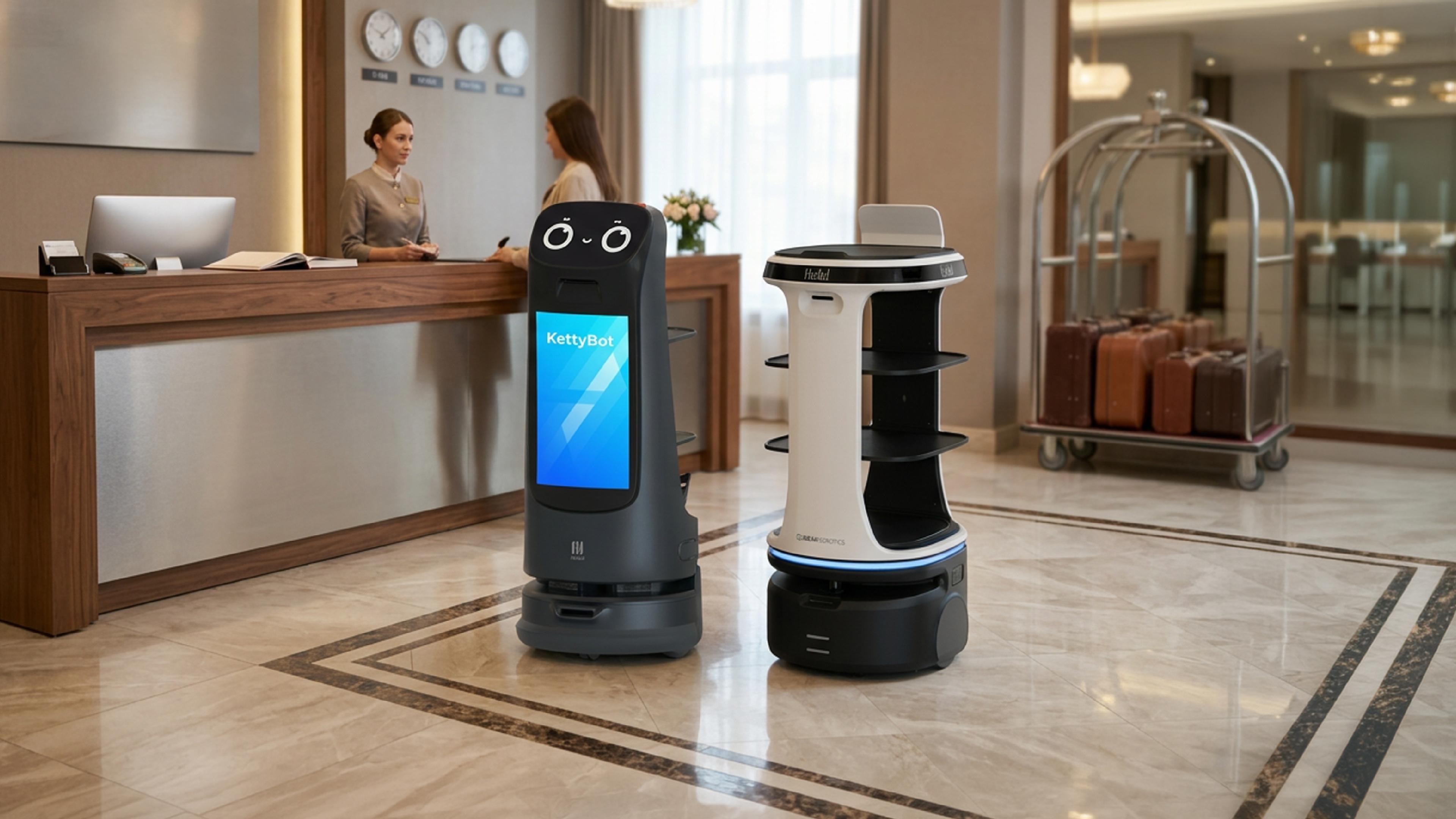
PUDU KettyBot Pro and Bear Robotics Servi Q are both autonomous restaurant delivery and service robots compared here on mobility, passage clearance, advertising displays, navigation and obstacle detection, fleet coordination and operating endurance.

November 11, 2026 by Business Desk Team
Introduction
PUDU KettyBot Pro and Bear Robotics Servi Q are compared for restaurant delivery and front-of-house service. Both are commercial robotic mobile platforms for food service from different vendors with distinct focal points.
KettyBot Pro has a consumer facing app, delivery restaurant app, and a large advertising display, alongside a claimed top speed of 1.2 m/sec. Bear Robotics Servi Q has a narrower claimed passage requirement of 450 mm, no consumer-facing app, and a noted runtime of greater than 12 hours. How these impact the layout and service model of the restaurant is important.
At a Glance
| Metric | PUDU KettyBot Pro | Bear Robotics Servi Q |
|---|---|---|
| Robot type | Autonomous restaurant delivery and advertising AMR | Autonomous restaurant delivery AMR |
| Best-fit use cases | Food delivery, front-of-house service and promotional display | Meal delivery and restaurant logistics |
| Display | Large advertising touchscreen | 18.5-inch advertising display |
| Charging time | Approximately 4 h | Under 4 h (Robot24 record) |
| Runtime | Up to 8 h | At least 12 h |
| Maximum speed | 1.2 m/s | 0.7 m/s |
| Minimum passage width | Approximately 60 cm | 450 mm (18 in) |
| Obstacle detection | Supported; sensor details not specified in supplied record | Supported; sensor details not specified in supplied record |
| Fleet / cloud management | Supported | Supported |
| Multi-robot coordination | Supported | Supported |
| Connectivity | Wi-Fi | Wi-Fi |
| Nationality | Chinese | American |
| Commercial status | Commercial | Commercial |
| Key distinction | Higher listed maximum speed and integrated advertising touchscreen | Narrower stated passage requirement and longer listed runtime |
| Key limitation / caveat | Up to 8 h runtime; actual endurance depends on operating conditions | Charging-time and runtime figures require confirmation against the exact configuration |
How They Compare
Operational role and customer engagement: PUDU Ketty Bot Pro is an autonomous food delivery robot that adds a touchscreen advertising display, providing restaurants an extra channel for promotional content. Bear Robotics Servi Q also offers an advertising display, listed as 18.5 inches. Both can be used for customer-facing applications, but the content-management capabilities of the display, as well as its orientation, brightness and software, should be evaluated during a demo.
Mobility and passage clearance: The maximum speed for KettyBot Pro is specified as 1.2 m/sec, while for Servi Q it is 0.7 m/sec. These are top speeds, not necessarily indicative of speed in a congested restaurant setting. Minimum passage width for Servi Q is specified as 450 mm, compared with around 600 mm for KettyBot Pro. Servi Q may be relevant if tighter layouts are needed, although check overall size, turning clearance and approach space requirements. Passage width figures to be checked against manufacturer measurement conditions.
Runtime and charging: KettyBot Pro is listed as up to 8 hours runtime, around 4 hours charging. Servi Q is listed as at least 12 hours runtime, under 4 hours charging. In the simulator and based on a range of inputs, Servi Q appears to offer a longer operating time but there may not be a like for like comparison based on test conditions and real-life usage for each robot. Payload, traffic and battery charge history are factors.
Navigation and fleet coordination: Both robots are enumerated for obstacle detection, cloud management, fleet management and multi-robot coordination. These features can enable coordinated service within a restaurant, but the provided specs do not specify which sensor arrays or navigation architecture is used, how many robots can be in the fleet, or what software integrations are required. Verify multi-robot coordination is supported with mixed fleets.
Connectivity and deployment: Wi-Fi connectivity and commercial availability are common features across the models. Prior to deployment, check wireless coverage over the entire service area, how the robot will integrate with restaurant workflows, location of charging stations, and ability to steer around guests, staff, chairs and temporary obstructions.
Important Qualification
The provided logs do not include information on payload capacity, trays configuration, size, sensor configurations, the operating envelope or the used navigation architecture to determine runtime. These should be verified against the real models and commercial configuration.
The Servi Q charge time of under 4 hours should be considered a supplied-record claim until confirmed with up-to-date manufacturer documentation. Likewise, maximum speed and advertised runtime should not be seen as guaranteed performance across a fully load restaurant operation.
Summary
Choose PUDU KettyBot Pro when service environment corresponds to listed higher maximum speed, built-in advertising touchscreen and restaurant delivery features.
Consider Bear Robotics Servi Q when you need narrower passage access, a larger specified advertising display and longer listed operating endurance are your priorities to the workflow.
This comparison is based on ROBOT24.com market-research data records and manufacturer-reported specifications rather than controlled performance testing.
More articles on this topic
144 articles ReportRichtech DUST-E S vs. Gausium Phantas
 ReportEngineAI SE01 vs. AGIBOT RAISE A1ReportRichtech DUST-E S vs. KEENON KLEENBOT C20
 ReportPUDU PuduBot 2 vs. OrionStar LuckiBot Pro
 ReportUnitree G1 vs. EngineAI PM01
 ReportKEENON DINERBOT T11 vs. PUDU KettyBot Pro
 ReportAGIBOT D1 Pro vs. Unitree Go2 Pro
 ReportKEYi Tech Loona vs. WEILAN BabyAlpha A2
 ReportPUDU BellaBot Pro vs. KEENON DINERBOT T11
 ReportBear Robotics Servi Plus vs PUDU BellaBot Pro
 ReportUnitree G1 vs. AGIBOT X2
 ReportUnitree GO2-W vs. MagicLab MagicDog-W
BUSINESS NEWS WEEKLY LETTER
The Weekly Letter for Robotics Professionals, Summarizing the Most Important Industry Moves, Launches, Deals and Signals.