KEENON DINERBOT T11 vs. PUDU KettyBot Pro
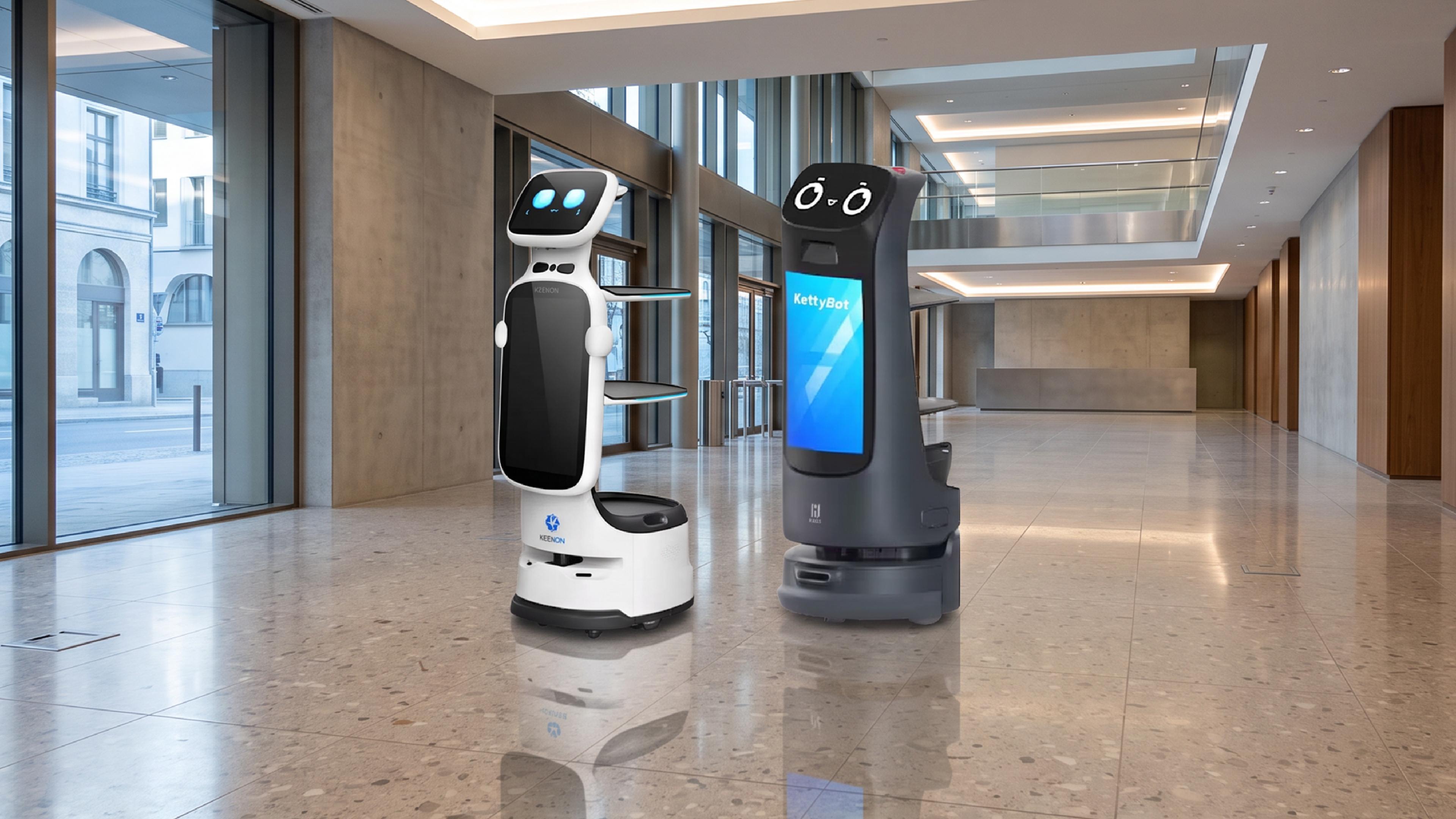
KEENON DINERBOT T11 and PUDU KettyBot Pro are both autonomous indoor delivery and service robots compared here on mobility, passage clearance, navigation and sensing, multi-robot coordination, operating speed and battery endurance.

November 12, 2026 by Business Desk Team
Introduction
KEENON DINERBOT T11 and PUDU KettyBot Pro are intelligent indoor service robots that is built for commercial use with material delivery and mobile assistance. It's not about headline speed, but the right pace for your environment and your process.
DINERBOT T11 has retail, showroom and healthcare applications with up to 20 robot management. KettyBot Pro is targeted at food service and features an autonomous delivery coupled with a mobile advertising display. The key distinctions are about application, passage clearance, speed, recharge time and listed endurance.
At a Glance
| Metric | KEENON DINERBOT T11 | PUDU KettyBot Pro |
|---|---|---|
| Robot type | Autonomous indoor service robot | Autonomous delivery and advertising robot |
| Best-fit use cases | Retail, showroom and healthcare operations | Food-service delivery and restaurant operations |
| Charging time | Approximately 5.5 h | Approximately 4 h |
| Runtime | Approximately 10–13.5 h | Up to 8 h |
| Maximum speed | 1.0 m/s | 1.2 m/s |
| Minimum passage width | 49 cm | Approximately 60 cm |
| Navigation / sensing | LiDAR | LiDAR |
| Fleet coordination | Up to 20 robots | Multi-robot coordination supported |
| Connectivity / updates | Wi-Fi; OTA updates | Wi-Fi; OTA updates |
| Key limitation / caveat | Healthcare suitability and deployment requirements need verification | Listed runtime is up to 8 hours; operating conditions are not specified |
How They Compare
Operationale role: KEENON DINERBOT T11 is listed for retail, showroom and healthcare workflows so applicable to potential places that rely on indoor delivery and service support. PUDU KettyBot Pro is focused on food service, with delivery functionality and an advertising-oriented design. The two robots have quite different intended environments so should be selected based on use case and payload requirements.
Mobility and passage clearance: As indicated in this table, at a minimum, the DINERBOT T11 requires roughly 10 cm less clearance through a doorway compared to the KettyBot Pro. The maximum forward speed of KettyBot Pro is also listed higher at 1.2 m/s, versus T11's 1.0 m/s. Again, these metrics should be tested in the real-world environment as turning, doors, pedestrians, and obstacle avoidance will impact actual mobility.
Navigation and fleet coordination: all the robots featured LiDAR and multi-robot coordination. DINERBOT T11 has capacity for 20 robots (average of 1.02 robots per customer), but volumes are not specified in the KettyBot Pro record which only says "Multi-robot" in the specs, for listing purposes. The T11 therefore has the more specific fleet-capacity figure in the supplied data. Confirm whether fleet management, traffic scheduling and integration with existing systems are included in the ordered configuration.
Hardware and endurance: DINERBOT T11 mentions the run time of around 10-13.5 hours and a charge time of 5.5 hours. KettyBot Pro mentions a run time of up to 8 hours and 4 hours to charge T11 has the higher stated maximum run time, while the KettyBot Pro has the shorter cited maximum charge time. Actual endurance will vary depending on workload and route.
Connectivity and Software: Both models have Wi-Fi and over-the-air software updates. These features support connected operation and remote software updates, but the supplied specifications do not verify details of cloud management, remote diagnostics, third-party integrations or software subscription needs.
Important Qualification
KEENON DINERBOT T11: Record provided states it has been used in healthcare, but that does not prove that it's fit to deliver in the clinical setting, or requirements for infection-control or regulated medical setting. Its list of 20-robot built-in orchestration number must also be validated for that software and deployment configuration.
PUDU KettyBot Pro: The enumerated runtime is 8 hours. It must not be cited as a assured working duration while operating under process need load and conditions.
Both models: Payload, size, weight, battery data, detailed obstacle-detection systems and environment operating limits are not part of the comparison data provided. Having the presence of LiDAR alone does not constitute matching navigation performance or safety capability.
Summary
Select KEENON DINERBOT T11, if narrower passage clearance, a longer listed runtime and an indicated coordination for up to 20 robots are a more suitable match. Consider PUDU KettyBot Pro, if food-service delivery, a higher listed maximum speed and a shorter charging time are more appropriate to your workflow.
DINERBOT T11 exhibits a greater rated endurance and fewer inches of passage requirement, while KettyBot Pro has a higher available max speed and is more quickly recharge at a given rate. This is a fit-for-purpose comparison, not a performance test. Verify specific configurations, payload capacity, fleet management features and real-world runtime, and conduct an in-person demo before claiming superiority.
This comparison is based on ROBOT24.com market-research data records and manufacturer-reported specifications rather than controlled performance testing.
More articles on this topic
144 articles ReportRichtech DUST-E S vs. Gausium Phantas
 ReportEngineAI SE01 vs. AGIBOT RAISE A1ReportRichtech DUST-E S vs. KEENON KLEENBOT C20
 ReportPUDU PuduBot 2 vs. OrionStar LuckiBot Pro
 ReportUnitree G1 vs. EngineAI PM01
 ReportAGIBOT D1 Pro vs. Unitree Go2 Pro
 ReportKEYi Tech Loona vs. WEILAN BabyAlpha A2
 ReportPUDU BellaBot Pro vs. KEENON DINERBOT T11
 ReportBear Robotics Servi Plus vs PUDU BellaBot Pro
 ReportUnitree G1 vs. AGIBOT X2
 ReportPUDU KettyBot Pro vs. Bear Robotics Servi Q
 ReportUnitree GO2-W vs. MagicLab MagicDog-W
BUSINESS NEWS WEEKLY LETTER
The Weekly Letter for Robotics Professionals, Summarizing the Most Important Industry Moves, Launches, Deals and Signals.