Unitree H2 vs. EngineAI SE01
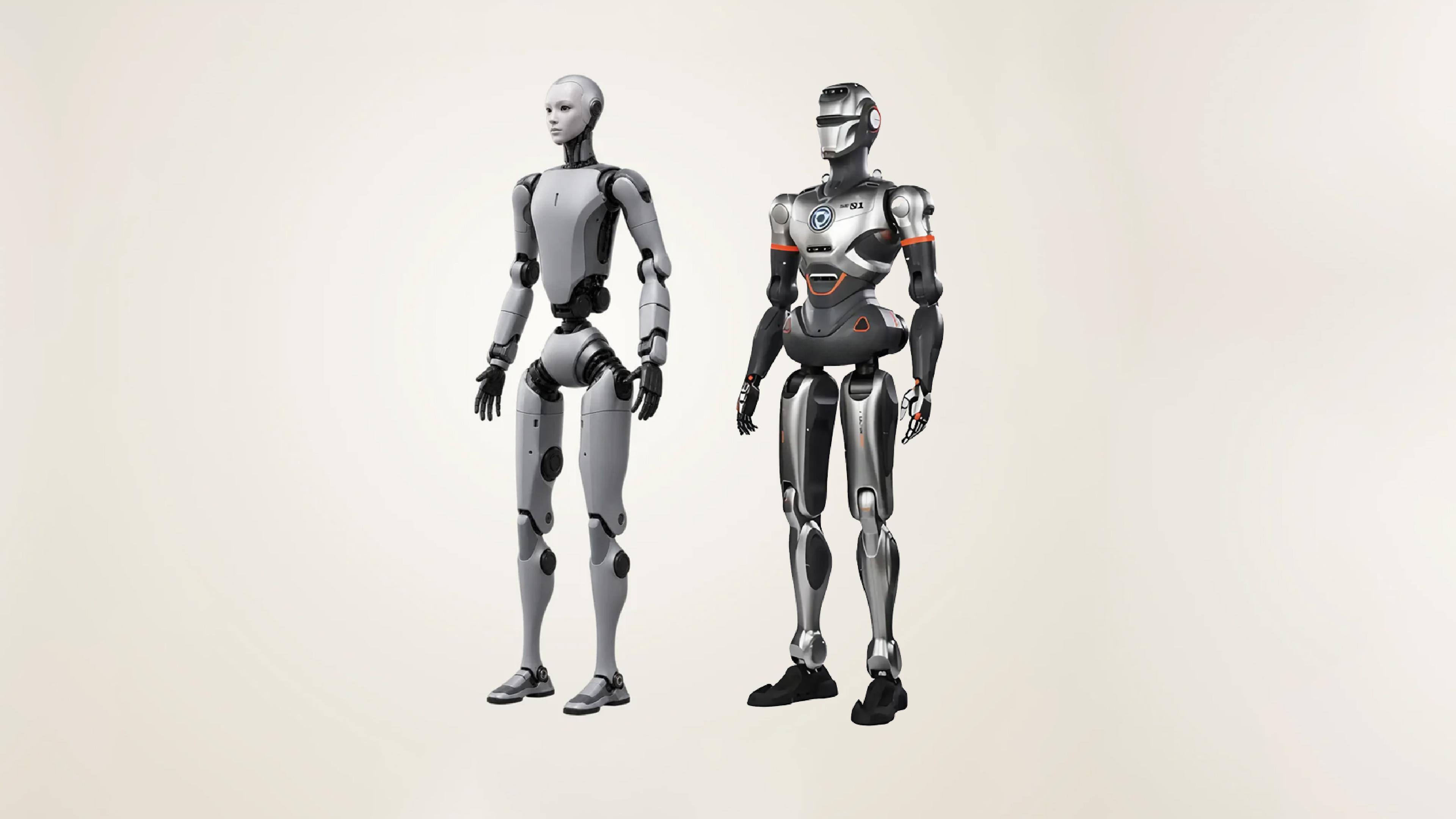
Unitree H2 and EngineAI SE01 are both full-size bipedal humanoid robots compared here on locomotion, dynamic balance, joint articulation, physical configuration, battery systems and industrial deployment capabilities.

November 10, 2026 by Business Desk Team
Introduction
Unitree H2 and EngineAI SE01 are scaled biped humanoid robots for industrial applications, research and development, and advanced training purposes. Both units are off-the-shelf options with active balancing, autonomous navigation, use of IMU sensor, and software update support.
The main differences in the supplied specifications concern physical dimensions, weight and joint configuration. Unitree H2 stands at 180 cm and weighs approximately 70 kg, with 31 degrees of freedom. EngineAI SE01 is listed at 170 cm and 55 kg, with 32 degrees of freedom. These differences affect deployment considerations, but degrees of freedom and body weight alone do not establish manipulation capability or real-world task performance.
At a Glance
| Metric | Unitree H2 | EngineAI SE01 |
|---|---|---|
| Robot type | Full-size bipedal humanoid robot | Full-size bipedal humanoid robot |
| Best-fit use cases | Industrial and AI development, research, education and training | Manufacturing and industrial operations, research, education and training |
| Height | 180 cm | 170 cm |
| Weight | Approximately 70 kg | 55 kg |
| Degrees of freedom | 31 DOF | 32 DOF |
| Mobility | Bipedal locomotion with dynamic balance | Bipedal locomotion with dynamic balance |
| Autonomous navigation | Supported (supplied record) | Supported (supplied record) |
| IMU | Supported | Supported |
| Battery | Quick-release smart battery | Quick-release lithium-ion battery |
| OTA updates | Supported | Supported |
| Connectivity | Wi-Fi | Wi-Fi |
| Availability | Commercially available | Commercially available |
| Nationality | Chinese | Chinese |
| Commercial status | Commercial | Commercial |
| Key distinction | Taller platform with a quick-release smart battery | Lighter platform with one additional listed degree of freedom |
| Key limitation / caveat | Battery endurance and task-specific payload require confirmation | Navigation, manipulation and battery-performance details require confirmation |
How They Compare
Physical configuration and deployment: Unitree H2 is listed at 180 cm tall, 70 kg weight, while EngineAI SE01 170 cm tall and 55 kg in weight. SE01 is thus 15 kg lighter, 10 cm shorter, in the supplied data. This could affect transport, setup, access to working space and handling of units for repair or maintenance. Note that platform mass alone is not indicative of stability, strength or gait.
Degrees of freedom and articulation: H2 has 31 degrees of freedom, 1 less than SE01, which has 32 DOF. Although greater articulation may be indicative of another joint or articulation axis independent of others, the measure does not inherently imply greater manipulability than other devices. What joints are articulations, their spatial relationships and their number do not necessarily dictate manipulability.
Locomotion and dynamic balance: Each robot is described as a bipedal humanoid with dynamic-balance and autonomous navigation. Such abilities have clear significance to the task of mobility in human-centric surroundings, such as industrial settings and laboratory environments. The specifications give no clue to walking speed or ability to negotiate stairs, slopes, or recover from obstructions; performance on representative floor surfaces and task environments should be considered.
Battery and maintenance: Unitree H2 features a quick-release smart battery, while SE01 is listed with a quick-release lithium-ion battery. In each case, the battery is removable but the available specifications do not confirm if the battery is hot-swap capable, how long each battery can run, or how long it takes to charge the batteries. Look for this data to compare shift endurance and maintenance times.
Software, sensing and connectivity: IMU functionality, autonomous navigation, OTA software updates and Wi-Fi connectivity are listed on both profiles. The following technologies suggest functionality but are not listed explicitly in the records provided: sensor types, onboard computing infrastructure, development environment, remote-control interface and fleet-management tools. These features will need to be verified if they are to be used in the research or in an industrial setting.
Application and deployment focus: Unitree H2 is designed for industrial & AI development and research, education and training. EngineAI SE01 is for manufacturing and industrial operations, research, education and training. While the use cases suggest areas of overlap for deployment, they do not imply that these products are ready for deployment into a specific production task. Demonstrations should be able to address repeatability of tasks, manipulating precision, safety in operation, and integration with existing equipment.
Important Qualification
These documents do not verify the maximum joint torque, arm payload, hand dexterity, walking speed, battery capacity, run-time, charge time, sensor range, computing power or environmental protection ratings. Such specs are crucial to assess the industrial robustness.
The one-DOF discrepancy is not a definitive indicator of better articulation or manipulation. Safety certification, emergency-stop behaviour, force limits and verified operating procedures still need to be checked individually. Dynamic balance and autonomous navigation alone do not ensure safe collaborative work in the proximity of human workers.
Summary
Select Unitree H2 for higher humanoid platform, quick-release smart battery and its positioning as a significant player in industrial and AI development matches the desired research or application purpose.
Consider EngineAI SE01 should a lower, more compact platform plus listed manufacturing and industrial application emphasis align more closely with the work environment and working requirements.
This is a suitability comparison, not a performance-controlled ranking. Specify joint-level specifications, manipulation payload, locomotion capability, battery life, sensors and safety features for the precise commercial models. Arranged for task-specific demonstration prior to purchase or public propagation of operational superiority.
This comparison is based on ROBOT24.com market-research data records and manufacturer-reported specifications rather than controlled performance testing.
More articles on this topic
144 articles ReportRichtech DUST-E S vs. Gausium Phantas
 ReportEngineAI SE01 vs. AGIBOT RAISE A1ReportRichtech DUST-E S vs. KEENON KLEENBOT C20
 ReportPUDU PuduBot 2 vs. OrionStar LuckiBot Pro
 ReportUnitree G1 vs. EngineAI PM01
 ReportKEENON DINERBOT T11 vs. PUDU KettyBot Pro
 ReportAGIBOT D1 Pro vs. Unitree Go2 Pro
 ReportKEYi Tech Loona vs. WEILAN BabyAlpha A2
 ReportPUDU BellaBot Pro vs. KEENON DINERBOT T11
 ReportBear Robotics Servi Plus vs PUDU BellaBot Pro
 ReportUnitree G1 vs. AGIBOT X2
 ReportPUDU KettyBot Pro vs. Bear Robotics Servi Q
BUSINESS NEWS WEEKLY LETTER
The Weekly Letter for Robotics Professionals, Summarizing the Most Important Industry Moves, Launches, Deals and Signals.