Unitree GO2-W vs. MagicLab MagicDog-W
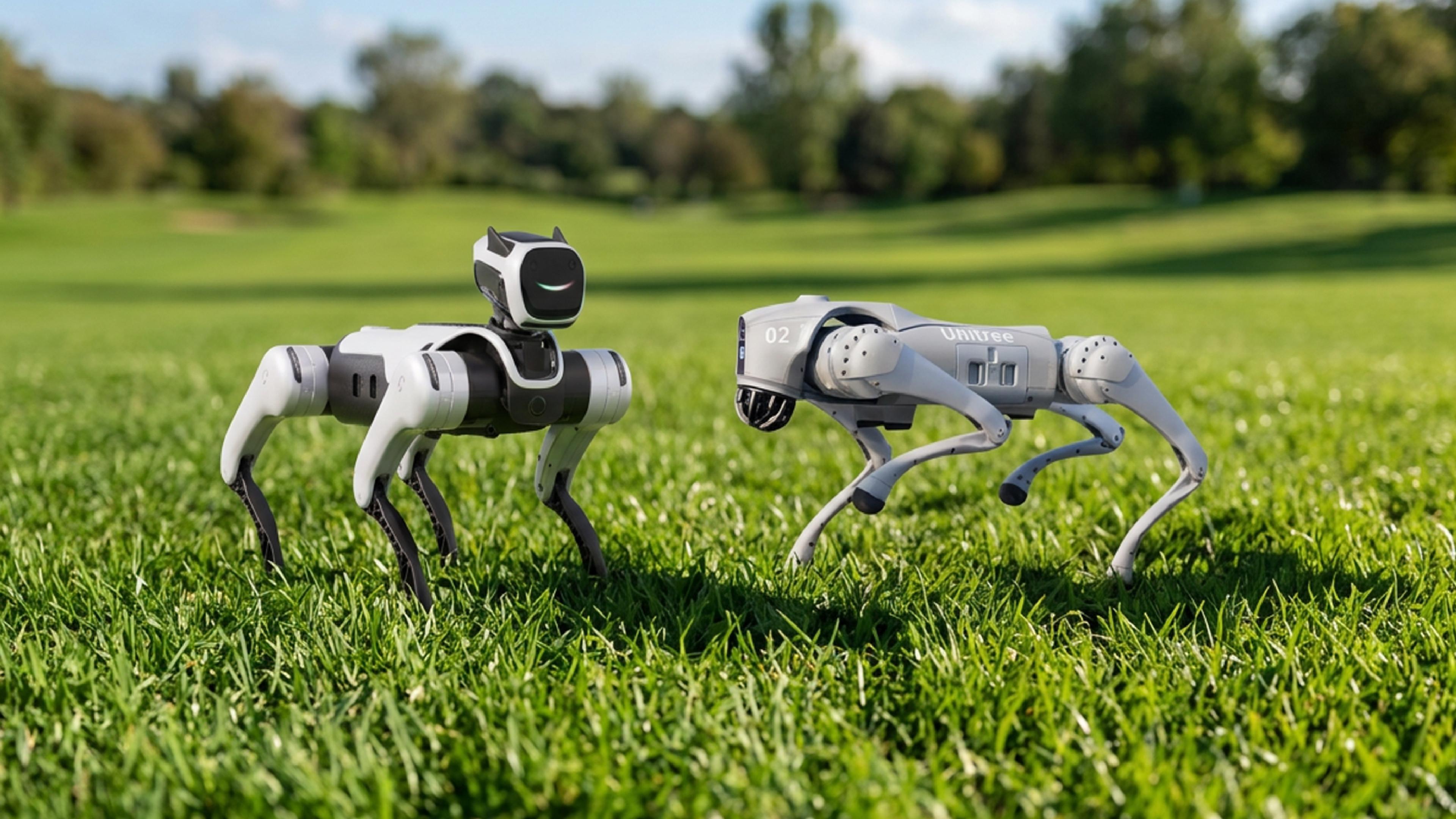
Unitree GO2-W and MagicLab MagicDog-W are both industrial and research quadruped robots compared here on locomotion, payload capacity, joint torque, operating endurance, software updates and deployment versatility.

November 11, 2026 by Business Desk Team
Introduction
Unitree GO2-W and MagicLab MagicDog-W are compared for research and development, industrial operations, manufacturing and security-related applications. Both are commercially available quadruped robots designed for mobile operation across environments where conventional wheeled platforms may face mobility constraints.
The supplied specs separate the two models primarily in payload, weight and joint torque. GO2-W is listed as 18kg at approximately 8kg payload and a maximum payload figure of approximately 12kg. MagicDog-W is heavier at 22.5kg and lists a 10kg payload. The practical choice is whether your payload and endurance requirements are worth the platform weight and mechanical build differences.
At a Glance
| Metric | Unitree GO2-W | MagicLab MagicDog-W |
|---|---|---|
| Robot type | Wheeled-legged quadruped robot | Wheeled-legged quadruped robot |
| Best-fit use cases | Research, industrial operations, manufacturing and security | Research, industrial operations, manufacturing and security |
| Weight | Approximately 18 kg | 22.5 kg |
| Payload | Approximately 8 kg; maximum approximately 12 kg | 10 kg |
| Maximum joint torque | Approximately 45 N·m | 37.5 N·m |
| Runtime | Approximately 1.5–4 h, depending on configuration and workload | 2–4 h |
| OTA updates | Supported | Supported |
| Availability | Commercially available | Commercially available |
| Nationality | Chinese | Chinese |
| Key distinction | Lower listed platform weight and higher stated maximum joint torque | Higher listed payload and longer stated minimum runtime |
| Key limitation / caveat | Payload and runtime depend on configuration and operating conditions | Payload rating and runtime conditions require manufacturer verification |
How They Compare
Platform configuration and mobility: Both models fall into the traditional wheeled-legged quadruped class, which adds the ability to roll from legged mobility. This is designed to enable mobility in different environments. However, the provided logs do not include wheel speed, walking speed, terrain constraints, obstacle height, maximum slope or handling of switching between modes. Such data is useful for assessing their abilities to operate on factory floor, outdoor walkways and rough terrain.
Payload and mechanical capability: Unitree GO2-W is approximately 8 kg & 12 kg (max) respectively, while MagicLab MagicDog-W states 10kg payload. Unitree GO2-W also states approximately 45 Nm maximum joint torque compared with 37.5 Nm for MagicDog-W. Note that joint torque and payload (mechanical load capacity) are not equivalent engineering metrics and a higher joint torque does not necessarily imply an increase in manageable loads and loads can be impacted by the location of the load (centre of gravity), walking speed and operating conditions etc.
Weight and deployment: GO2-W weighs about 18 kg, versus 22.5 kg for MagicDog-W. The overall weight of the platform can be a factor in transport, handling and deployment considerations, but does not alone indicate a platform's ease of mobility or stability. The entire platform with batteries, sensors and mounted equipment should be compared to understanding of transport requirements and available payload.
Runtime and operating endurance: GO2-W is shown to have a listed runtime of 1.5-4 hours depending on configuration and workload. MagicDog-W is shown to have a listed 2-4 hours. These are not a guaranteed operating time for either in industry. Walking or wheeled movement, payload, terrain, sensor activity and computing workload can all impact battery draw. A standardised runtime test would be needed to compare endurance in this instance.
Software maintenance and deployment: OTA support for both robots can help to make the software maintenance easier and allow remote deployment of supported updates. OTA support by itself does not imply fleet management, remote diagnostics, developer tools, industrial integration or long-term software support. Verify the supported APIs, SDKs, update policies and connectivity requirements for your deployment.
Important Qualification
The provided logs do not support the specifications below: Dimensions, battery size, max speed, wheel lay out, degrees of freedom, sensor set, system for navigation, ingress protection rating or autonomous operation. All of these specifications can be verified on the specific commercial variant.
The specified payloads may be dependent upon load position and operating conditions. Maximum joint torque must also be taken as only an indication of carrying capability or continuous operation. Run times – The comparison should only be made if the manufacturers quotes have been measured under comparable test conditions.
Summary
Select Unitree GO2-W if a lighter listed platform and a larger stated maximum joint torque are important for the application, assuming your payload and run time are within limits.
Consider MagicLab MagicDog-W when its 10 kg payload and 2-4 hr run time range are more compatible with equipment payload and work cycles.
This is an apples-to-apples match, not a controlled performance comparison. Verify payload limits, locomotion, terrain and other capability, sensor configurations and battery performance of the specific ordered models. Seek demonstrations with comparable loads and surface conditions before proclaiming superiority and/or placing an order.
This comparison is based on ROBOT24.com market-research data records and manufacturer-reported specifications rather than controlled performance testing.
More articles on this topic
144 articles ReportRichtech DUST-E S vs. Gausium Phantas
 ReportEngineAI SE01 vs. AGIBOT RAISE A1ReportRichtech DUST-E S vs. KEENON KLEENBOT C20
 ReportPUDU PuduBot 2 vs. OrionStar LuckiBot Pro
 ReportUnitree G1 vs. EngineAI PM01
 ReportKEENON DINERBOT T11 vs. PUDU KettyBot Pro
 ReportAGIBOT D1 Pro vs. Unitree Go2 Pro
 ReportKEYi Tech Loona vs. WEILAN BabyAlpha A2
 ReportPUDU BellaBot Pro vs. KEENON DINERBOT T11
 ReportBear Robotics Servi Plus vs PUDU BellaBot Pro
 ReportUnitree G1 vs. AGIBOT X2
 ReportPUDU KettyBot Pro vs. Bear Robotics Servi Q
BUSINESS NEWS WEEKLY LETTER
The Weekly Letter for Robotics Professionals, Summarizing the Most Important Industry Moves, Launches, Deals and Signals.