temi V3 vs. Hantewin S30 (BenXiaoBao)
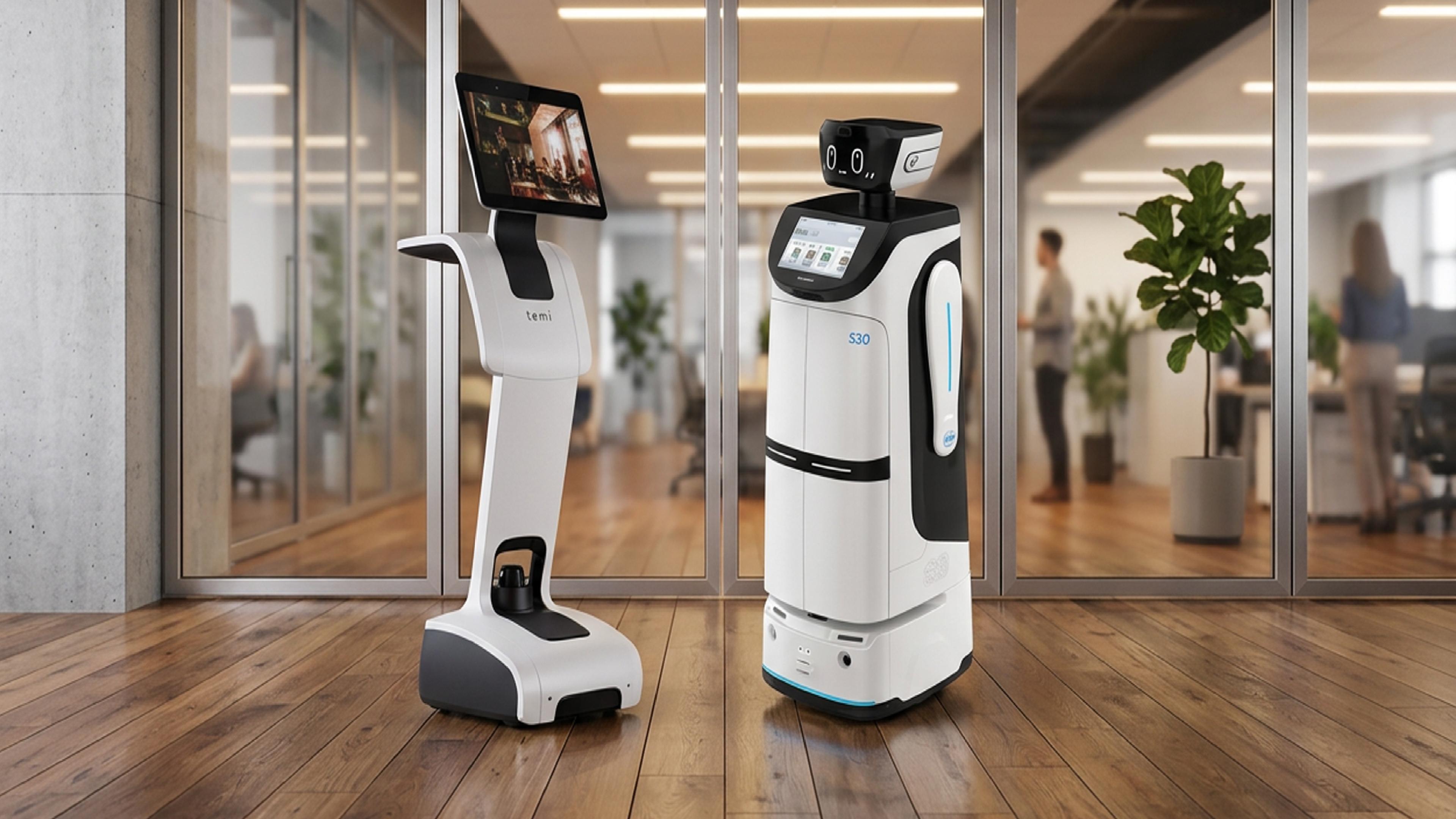
temi V3 vs. Hantewin S30 are both indoor service robots compared here on autonomous mobility, human–robot interaction, visitor engagement, navigation capabilities and delivery functionality.

October 31, 2026 by Business Desk Team
Introduction
temi V3 and Hantewin S30 (Ben Xiao Bao S30) are examined for autonomous indoors such as visitor greeting, and engagement, concierge and customer services. The choice depends on whether your business requires a small, mobile telepresence assistant or a large, humanoid-appearance service robot for reception, visitor orientation and delivery tasks.
temi V3 is advertised as a personal assistant and telepresence robot for mobile use. It integrates autonomous navigation, touch screen with third-party apps, autonomous voice conversations, and video calling. Hantewin S30 is a reception / service platform with an emphasis on visitor management, guided tours, intelligent delivery, touch screens, face-recognition and a 75-litre storage capacity. Both support indoor service tasks but exhibit very different form factors and corresponding interaction modalities.
At a Glance
| Metric | temi V3 | Hantewin S30 (BenXiaoBao) |
|---|---|---|
| Robot type | Mobile personal assistant and telepresence robot | Humanoid intelligent service and reception robot |
| Best-fit use cases | Remote communication, reception, healthcare assistance, visitor guidance and personal assistance | Proactive reception, visitor management, guided tours, advertising and indoor delivery |
| Dimensions | 1,000 × 350 × 450 mm (H × W × D) | 1,330 × 539 × 478 mm (dimension order not specified in the published diagram) |
| Robot weight | 12 kg | 50 kg |
| Display configuration | 13.3-inch Full HD touchscreen | 7-inch, 10.1-inch and 18.5-inch displays |
| Payload / storage | 3 kg tray capacity, depending on assembly | 30 kg load capacity; 75 L storage space |
| Runtime / charging | Up to 8 h; autonomous docking; charging time varies by configuration | 10 h battery life; 4 h charging; automatic recharging |
| Navigation / sensing | 360° LiDAR, two depth cameras, RGB camera, IMU and six time-of-flight sensors | Precise navigation and path planning are stated; detailed sensor configuration is not published on the cited product page |
| Mobility | Two 50 W motors; zero-turn radius; speed up to 1 m/s | Travel speed 0–1.2 m/s; automatic recharging |
| Communication / interaction | Voice recognition, natural-language processing, video calls, touchscreen and human-follow mode | Facial recognition, proactive greetings, visitor verification, voice/screen-triggered guided tours and animated facial expressions |
| Software / customization | temi OS, temi Center, built-in apps and full SDK for third-party development | Guided-tour content, visitor-management functions, IoT integration and advertising content |
| Connectivity | Wi-Fi 5, Bluetooth 5.1; optional 4G/5G | 4G and Wi-Fi |
| Distinctive capabilities | Autonomous telepresence, 13 MP camera, 13.3-inch display and developer SDK | 30 kg load capacity, 75 L storage, three display sizes and mobile advertising |
| Key limitation / caveat | Small 3 kg tray limits material-delivery applications | Larger 50 kg platform; detailed sensor specifications and navigation accuracy are not published on the cited product page |
Specifications are manufacturer-published. Runtime and payload figures are not directly comparable because the robots are designed for different operational tasks.
How They Compare
Operational role: Advanced features in temi V3 include communication with mobile users, personal assistance and telepresence. It can follow users between prespecified locations, facilitate video calls and stream information to third-party apps. The Hantewin S30 is constructed with front of house service functions in mind, such as welcomed reception, visitor registration, guided tours, on-demand advertising and item delivery. With its larger storage and payload specifications, it is better equipped for workflows with physical products, whereas temi is designed around communication.
Hardware and carrying capacity: The dimensions of the temi V3 are 1000 × 350 × 450 mm and it has a 12 kg weight, with the tray capacity up to 3 kg based on assembly. The dimensions of the Hantewin S30 are 1,330 × 539 × 478 mm and it weighs 50 kg. Capacity is specified as 30 kg and 75 L of storage space. This represents quite a marked difference in physical form and its ability to carry material, but its far greater size and weight also take significantly more planning when it comes to building corridors, turning circles, lifts and routes.
Communication and visitor engagement: The temi V3 relies on a 13.3-in. Touch-screen, four omni-directional microphones, a 13 MP camera and voice-interaction technologies that include speech recognition and natural-language processing. It also has a video call feature for remote communications. Tech specs: The S30 offers an alternative approach to visitor interaction: facial recognition serves as an entry point to interacting with the S30 through notifying you of visitors and greeting them proactively, and a fully-flexible head offers 22 different expressions and can be outfitted with three display sizes - including a 18.5-in. Ad-screen. The S30 has a guided-tour feature that has text and voice prompts, and it can pause and pick up explanations when interrupted.
Navigation and sensor capabilities: The published navigation spec for the temi V3 lists 360°LiDAR, two depth cameras, an RGB camera, an inertial measurement unit and six time-of-flight sensors. Its navigation system supports SLAM (mapping and localization), obstacle avoidance, path planning and human-follow mode. According to Hantewin, S30 has "a precise navigation system, path planning, and artificial intelligence delivery", but there is no published product info on the platform that reveal its exact LiDAR, camera or depth-sensor configuration. Not publishing specifications on the platform should not be conflated with a lack of sensing hardware, but rather its specifications need substantiation.
Delivery and physical assistance: It is a flat bottom tray (varying on assembly) that supports, respectively, 3 Kg for temi V3, for bags of auxiliary objects 7 Kg for a carrying tray for the transport of small objects from base. It is specified as 30 kg, with a volume of 75 L It also describes IoT connected intelligent delivery, and according to product sheet buyer should verify access to other computer interface, load per square meter of the holding section, safety of deliveries, whether elevator or access-control is part of quoted configuration.
Endurance and deployment: temi V3 claims eight hours of operation per charge with autonomous docking. Hantewin S30 mentions 10 hours of battery life, four hours of charging time and automatic recharging. These values are manufacturer announcements and vary depending on display operation, navigation, payload, and service condition. For both systems, deployment planning should consider Wi-Fi connectivity, remote operation, software setup and management, access to maintenance, as well as integration with current visitor management/operating systems.
Important Qualification
temi V3: 3 kg tray weight capacity will vary depending upon assembly level and cannot be considered a delivery specification for heavy-duty loads. Eight hours listed is a maximum figure supplied by the manufacturer and does not apply when using video calling and navigation non-stop.
Hantewin S30: The manufacturer lists a 30 kg load weight, 75 L storage volume, 10 hours of battery life, and four hours of charging time. While no detailed navigation sensors, accuracy of positioning, or obstacle-detection are listed at the link to this product page.
Display configuration: the product diagram released by Hantewin shows 7-inch, 10.1 inch and 18.5-inch display. Please let us know if the three types are included in the order and their roles.
Visitor data and privacy: Visitor and face recognition can give rise to specific issues in respect to information handling, consent, storage, access rights and privacy laws.
Performance claims: Ask manufacturers for information on products and their capabilities and demonstrate at your site before claiming superiority. Navigate the test area, navigate with voice recognition in loud crowds, test visitor flow, delivery accuracy and automatic docking.
Summary
Choose temi V3 if the most important features are autonomous telepresence, video communication, voice control, a small mobile platform, or developer access to third-party apps. The listing's comprehensive navigation and sensor specs may also be of interest to anyone interested in a highly configurable mobile assistant for healthcare, the office, or reception areas.
Consider Hantewin S30 (Ben Xiao Bao) if you adopt a proactive standoff, visitor handling, guided working, large scale advertising and higher volume item delivery. The greater load capacity (30 kg), the storage bin (75 L) and the multi-display structure will carry out an expanded physical human serving role.
This is a tailor-made conclusion and not a controlled comparison on performance. Identify the precise S30 display and sensor setup. Check the 30kg payload you expect in the by participating environment. Ask to see both robots operate on site before claiming superiority.
This comparison is based on ROBOT24.com market-research data records and manufacturer-reported specifications rather than controlled performance testing.
More articles on this topic
144 articles ReportRichtech DUST-E S vs. Gausium Phantas
 ReportEngineAI SE01 vs. AGIBOT RAISE A1ReportRichtech DUST-E S vs. KEENON KLEENBOT C20
 ReportPUDU PuduBot 2 vs. OrionStar LuckiBot Pro
 ReportUnitree G1 vs. EngineAI PM01
 ReportKEENON DINERBOT T11 vs. PUDU KettyBot Pro
 ReportAGIBOT D1 Pro vs. Unitree Go2 Pro
 ReportKEYi Tech Loona vs. WEILAN BabyAlpha A2
 ReportPUDU BellaBot Pro vs. KEENON DINERBOT T11
 ReportBear Robotics Servi Plus vs PUDU BellaBot Pro
 ReportUnitree G1 vs. AGIBOT X2
 ReportPUDU KettyBot Pro vs. Bear Robotics Servi Q
BUSINESS NEWS WEEKLY LETTER
The Weekly Letter for Robotics Professionals, Summarizing the Most Important Industry Moves, Launches, Deals and Signals.