Stäubli FL1500 vs. VisionNav VNE30
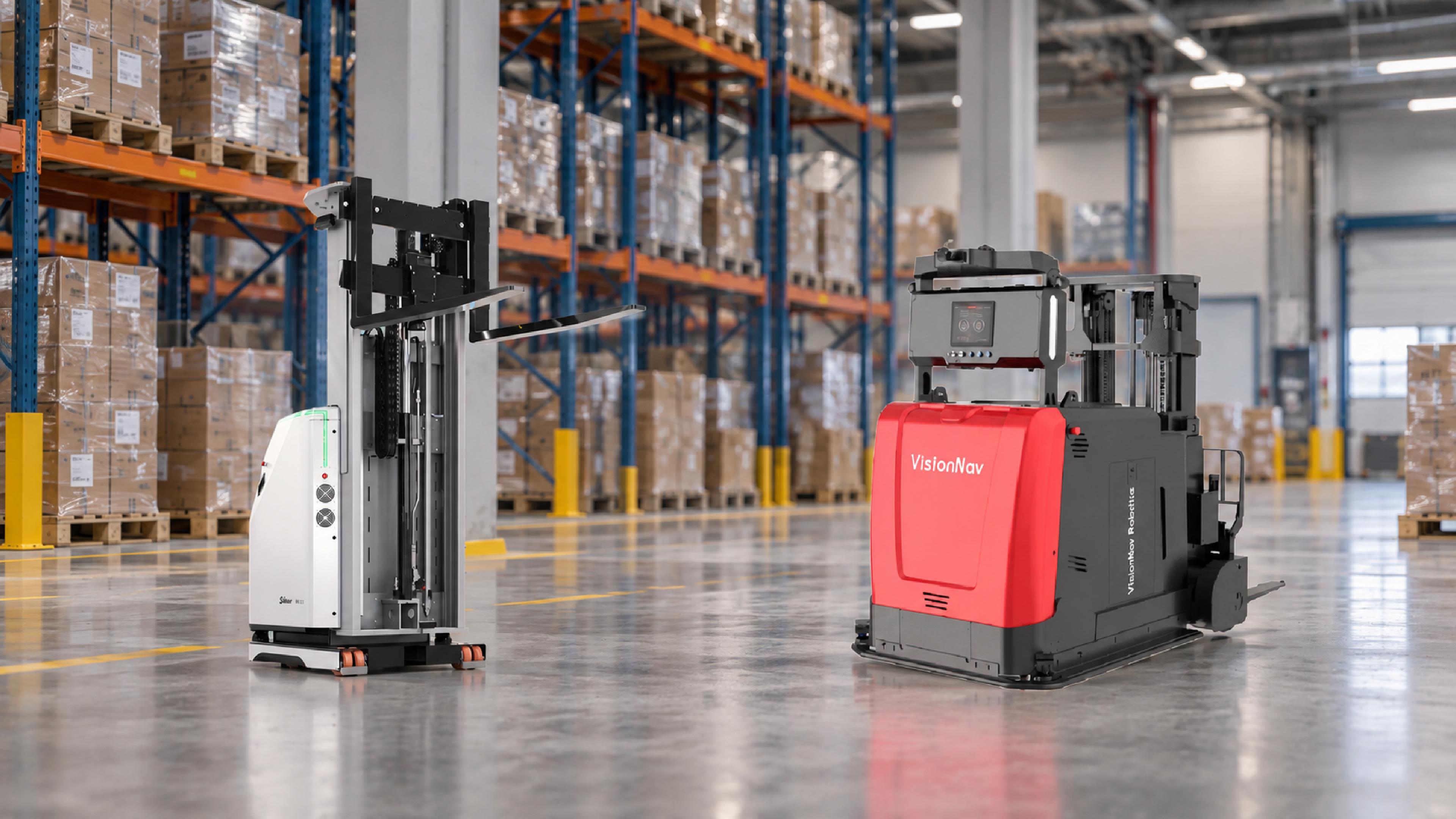
Two autonomous forklifts for warehouse logistics and pallet handling compared on how FL1500’s extended operation and inductive charging and VNE30’s higher load capacity and travel speed shape their capabilities and operating focus.

September 25, 2026 by Business Desk Team
Introduction
The Stäubli FL1500 and VisionNav VNE30 are autonomous forklift robots designed for pallet movement, warehouse logistics and industrial material handling.
Both can autonomously navigate warehouse environments, detect obstacles and pick up and transport palletised loads. However, there is a substantial difference in their load capacities.
The Stäubli FL1500 is rated for loads up to 1,500 kg, while the VisionNav VNE30 doubles this with a 3,000 kg rated capacity.
The VNE30 also offers a higher recorded maximum travel speed and a wider range of optional mast heights, while the FL1500 has up to 24-hour operation and inductive charging recorded in Robot24.
At a Glance
| Metric | Stäubli FL1500 | VisionNav VNE30 |
|---|---|---|
| Robot type | Autonomous forklift AMR | Counterbalance forklift AGV/AMR |
| Main use cases | Pallet transport; rack replenishment; production supply; machine feeding | Pallet transport; pallet stacking; production logistics ; heavy-load movement |
| Maximum payload | 1,500 kg | 3,000 kg |
| Robot weight | 3,500 kg | 5,450 kg |
| Maximum speed | Up to 1.5 m/s | Up to 2.2 m/s |
| Standard lift height | Up to 3,205 mm with duplex mast | 3,000 mm |
| Optional / alternative lift height | 1,835 mm mono mast | 3,500 / 4,000 / 4,500 mm options |
| Turning radius | 1.5 m | 2.24 m |
| Positioning accuracy | Up to ± 10 mm | High-precision 3D positioning; exact figure not separately recorded in VNE30 record |
| Navigation | Laser natural-feature navigation | 3D SLAM |
| Environmental perception | Safety and load-monitoring laser scanners | 3D laser adaptive sensing |
| Obstacle avoidance | Yes | Yes |
| Autonomous pallet handling | Yes | Yes |
| Pallet stacking | Yes | Yes |
| Automatic charging | Yes | Yes |
| Charging type | 3 kW side or floor inductive charging | Manual or automatic |
| Battery | 48 V lithium-ion | 83.2 V / 500 Ah LiFePO ₄ |
| Runtime | Up to 24 hours | Not publicly disclosed |
| Fleet coordination | Yes | Yes |
| Indoor operation | Yes | Yes |
| Semi-outdoor operation | Not recorded / outdoor operation listed as no | Yes |
| Protection rating | Up to IP54 | Not publicly disclosed |
| Price | Quote based | Not publicly disclosed |
| Availability | Commercially available | Commercially available |
How They Compare
Both robots are designed to replace or automate conventional forklift tasks within warehouses and industrial facilities.
The largest technical distinction is payload. The FL1500 carries up to 1,500 kg, whereas the VNE30 is designed for loads of up to 3,000 kg. This gives the VisionNav robot considerably greater capacity for heavy pallet movement.
The VNE30 is also faster in the recorded specifications. It can travel at up to 2.2 m/s when empty, compared with a maximum of approximately 1.5 m/s for the FL1500.
Lift capability is more nuanced. The FL1500's duplex mast is recorded at up to 3,205 mm. The VNE30 has a standard 3,000 mm lift but can be configured with 3,500 mm, 4,000 mm or 4,500 mm lift heights.
Stäubli has the more compact turning specification, with a 1.5 m turning radius compared with 2.24 m for the VisionNav VNE30.
Their autonomous systems also use different approaches. FL1500 uses laser natural-feature navigation and has safety laser scanners and load-monitoring laser scanners. VNE30 uses 3D SLAM and adaptive 3D laser perception for mapping, positioning, load recognition and obstacle avoidance.
FL1500 has up to 24-hour runtime recorded and supports 3 kW inductive side or floor charging. The VNE30 uses a substantially larger 83.2 V / 500 Ah LiFePO₄ battery with manual or automatic charging, although its runtime is not recorded in Robot24.
Summary
Both the Stäubli FL1500 and VisionNav VNE30 are commercially available autonomous forklift platforms designed for warehouse and industrial logistics.
The FL1500 combines a 1,500 kg payload with compact manoeuvrability, ±10 mm positioning, inductive charging and up to 24-hour operation.
The VNE30 is the substantially heavier-capacity machine, supporting up to 3,000 kg, speeds of up to 2.2 m/s and optional mast configurations reaching 4.5 m. Its 3D SLAM and adaptive 3D laser system support autonomous pallet recognition, positioning and obstacle avoidance.
The main distinction is therefore the FL1500's more compact 1,500 kg intralogistics configuration versus the VNE30's higher-capacity 3,000 kg autonomous forklift platform.
More articles on this topic
28 articles ReportDEEPRobotics Lite3 vs. Unitree Go2 EDU
 ReportIDMind AIDA vs. Reeman Nurse
 ReportAGIBOT G2 vs. EngineAI SE01
 ReportUBTECH Cruzr 1S vs. OrionStar GreetingBot Mini Robot: Which Retail Service Robot Fits Better?
 ReportDoog THOUZER THOUZER Standard vs. SPARQ Lift AL-450: Which Warehouse AMR Fits Better?
 ReportRobopreneur AI Security Robot (Johan & Jaguh) vs. IHMC Alex / Alexander: Who’s Better Suited to Patrol?
 ReportDonut Robotics Cinnamon Guide vs. AeiROBOT AIMY: Which Hotel Service Robot Fits Better?
 ReportBG1 (Pudu Robotics) vs. Servi Clean (Bear Robotics): Commercial Cleaning Comparison
 ReportG2 Genie (AGIBOT) vs. D7 (Pudu Robotics): Humanoid Comparison
 ReportServi (Bear Robotics) vs BellaBot (Pudu Robotics)
 ReportHolaBot (Pudu Robotics) vs. Foodie (Robint): Restaurant Service Comparison
 ReportPudu Robotics BG1 vs. VIGGO SC50 Pro Plus: Which Cleaning Robot Fits Your Facility?
BUSINESS NEWS WEEKLY LETTER
The Weekly Letter for Robotics Professionals, Summarizing the Most Important Industry Moves, Launches, Deals and Signals.