PUDU FlashBot Max vs. Robotise JEEVES
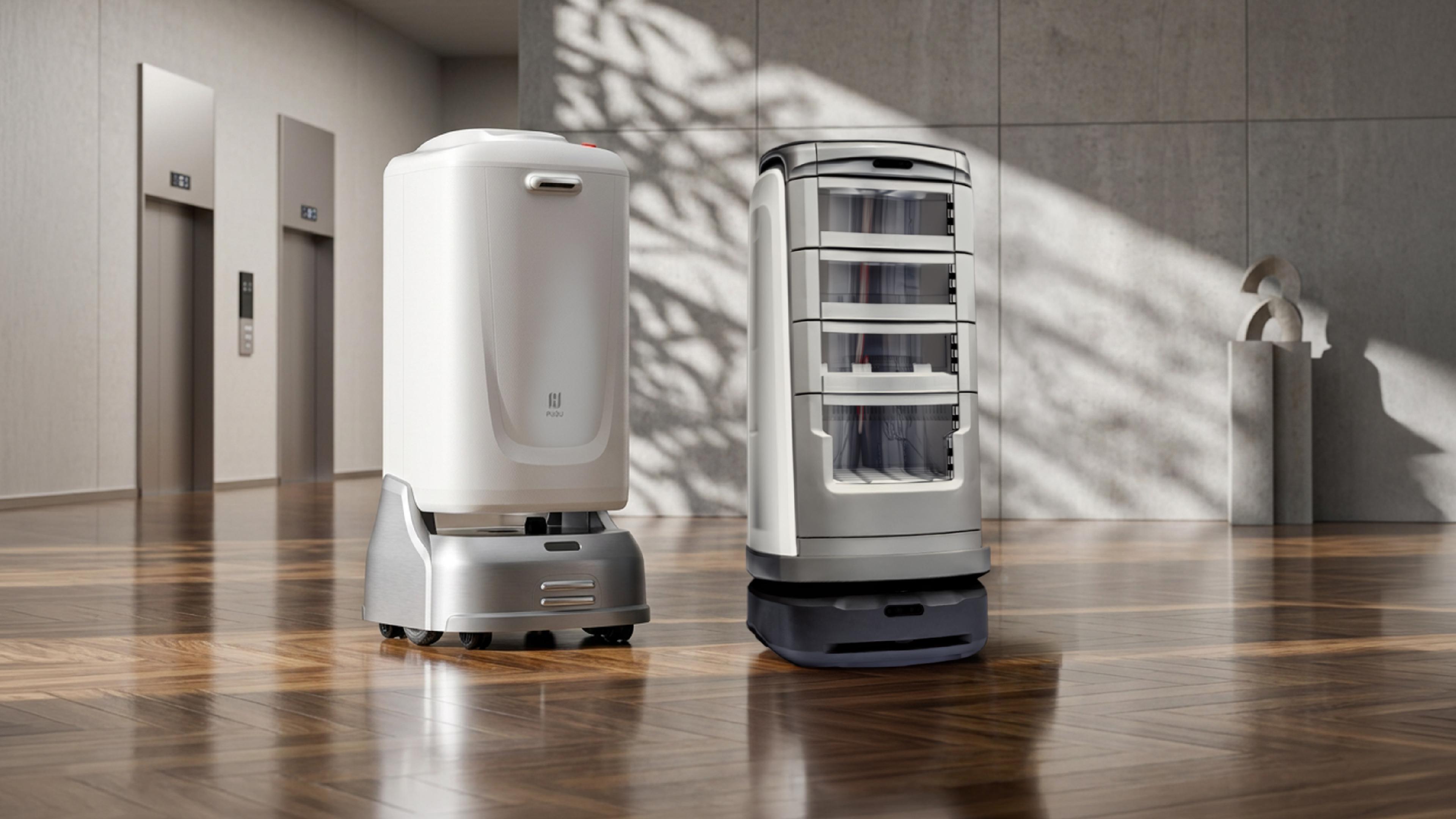
PUDU FlashBot Max and Robotise JEEVES are commercial autonomous delivery robots designed to transport items through indoor environments, including multi-floor buildings. We compare their physical dimensions, navigation systems, elevator integration, obstacle detection, operating endurance and deployment requirements to examine their suitability for hospitality, healthcare and internal delivery operations.

November 12, 2026 by Business Desk Team
Introduction
Autonomous delivery robots become increasingly relevant for hotels, hospitals and commercial facilities where personnel is responsible for delivering items between different rooms, departments and floors.
Multi-floor delivery systems differ from conventional delivery robots working in one corridor or even open dining area.
Such robots need to move in more complicated environment, e.g., in common corridors, bypassing people, communicating with elevators and reaching delivery places without constant human control.
PUDU FlashBot Max and Robotise JEEVES are two commercial robotic platforms created for such tasks.
FlashBot Max belongs to PUDU Robotics' FlashBot delivery robot line. It was designed specifically for indoor delivery purposes with autonomous navigation and elevator integration capabilities registered.
Robotise JEEVES is a European-made autonomous service robot used for internal delivery in hotels, healthcare institutions and other commercial facilities.
Both robotic platforms use differential drive mechanism and have elevator integration capabilities. But their specifications show some differences in physical parameters, weight, navigation system and operational capacity.
Comparing these two robotic platforms using ROBOT24.com market research data records, the paper analyzes their navigation capabilities, building integration, operational requirements and suitability for delivery workflows.
At A Glance
| Availability | Commercially available | Commercially offered by quotation for project deployment; configuration and delivery to be confirmed with the supplier. |
|---|---|---|
| Dimensions | 538 × 534 × 1052 mm | Approximately 124 × 56 × 65 cm |
| Drive System | Differential Drive | Differential drive |
| Elevator Integration | Yes | Yes, through an installed elevator interface |
| Navigation | VSLAM+ + LiDAR SLAM | LiDAR-based autonomous navigation using 3D depth maps, IMU support and dead reckoning |
| Obstacle Detection | Yes | People, stairs and environmental obstacles |
| Runtime | Up to 9 h | Up to 8 hours, depending on operation and configuration |
| Weight | 60 kg | Approximately 100 kg |
| Typical use | Hospitality, Healthcare, Personal Use | Healthcare, Generic Deliveries, Hospitality |
| Status | Commercial | Commercial |
How They Compare
Commercial applications and operational focus
PUDU FlashBot Max and Robotise JEEVES are meant for indoor delivery robots, specifically within buildings where there is a need for delivering items from one place to another. FlashBot Max has been linked to hospitality, healthcare, and personal uses from the provided data.
The use of the robot includes moving appropriate items indoors through autonomous navigation. JEEVES has been designed for healthcare, deliveries, and hospitality.
The use of the robot includes delivering items indoors through designated places without the need for personnel to guide it all the way through. Both robots could help eliminate repetitive tasks involving moving items; however, it will depend on the nature of items to be moved, layout of the building, and infrastructure at hand. In case of multi-story buildings, elevator integration becomes very crucial.
Physical Dimensions and Building Access
FlashBot Max has the physical dimensions of 538 × 534 × 1,052 mm based on the information provided. JEEVES has physical dimensions of approximately 124 × 56 × 65 cm.
This means that the two robots differ in physical dimension profile. FlashBot Max has relatively smaller physical footprint dimensions of about 54 × 53 cm and height of 105 cm. The larger physical dimension of JEEVES robot is approximately 124 cm along one axis and the other two dimensions are 56 cm and 65 cm.
However, there is no clear mention of which dimension is for what in the provided record for JEEVES. So, it would be incorrect to compare their physical dimensions and height.
In terms of business application in commercial buildings, physical dimensions can determine whether the robot can use elevators and corridors as well as the space required at delivery points. It is advisable that businesses establish their physical dimensions and turning radius.
Weighing and Deployment Needs
FlashBot Max is stated to weigh 60 kg. JEEVES is said to weigh about 100 kg. From this information, JEEVES is said to be approximately 40 kg heavier than FlashBot Max. This may affect the transportation needs, installation needs and handling needs. A lighter robot could be easier to move while deploying for the first time, while a heavier one could have different carrying needs.
However, just weight alone does not determine carrying capabilities or delivery performance. The comparison information provided does not provide direct carrying capabilities, cargo space or maximum weight.
Differential-drive mobility
Both robots have differential drive. Differential drive basically means the control of the speeds of the powered wheels separately for the movement and turns of the robot.
This form of mobility is commonly used in indoor autonomous robots. It may be used for navigating through corridors and other organized environments. In terms of delivery, the efficiency of differential drive mobility is contingent upon the physical size, turning radius, and navigation program of the robot.
However, despite having similar drive systems, these robots may vary in their movement capabilities. The provided data does not have information on maximum speeds, minimum pass width, and turning radii. It is impossible to make a conclusion about the greater maneuverability of one platform in comparison with another one based only on this data.
Autonomous navigation technology
FlashBot Max uses a recorded navigation system using VSLAM+ and LiDAR SLAM. VSLAM uses visual information from cameras to help the robot understand the environment and calculate its own location.
LiDAR SLAM uses laser information to calculate distances that can be used for localization and mapping. Using various methods of localization might provide additional environmental information sources.
JEEVES uses LiDAR-based autonomous navigation with 3D depth maps, IMU and dead reckoning. IMU uses information about movement and orientation, dead reckoning calculates changes in position according to movements.
Such systems provide necessary information for localization and navigation within the building. Both technologies are useful in commercial deliveries, but since the technology description is different, there is no information which of the two systems is more accurate. The accuracy of the navigation is dependent on sensor quality, software, environmental information and the difficulty of the route. Comparison of technologies is possible only under similar conditions, which means the same building should be used.
Obstacle detection and avoidance
Both FlashBot Max and JEEVES are capable of obstacle detection. For FlashBot Max, the provided records show that obstacle detection is possible without detailing specific types of obstacles.
For JEEVES, the provided records provide a clearer description with people, stairs, and environmental obstacles listed. These characteristics are critical for such places as hotels, hospitals, and commercial buildings, where robots have to operate on pedestrian paths.
People can move unpredictably, while furniture and other objects can obstruct the planned route. In addition, stair detection is crucial for wheeled robots, since they need to avoid areas where they are not able to go. Nonetheless, the more specific description for JEEVES does not prove that the obstacle detection abilities are not present in FlashBot Max. These differences relate only to the level of detail of the provided descriptions.
Elevator integration and multi-floor delivery
Both FlashBot Max and JEEVES support elevator integration. This capability is particularly relevant to hotels, hospitals and office buildings where deliveries may need to move between floors. FlashBot Max has elevator integration listed among its capabilities.
JEEVES supports elevator integration through an installed elevator interface. The distinction is important because elevator operation depends on the infrastructure available in a building.
A robot may need a compatible interface to request an elevator, select a floor and coordinate entry and exit. Integration may also involve building permissions, elevator-system compatibility and installation work. The supplied records do not establish whether either robot can connect to every elevator system without modification. Businesses should confirm the specific elevator models supported and the installation requirements involved.
Multi-floor delivery processes
Integration with an elevator allows the delivery robot to be used in delivery processes that go beyond a single floor. A robot, for instance, may move appropriate items from the central service location to specific delivery points within the building.
Within hospitality settings, it would save repeated visits between the service departments and the guest areas. Within the healthcare facilities, internal delivery robots may help to deliver approved items between departments.
It is worth noting that integration with elevators is not enough to create a full delivery process. Access to doors, security control, identification of destination and recipient handing over may require additional features or integration.
The data provided do not contain the directly comparable data on these features. The organizations should consider the entire process of delivering, not just the integration with elevators.
Operating endurance and runtime
For FlashBot Max, the recorded operating runtime is up to nine hours. For JEEVES, the recorded runtime is up to eight hours, contingent on use and configuration.
From these numbers, FlashBot Max has a longer recorded maximum operating time than JEEVES. It is one hour longer. This could be important to facilities that need robot deliveries to span over a long period of time. Nevertheless, maximum runtime is not always synonymous with constant operation.
There are many factors that will affect the battery endurance such as the amount of distance traveled, weight being carried, frequency of movement, waiting times at elevators, and inactive time periods. These two sets of records do not prove the equality of the conditions used in measuring the runtimes. Methods of charging are also left unspecified. Companies should determine their own needs to ascertain the endurance capacity per unit robot before computing the number of units needed daily.
Applications within Healthcare
Both robots list healthcare as an application area for them.Autonomous delivery robots could be employed in hospitals and other facilities for certain transport operations internally.
This could include carrying of approved items from one point to another. But healthcare settings present new considerations for the use of robots. Robots will have to maneuver around patients, people and medical equipment as per facility regulations.
From the documentation provided, it is not clear whether any of the robots meet any clinical transport criteria. Hence the suitability of the robot in healthcare must be determined by its specific application and the capabilities of the manufacturer. Suitability of any robot in healthcare must not be assumed on the basis of its healthcare application alone.
Personal use and general deliveries
The FlashBot Max is noted for personal use among its applications. The JEEVES robot is known to be used for general deliveries. This classification points to different areas of commercial applications, but does not provide the complete list of tasks the robots can perform.
Applications of personal use might include deliveries in a private environment, if the robot has the appropriate configuration. General delivery applications might also require transport of goods from one indoor location to another. Nevertheless, neither of these classifications ensures the possibility of navigating any home or business setting.
The presence of door thresholds, surface conditions of floors, elevators and space available would have an impact on the usage. Therefore, the use must be confirmed with the manufacturer.
Commercial availability and purchasing arrangements
Both robots have commercial status in the supplied records. FlashBot Max is listed as commercially available.
JEEVES is commercially offered through a quotation-based project deployment process, with configuration and delivery terms to be confirmed with the supplier. This distinction may be important to organizations evaluating procurement.
A quotation-based deployment may involve assessing the building, selecting the required configuration and determining integration requirements. However, commercial availability does not necessarily mean that every configuration is immediately available in every market. Businesses should confirm delivery schedules, installation requirements, warranty coverage and technical support before purchasing either platform.
Building integration and deployment planning
For multi-floor delivery robots, deployment involves more than placing a robot inside a building. Operators must consider corridor dimensions, elevator compatibility, pedestrian traffic and delivery destinations. Both FlashBot Max and JEEVES require evaluation against these conditions.
For buildings with restricted access areas, additional integration may be necessary to support the intended delivery workflow. Organizations should also consider how staff will load the robot, initiate deliveries and retrieve items at the destination.
The supplied records do not establish directly comparable fleet-management capabilities, software interfaces or access-control integrations. These factors should be assessed during a site-specific demonstration.
Summary
PUDU FlashBot Max and Robotise JEEVES are commercial autonomous delivery robots designed for indoor transport across hospitality, healthcare and other building environments.
FlashBot Max may appeal to organizations seeking a relatively compact delivery robot with combined VSLAM+ and LiDAR SLAM navigation. Its recorded weight of 60 kg and runtime of up to nine hours are relevant considerations for deployment planning.
JEEVES may suit organizations seeking a project-based autonomous delivery solution with LiDAR navigation, 3D depth mapping and elevator integration through an installed interface. Its recorded runtime of up to eight hours and approximately 100 kg weight reflect a different physical and operating profile. Both robots use differential-drive mobility, support obstacle detection and offer elevator integration.
The choice depends on the building layout, items being transported, operating schedule, elevator compatibility and the level of installation and technical support required.
This comparison is based on ROBOT24.com market-research data records rather than controlled performance testing. Physical dimensions, runtime, payload capacity, navigation performance and elevator integration should be verified against current manufacturer documentation before drawing conclusions about overall performance.
More articles on this topic
145 articles ReportRichtech DUST-E S vs. Gausium Phantas
 ReportEngineAI SE01 vs. AGIBOT RAISE A1ReportRichtech DUST-E S vs. KEENON KLEENBOT C20
 ReportPUDU PuduBot 2 vs. OrionStar LuckiBot Pro
 ReportUnitree G1 vs. EngineAI PM01
 ReportKEENON DINERBOT T11 vs. PUDU KettyBot Pro
 ReportAGIBOT D1 Pro vs. Unitree Go2 Pro
 ReportKEYi Tech Loona vs. WEILAN BabyAlpha A2
 ReportPUDU BellaBot Pro vs. KEENON DINERBOT T11
 ReportBear Robotics Servi Plus vs PUDU BellaBot Pro
 ReportUnitree G1 vs. AGIBOT X2
 ReportPUDU KettyBot Pro vs. Bear Robotics Servi Q
BUSINESS NEWS WEEKLY LETTER
The Weekly Letter for Robotics Professionals, Summarizing the Most Important Industry Moves, Launches, Deals and Signals.