PUDU BellaBot vs. KEENON DINERBOT T9 Pro
PUDU BellaBot and KEENON DINERBOT T9 Pro are both autonomous restaurant delivery robots compared here on mobility, navigation and obstacle detection, payload capacity, customer interaction, operating endurance and service efficiency.

November 7, 2026 by Business Desk Team
Introduction
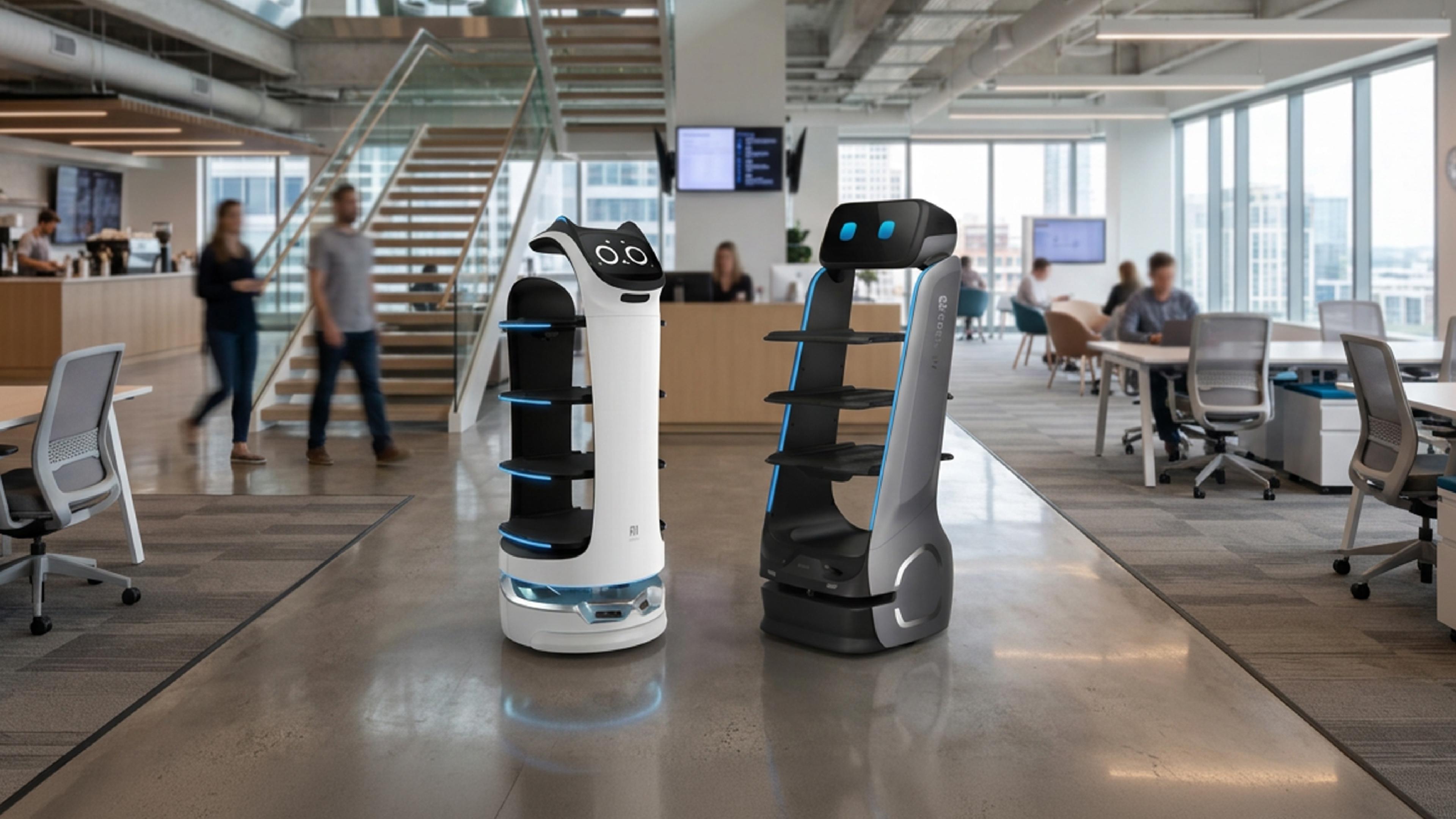
PUDU BellaBot and KEENON DINERBOT T9 Pro PUDU BellaBot is an autonomous robot that functions as a mobile service bot to assist in food delivering and staff workflow in commercial settings. KEENON DINERBOT T9 Pro shares the same function, multi-sensor navigation and obstacle detection, multi-tier trays of the PUDU BellaBot to move materials in an indoor setting.
Their distinction lies in their interaction design and operational characteristics. BellaBot places greater emphasis on multimodal guest interaction, expressive feedback and touch-responsive features. DINERBOT T9 Pro focuses on practical food-service automation, with visual guidance, tray-level item detection and a shock-absorbing chassis designed for stable movement across commercial floors.
It is all down to what service the installation is going to provide, number of customers, how they want to interact with the customer, site layout and hours of operation rather than the headline run time or maximum speed.
At a Glance
| Metric | PUDU BellaBot | KEENON DINERBOT T9 Pro |
|---|---|---|
| Robot type | Interactive multi-tray delivery AMR | Autonomous multi-tray service delivery AMR |
| Best-fit use cases | Restaurant food delivery, table service, hospitality and guest interaction | Restaurant food delivery, self-pickup workflows and commercial service operations |
| Dimensions (W × D × H) | 565 × 537 × 1,290 mm | 500 × 527 × 1,266 mm |
| Weight | 55 kg | 45.2 kg |
| Payload capacity | 40 kg total; 10 kg per tray | 40 kg total; 10 kg per tray |
| Runtime | 13 hours (no-load manufacturer specification); replaceable battery | Up to 15 hours (manufacturer specification) |
| Charging time | 4.5 hours | Approximately 4 hours |
| Battery | 25.6 Ah lithium battery; replaceable | 48 V, 12 Ah lithium battery (published brochure specification) |
| Maximum speed | 0.5–1.2 m/s, adjustable | 0.8 m/s |
| Navigation / sensing | Laser SLAM or marker positioning; three RGB-D depth cameras | VSLAM; visual sensors and 3D vision for obstacle detection |
| Obstacle handling | Multi-sensor environmental perception and obstacle detection | 3D vision for detecting low obstacles, steps and objects near the floor |
| Tray configuration | Four-tier delivery trays with intelligent infrared sensing | Three trays with radar-based item detection |
| Distinctive capabilities | Touch-sensitive interaction, expressive feedback, smart expressions and replaceable battery | Smart self-pickup guidance, tray-level detection, voice and visual prompts, multi-link damping suspension |
| Autonomous charging | Supported | Supported |
| Key limitation / caveat | The 13-hour runtime is specified under no-load conditions; battery life varies with use | The 15-hour runtime is a published maximum; actual endurance depends on workload and operating conditions |
How They Compare
Operational role: Optimized for restaurant delivery and customer interaction. Equipped with large expressive eyes, touch points, and visual and audible feedback, BellaBot is ideal for use in a setting where face-to-face customer interaction is part of the service. KEENON DINERBOT T9 Pro: Designed for food delivery and self-order pickup workflows. Tray sensors monitor when food is loaded and picked up; interactive prompts and screens provide instructions during robot-to-customer handoff.
Payload and physical design: Both robots feature a published total payload of 40kg, maximum 10kg per tray. BellaBot has four trays, and dimensions of 565 × 537 × 1,290mm, with a quoted weight of 55kg. DINERBOT T9 Pro has three trays, and dimensions of 500 × 527 × 1,266mm, with a quoted weight of 45.2kg. The lower overall weight of the T9 Pro and the more compact set of dimensions could be advantageous on tight floors, though manoeuvring may be limited if there are tight turns, small aisle widths or obstructions along the route. Tray number and arrangement should also be considered in context of the required coverage.
Navigation and environmental perception: BellaBot has laser SLAM and marker positioning, 3 RGB-D depth cameras for 3D environment perception KEENON DINERBOT T9 Pro has VSLAM for markerless position, 3D vision for low obstacle detection, steps and something that may block movement both are fully autonomous and indoor navigation. Number of lights, reflective surfaces, changes of furniture, population size and direction of map may affect the navigation quality. Running a site trial is recommended for testing narrow aisles, busy service times and table visits.
Interaction and service workflow: BellaBot adopts a multimodal interaction architecture integrating touch, expressive lighting, and animation providing a more engaging guest interface. DINERBOT T9 Pro is more task-driven with tray sensing, voice reminder and visual instruction, and self-pickup guidance. The distinction is therefore between expressive guest engagement and structured delivery handover. Restaurants should assess which interaction model better supports their service style and customer expectations.
Battery and operating endurance: BellaBot claims 13 hours of battery autonomy without any load and 4.5 hours for charging. Its 25.6 Ah spare battery also enables battery-exchange procedures. DINERBOT T9 Pro includes up to 15 hours operating time and around four hours of recharging time. The published operation time figure is greater in magnitude for the T9 Pro, but it is not appropriate to compare them as the two figures are irrelevant unless the payload, movement, interaction and operating environment are comparable. Again, battery replacement and recharging arrangements need to be designed for multi-shift operation.
Important Qualification
PUDU BellaBot: According to the manufacturer's description of the product page, battery life without load is specified as 13 hours (not a guaranteed run-time of 12-24 hours). The battery can be changed with the ability to extend the operating time, but spare batteries and a change protocol must be available.
KEENON DINERBOT T9 Pro: The 15 hr run-time is a listed maximum not a continuous full load run-time. 48 V 12 Ah is a listed power pack specification in the product brochure available and should be rechecked for the specific local configuration.
Payload: Rating is 40 Kg per tray, 10 Kg per tray, both robots. These ratings should not be interpreted as permission to load 40 kg onto an individual tray. Load distribution and stability must be maintained within the manufacturer's limits.
Navigation and safety: Autonomous navigation and obstacle detection alone does not necessarily mean certified human-collaborative safety. Confirm the emergency-stop functionality, obstacle handling, operating speed, and safety information before use.
Application scope: Both are mostly noted as being service and delivery robots. More extensive use within a healthcare, retail or showroom environment should be evaluated based on the proposed workflow, available accessories and manufacturer-supported integrations.
Summary
Choose PUDU BellaBot in your restaurant when customer interaction, expressive communication, and four tier tray presentation are a part of the dine-in service experience. Its touch capabilities, RGB-D camera, and interchangeable battery make it suitable for food delivery.
KEENON DINERBOT T9 Pro is a good choice when structured food delivery, tray-level item detection and self-pickup directions are important. These three-tier tray delivery robot with VSLAM navigation, 40 kg load capacity and shock absorbing chassis is apt for the restaurant that wants to manage a task-centric delivery process.
This is a suitable service-type comparison, not a performance test ranking. Verify the battery configuration, test runtime conditions, tray sizes, minimum passage width and autonomous navigation and charging setup prior to ordering. You will need to conduct some in-house testing using representative service loads before you can make direct comparisons of relative superiority.
This comparison is based on ROBOT24.com market-research data records and manufacturer-reported specifications rather than controlled performance testing.
More articles on this topic
144 articles ReportRichtech DUST-E S vs. Gausium Phantas
 ReportEngineAI SE01 vs. AGIBOT RAISE A1ReportRichtech DUST-E S vs. KEENON KLEENBOT C20
 ReportPUDU PuduBot 2 vs. OrionStar LuckiBot Pro
 ReportUnitree G1 vs. EngineAI PM01
 ReportKEENON DINERBOT T11 vs. PUDU KettyBot Pro
 ReportAGIBOT D1 Pro vs. Unitree Go2 Pro
 ReportKEYi Tech Loona vs. WEILAN BabyAlpha A2
 ReportPUDU BellaBot Pro vs. KEENON DINERBOT T11
 ReportBear Robotics Servi Plus vs PUDU BellaBot Pro
 ReportUnitree G1 vs. AGIBOT X2
 ReportPUDU KettyBot Pro vs. Bear Robotics Servi Q
BUSINESS NEWS WEEKLY LETTER
The Weekly Letter for Robotics Professionals, Summarizing the Most Important Industry Moves, Launches, Deals and Signals.