PUDU BellaBot Pro vs. KEENON DINERBOT T10
PUDU BellaBot Pro and KEENON DINERBOT T10 are both restaurant service robots compared here on delivery capacity, navigation technology, customer interaction, advertising capabilities and deployment requirements.

November 10, 2026 by Business Desk Team
Introduction
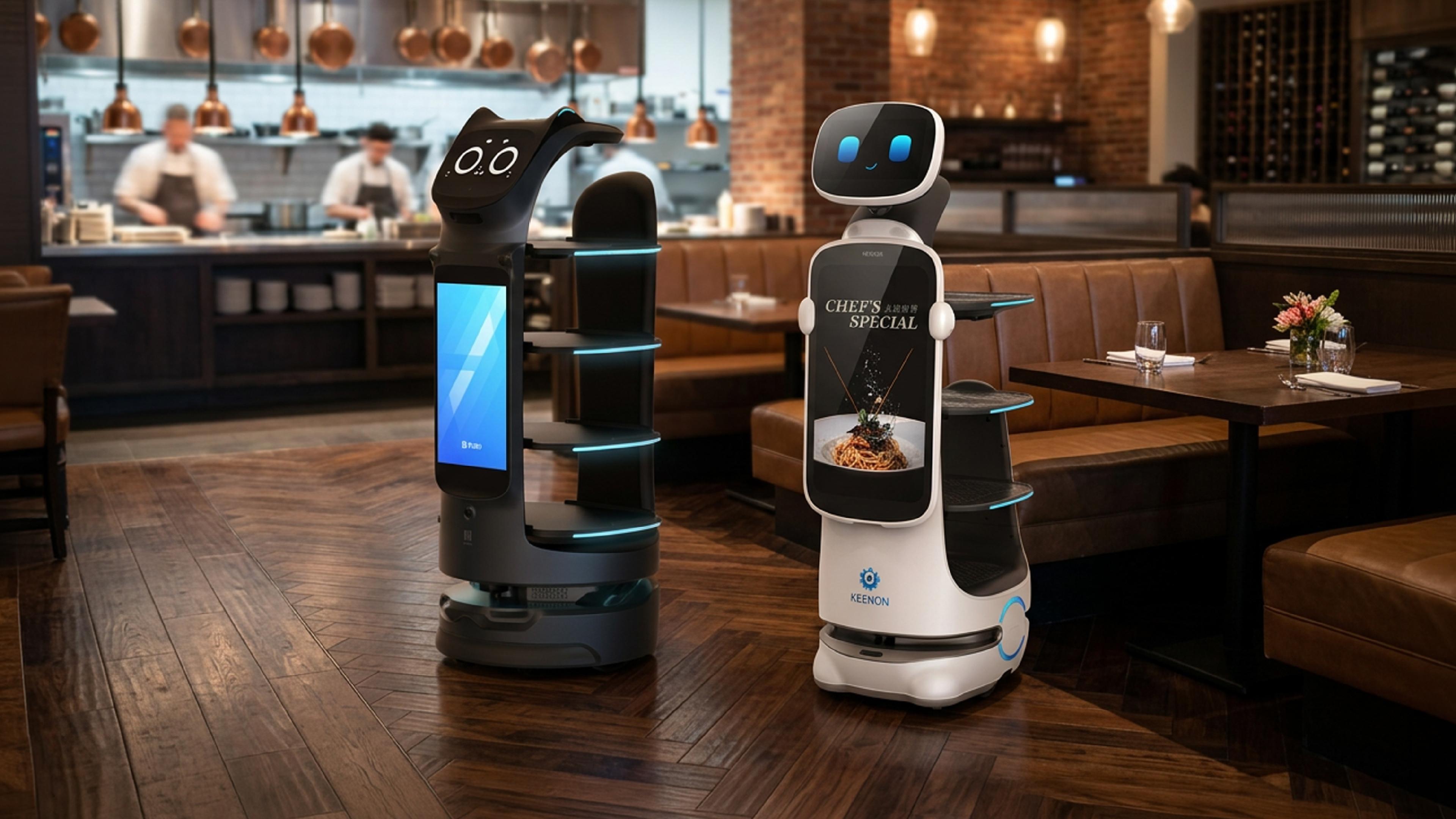
PUDU Bella Bot Pro and KEENON DINERBOT T10 are compared in terms of restaurant meal delivery, customer flow and on-venue promotional process. Both of them are autonomous food service robots that travel across the dining room to carry food and communicate with guests. Their difference is embodied in the way they carry out visual communication and interactive activities.
PUDU Bella Bot Pro is for multi-tray food delivery, dish recognition, and mobile advertising – 40 kg total payload, 18.5-inch advertising display, 10.1-inch control screen, multimodal sensing KEENON DINERBOT T10 is 40 kg with 23.8-inch display, mobile interactive head, touch control, tray-detection KEENON T10 has a narrower published passage requirement: possibly of benefit to eateries with narrow passages.
The comparison takes into account delivery capacity, physical access, navigation, customer interaction and operating endurance rather than approaching screen size or payload as serial factors for determine suitability for operation.
At a Glance
| Metric | PUDU BellaBot Pro | KEENON DINERBOT T10 |
|---|---|---|
| Robot type | Interactive multi-tray delivery and advertising AMR | Interactive restaurant delivery and marketing robot |
| Best-fit use cases | Food delivery, dish recognition, customer engagement and mobile advertising | Food delivery, self-pickup, customer interaction and in-venue promotion |
| Dimensions (W × D × H) | 570 × 550 × 1,290 mm | 486 × 555 × 1,399 mm |
| Weight | 55 kg | 58 kg |
| Total payload | 40 kg; 10 kg per tray | 40 kg total; per-tray limit not specified on cited official page |
| Tray configuration | Four trays; 410 × 500 mm each | Open-access tray arrangement; individual tray dimensions not specified on cited official page |
| Runtime / charging | Up to 11 h unloaded (distributor-published); 4.5 h charging | 9–12.5 h battery life; 5.5 h charging |
| Maximum speed | 0.2–1.2 m/s | 1 m/s |
| Minimum passage width | 65 cm | 59 cm |
| Navigation / sensing | VSLAM and LiDAR SLAM; 2 front-view cameras, 3 RGBD sensors and 1 LiDAR | VSLAM, 4 stereo vision sensors and 1 RGB camera |
| Display / interaction | 10.1-inch control screen and 18.5-inch advertising screen; dish recognition and voice broadcast | 23.8-inch screen, movable head, interactive buttons, touch control and voice prompts |
| Distinctive capabilities | Dish recognition and broadcast; smart tray detection; customised advertising; multiple delivery modes | Adaptive head movements; AI tray detection; 360° recognition; multi-robot fleet coordination |
| Key deployment consideration | Requires at least 65 cm path clearance; runtime figure is unloaded | Narrower 59 cm passage requirement; published charging time is 5.5 h |
Specifications are manufacturer-published unless otherwise identified. KEENON's battery-life figure is subject to operating conditions. BellaBot Pro's 11-hour unloaded runtime is published by a distributor and is not listed in the cited PUDU product-page specifications.
How They Compare
Operational Role: PUDU Bella Bot Pro is a product of restaurant delivery and dish recognition, voice promotion and mobile advertisement. The 18.5-inch screen can display customised advertising and advertisements; the 10.1-inch screen acts as a control screen. KEENON DINERBOT T10's focus on menu ordering and customer engagement is more driven by 23.8-inch screen, moveable head, button and voice prompt. Both robots deliver food and serve customers, but the features of customer engagement are various.
Payload and delivery configuration: PUDU Bella Bot Pro has a 40 kg total payload supported by four trays (officially limited to 10kg each), with defined dimensions of 410 × 500 mm serving as a clear reference for plate and dish compatibility. KEENON DINERBOT T10 lists an identical total load capacity of 40 kg but offers no clear figure for per-tray weight limit and references no specific tray size in its official product page, so these points need to be checked before dictating meal loads or plotting routes.
Hardware and endurance: PUDU Bella Bot Pro dimensions are 570 × 550 × 1,290 mm, 55 kg. Charging time is 4.5 hours, and the distributor claims up to 11 hours of unloaded runtime. KEENON DINERBOT T10 dimensions are 486 × 555 × 1,399 mm, 58kg. KEENON specifies 9-12.5 hours of runtime, 5.5-hour charging time. Operating times are not directly comparable - KEENON notes actual working time is subject to operating conditions, and that their runtime is specified as the expected battery life without load.
Navigation and deployment: Bella Bot Pro runs on VSLAM and LiDAR SLAM, combining two front cameras, three RGBD sensors and a LiDAR. PUDU claims to upgrade VSLAM positioning for unmodified environment mapping. DINERBOT T10 uses VSLAM alongside four stereo vision sensors and an RGB camera for 360-degree recognition. KEENON also highlights multi-robot dispatching and fleet coordination. For physical deployment, the T10's 59 cm minimum passage width is narrower than BellaBot Pro's 65 cm requirement. That difference can matter in compact dining rooms, although turning space, table placement, traffic density and approach angles must also be tested.
Customer interaction and advertising: Bella Bot Pro includes an exclusive 18.5-inch advertising display, dish recognition and broadcast, and 10.1-inch control screen. Using these features, it can push promotional messages and has more contextual interaction for better handover of orders and food. DINERBOT T10 has the 23.8-inch screen, a rotating head, interactive buttons, head movement, screen guidance, and a greater focus on visible, engaged interaction with diners. Does size alone make one robot more engaging than the other? These factors, along with screen visibility, placement, language support and the service experience should all be considered during a demo.
Important Qualification
PUDU official Bella Bot Pro page mentions 40 kg total payload (10 kg each tray), 4.5-hour charging, 65 cm path clearance but does not state a runtime figure. The up-to 11 hour unloaded runtime figure is given by a distributor and should be recognised as such and not stated as a directly referenced figure from the cited manufacturer page.
KEENON highlights 9-12.5 hours of battery life and five-and-a-half hours of charging time, while warning that "battery life depends on usage and configuration." Its product page lists total payload at 40 kg but doesn't provide a per-tray threshold. And you should not assume your payload will be similarly split across its four-tray, 10 kg per-tray size, like Bella Bot Pro.
The front view of the robots still needs an on-site assessment of aisle width and turns clearance, floor transitions, table locations, Wi-Fi coverage, access to charging stations and human handover processes. Check if fleet-management capabilities, calling features, advertising support or third-party software integrations come standard or need to be configured.
Summary
Choose PUDU Bella Bot Pro if its particular advantages - a four-pack of well-defined 10 kg trays, dish recognition and broadcast, dual-screen set-up and customisable mobile advertising - better fit the restaurant's delivery and marketing operations. Consider KEENON DINERBOT T10 if its notable features - minimum passage width of 59 cm, 23.8-inch display, removable interactive head and multi-robot fleet management - better suit the physical layout of the venue and focus on patron engagement.
Bella Bot Pro offers enhanced defined tray level delivery and dedicated advertising display, whereas DINERBOT T10 has a leaner published passage requirement and larger customer-facing screen. "This is fit-for-purpose conclusion, not a controlled performance ranking". Validate ordered configurations, load per tray, software and runtime conditions and conduct in-situ performance testing before claiming superiority.
This comparison is based on ROBOT24.com market-research data records and manufacturer-reported specifications rather than controlled performance testing.
More articles on this topic
144 articles ReportRichtech DUST-E S vs. Gausium Phantas
 ReportEngineAI SE01 vs. AGIBOT RAISE A1ReportRichtech DUST-E S vs. KEENON KLEENBOT C20
 ReportPUDU PuduBot 2 vs. OrionStar LuckiBot Pro
 ReportUnitree G1 vs. EngineAI PM01
 ReportKEENON DINERBOT T11 vs. PUDU KettyBot Pro
 ReportAGIBOT D1 Pro vs. Unitree Go2 Pro
 ReportKEYi Tech Loona vs. WEILAN BabyAlpha A2
 ReportPUDU BellaBot Pro vs. KEENON DINERBOT T11
 ReportBear Robotics Servi Plus vs PUDU BellaBot Pro
 ReportUnitree G1 vs. AGIBOT X2
 ReportPUDU KettyBot Pro vs. Bear Robotics Servi Q
BUSINESS NEWS WEEKLY LETTER
The Weekly Letter for Robotics Professionals, Summarizing the Most Important Industry Moves, Launches, Deals and Signals.