OrionStar GreetingBot Nova vs. KEENON GUIDERBOT G2
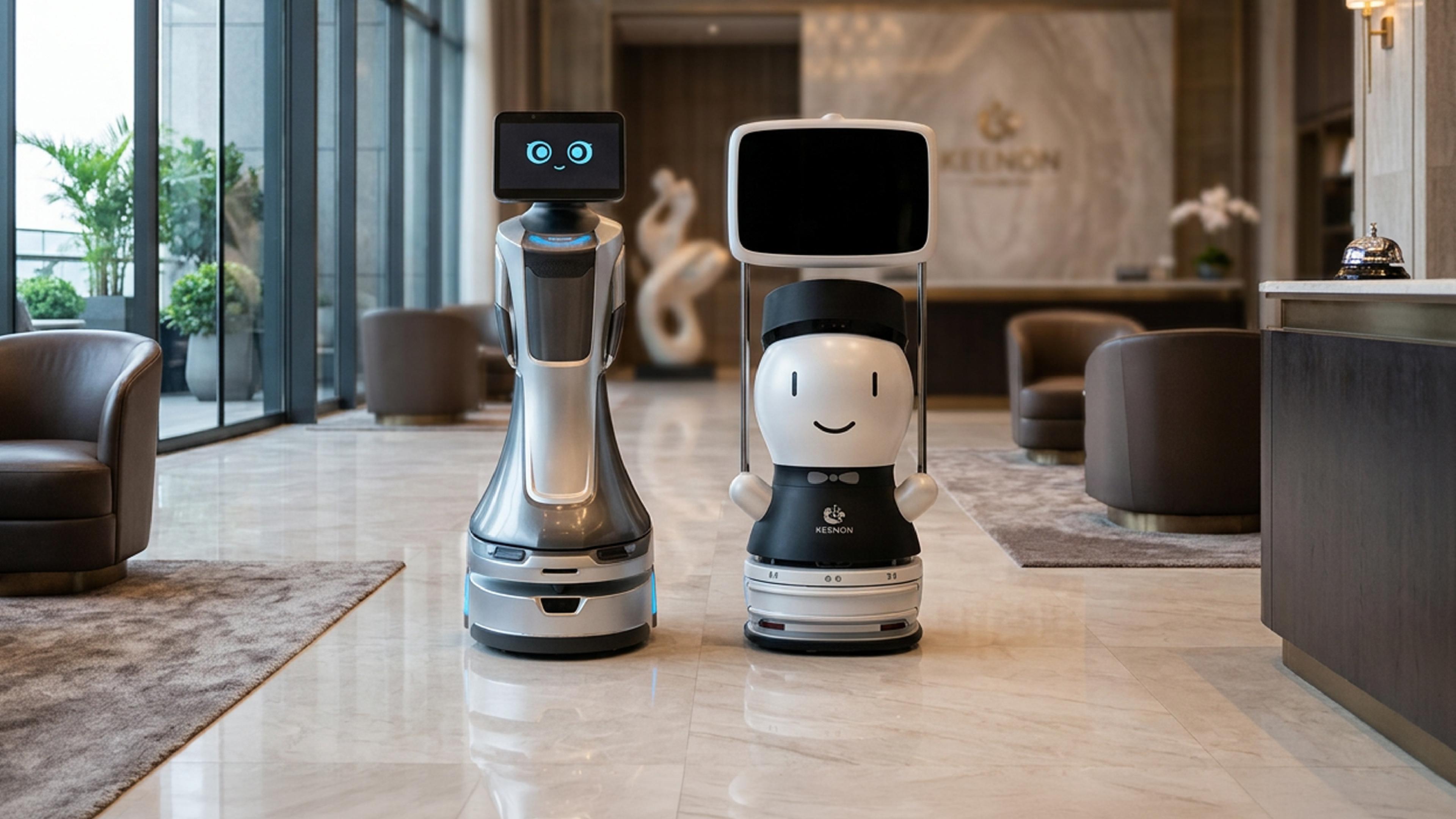
OrionStar GreetingBot Nova and KEENON GUIDERBOT G2 are both autonomous reception and visitor-guidance robots compared here on mobility, voice interaction, display technology, navigation and sensing capabilities, operating endurance and deployment versatility.

November 6, 2026 by Business Desk Team
Introduction
OrionStar GreetingBot Nova and KEENON GUIDERBOT G2 ' are' autonomous mobile service robots intended for visitor service operations in commercial and institutional settings. They share indoor autonomous navigation, voice interfaces and digital displays, but have different form factors, hardware set and batteries' maximum claimed operation time.
GreetingBot Nova can be deployed in and around reception to meet and greet visitors and guide them to their destination. Its 14-inch Full HD display, 13-megapixel camera, marker-less deployment and 3D LiDAR perception system enables a more interactive welcoming experience. GUIDERBOT G2 is designed for delivering information, entertainment and guidance in open-access areas thanks to its large double-sided display and multi-sensor navigation system.
The real comparison is therefore not only screen size or running time. It is how each solution aligns with the context of visit of the venue, visitor flow, navigation constraints, communication objectives and daily rhythm of the venue.
At a Glance
| Metric | OrionStar GreetingBot Nova | KEENON GUIDERBOT G2 |
|---|---|---|
| Robot type | Wheeled indoor autonomous mobile service robot (AMR) | Wheeled indoor autonomous guiding and service robot |
| Best-fit use cases | Reception, visitor engagement, guided tours and information services | Retail and showroom guidance, healthcare environments and information presentation |
| Dimensions (W × D × H) | 558 × 525 × 1,350 mm | 600 × 500 × 1,450 mm |
| Weight | 56 kg | 70 kg |
| Display | 14-inch Full HD (1080p) | Dual-sided 21.5-inch, 1080p HD display |
| Navigation / sensing | 3D LiDAR, depth-vision cameras and marker-free deployment | LiDAR, machine vision, depth vision and sonar; SLAM-based autonomous navigation |
| Maximum speed | 0.5–1.2 m/s, adjustable | Up to 1.2 m/s |
| Runtime | 12–14 hours in a typical cruising scenario | At least 7 hours |
| Charging time | 4.5 hours using the charging dock | Approximately 6 hours |
| Connectivity | Wi-Fi 2.4/5 GHz; 4G support listed in product documentation | Wi-Fi; other connectivity options depend on configuration |
| Voice interaction | Yes; conversational interaction and configurable applications | Yes; voice package for specific scenarios |
| Remote monitoring | Supported in the supplied Robot24 record | Supported in the supplied Robot24 record |
| Distinctive capabilities | 13 MP head camera, marker-free deployment, automatic return to dock | Large double-sided display, multi-sensor navigation and autonomous smart charging |
| Key limitation / caveat | Runtime is specified for a typical cruising scenario; actual performance depends on workload and deployment | Published battery life is at least 7 hours; the manufacturer notes that actual results vary with operating conditions |
How They Compare
Operational role: OrionStar GreetingBot Nova is a reception-oriented, visitor engagement and providing guided information. It is aimed at greeting visitors, sharing information and assisting visitors to navigate indoor environments. KEENON GUIDERBOT G2 incorporates a bigger advertising and information display, with autonomous guidance. Its double-sided screen is useful in situations where information needs to be accessible from different approach directions, such as retail stores, showrooms and visitor-facing services.
Display and visitor interaction: GreetingBot Nova has a 14" Full HD display, 13-megapixel camera and conversational interaction. Its smaller screen size means that it has less space for advertising and venue information. GUIDERBOT G2 features 2×21.5" 1080p displays, offering a larger screen surface area to show advertising, videos and venue information. While beneficial for sight and sound, a bigger display must not be mistaken for more extensive conversational ability.
Navigation and environmental perception: GreetingBot Nova is designed with 3D LiDAR and marker-free deployment. OrionStar states that its 3D LiDAR is used for full 170° field of view, expanded to 240° horizontally, with low obstacle sensing for people-focused environments. GUIDERBOT G2 combines LiDAR, machine vision, depth vision and sonar for positioning and navigation. Despite requirements for autonomous operation indoors, its ability to traverse the venue should be tested against layout, mirrors, crowd density and obstacles.
Mobility and physical footprint: GreetingBot Nova weighs 56 kg, 558 × 525 × 1,350 mm. GUIDERBOT G2 is heavier (70 kg) and larger (600 × 500 × 1,450 mm). Both state a maximum speed of 1.2 m/s. Nova's maximum cruising speed is also given as 1.2 m/s, but initial pilot is likely to want to use a lower cruising speed of around 0.5 m/s. G2 maximum speed has been measured in field testing at ~0.53 m/s, but initial pilot will probably wish to drive at cruising speed of 0.3 m/s. G2 minimum passage width is specified at 70 cm, maximum climb angle 5° (or less). These figures may need to be checked for compliance with circulation routes through actual facilities.
Operating endurance and charging: GreetingBot Nova lists at least 12-14 hours when running in normal cruising mode and requires about 4.5 hours of recharge time. GUIDERBOT G2 lists for minimum 7 hours of battery life with a 6-hour recharge time. Based on the numbers listed, Nova provides the better endurance and recharging profile. But the figure cannot be directly compared because it all depends how the robots are instructed to work, play and standby.
Deployment and fleet operations: Both robots are autonomous navigation and charging capable. GreetingBot Nova auto powers down when batteries fall below a user selected threshold, then auto returns to its charging dock. GUIDERBOT G2: auto scheduled or timed or battery level powered charging. Both Robots are listed for remote monitoring in the Robot24 comparative data supplied, but check with suppliers on what remote monitoring functionality, software subscriptions, fleet-management and network needs they have.
Important Qualification
OrionStar GreetingBot Nova: The claimed 12-14 hr. Battery life is based on the manufacturer's tests on standard levels of labor in standard cruising circumstances, not on extreme, straight time use and/or in heavy venue. Take into account software, hardware and camera specifications, language support, and connection before buying.
KEENON GUIDERBOT G2: The producer publishes runtime of not less than 7 hours and charging time of roughly 6 hours. Battery life can vary based on operating conditions and usage. Its bigger screen does not determine an advantage in navigating or visitor interaction.
Both platforms: Autonomous navigation and obstacle detection should not be considered in the context of proof of certified collaborative safety. Both systems: Test site trials in relation to pedestrian interactions, narrow spaces, lift access, network reliability and docking system and staff handover.
Summary
For first point of contact-led visitor interactions, friendly face-to-face chat and an extended named operating hour, pick OrionStar GreetingBot Nova. With marker-free navigation, a 13-megapixel camera, cruise speed regulation and an average cruising time of 12-14 hours, it can be a good fit for reception spaces, visitor centres, events and galleries.
Choose KEENON GUIDERBOT G2 for a bigger dual-sided display at the core of your workflow. 2 x 21.5-inch monitors, multi-sensor navigation design and autonomous charging capabilities are especially appropriate for retail, showroom and healthcare contexts were displaying information and inside positioning is critical.
This is a practical test, not a performance test. Verify which region you are comparing, the software package, monitoring features, support arrangement, and then test out at you location before buying.
This comparison is based on ROBOT24.com market-research data records and manufacturer-reported specifications rather than controlled performance testing.
More articles on this topic
144 articles ReportRichtech DUST-E S vs. Gausium Phantas
 ReportEngineAI SE01 vs. AGIBOT RAISE A1ReportRichtech DUST-E S vs. KEENON KLEENBOT C20
 ReportPUDU PuduBot 2 vs. OrionStar LuckiBot Pro
 ReportUnitree G1 vs. EngineAI PM01
 ReportKEENON DINERBOT T11 vs. PUDU KettyBot Pro
 ReportAGIBOT D1 Pro vs. Unitree Go2 Pro
 ReportKEYi Tech Loona vs. WEILAN BabyAlpha A2
 ReportPUDU BellaBot Pro vs. KEENON DINERBOT T11
 ReportBear Robotics Servi Plus vs PUDU BellaBot Pro
 ReportUnitree G1 vs. AGIBOT X2
 ReportPUDU KettyBot Pro vs. Bear Robotics Servi Q
BUSINESS NEWS WEEKLY LETTER
The Weekly Letter for Robotics Professionals, Summarizing the Most Important Industry Moves, Launches, Deals and Signals.