KEENON GUIDERBOT G2 vs. Robint Joy
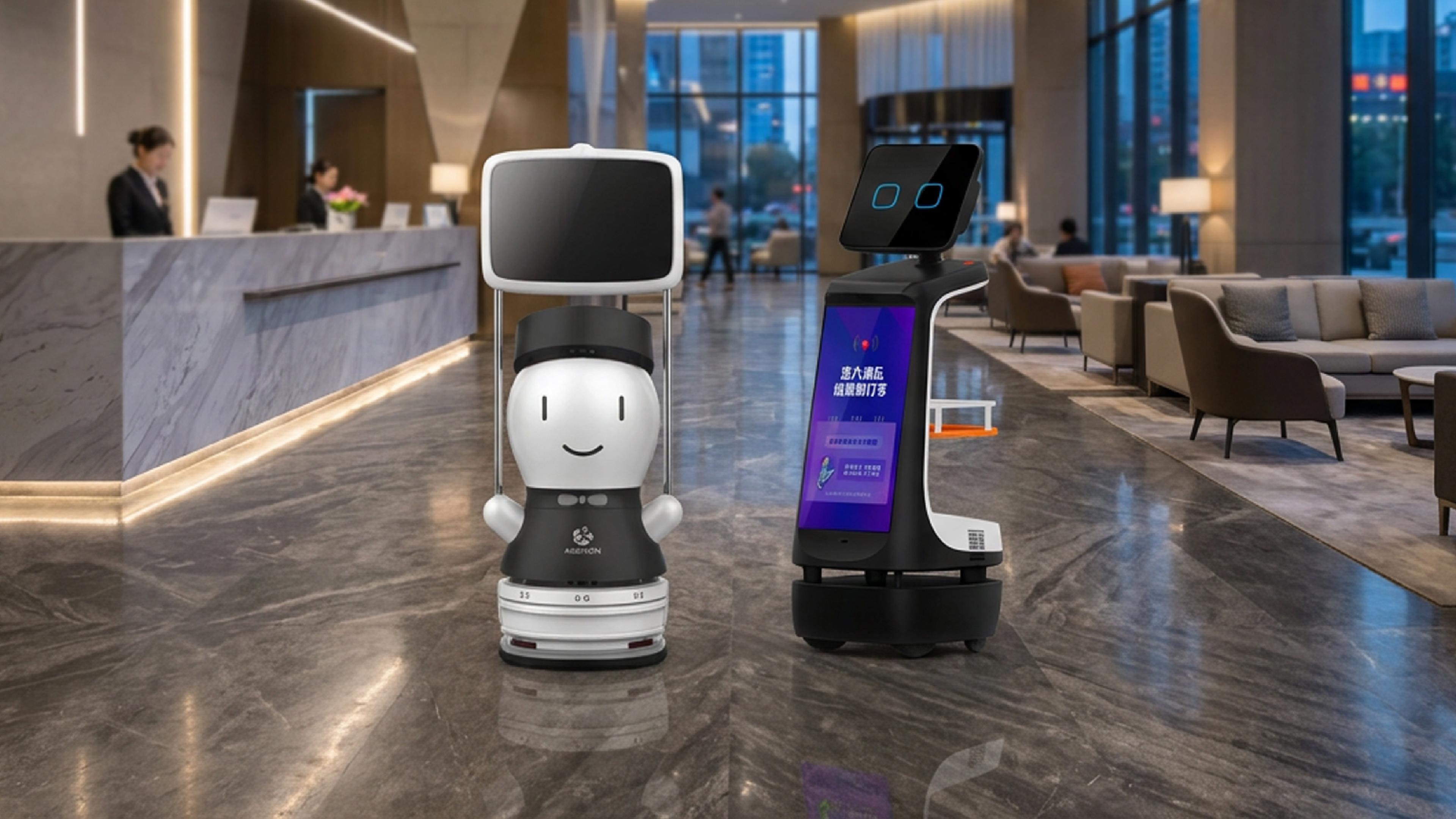
KEENON GUIDERBOT G2 and Robint Joy are both autonomous service robots compared here on navigation, visitor interaction, voice communication, sensor capabilities and deployment versatility.

November 6, 2026 by Business Desk Team
Introduction
KEENON GUIDERBOT G2 and Robint Joy are compared as wheeled autonomous service robots designed to assist visitor guidance, customer service and the operation of a facility listed as autonomous navigation, can detect humans, obstacle avoidance and voice interaction – relevant to environments open to the public such as retail stores, malls, hospital/healthcare environments and showrooms.
KEENON GUIDERBOT G2 targets visitor guidance, multi-lingual communications, and promotion display as a double-sided HD screen. Robint Joy (Joye on the current production website) is offered as an interactive reception platform for greetings, wayfinding, information requests, promotion display and security patrol. The main variance between them is their focus on a guided information presentation vs. a general reception and communication process.
At a Glance
| Metric | KEENON GUIDERBOT G2 | Robint Joy (Joye) |
|---|---|---|
| Robot type | Wheeled autonomous guiding and advertising service robot | Wheeled autonomous reception and service robot |
| Best-fit use cases | Healthcare guidance, retail, showrooms, hotels, museums and visitor information | Reception, healthcare check-in, retail, visitor guidance and facility patrol |
| Dimensions | 600 × 500 × 1,450 mm | 390 × 380 × 1,030 mm |
| Weight | 70 kg | 32 kg |
| Navigation | SLAM-based autonomous positioning and navigation | Autonomous navigation; specific SLAM method not confirmed in the product specification reviewed |
| Human detection | Listed as supported | Listed as supported; high-definition camera also specified |
| Obstacle avoidance | Yes; LiDAR, machine vision, depth vision, sonar and other sensors | Yes; manufacturer describes flexible obstacle avoidance |
| Voice interaction | Yes; multilingual voice guidance and scenario-based communication | Yes; natural-language enquiries, greetings and multilingual interaction |
| Display | 21.5-inch, 1080p double-sided HD screen | 13.3-inch touch control screen and 18.5-inch advertising display |
| Runtime / charging | At least 7–8 hours; charging time varies by specification source | 6–8 hours; approximately 3–4 hours charging |
| Maximum speed | Up to 1.2 m/s | 0–1.2 m/s |
| Obstacle clearance | Not specified in the reviewed product specification | Below 15 mm |
| Distinctive capabilities | Multilingual guidance, double-sided advertising, autonomous charging and SLAM navigation | Natural-language information enquiries, customised guided tours, advertising and security-patrol functions |
| Commercial status | Commercial | Commercial |
| Key limitation / caveat | Battery-life and charging figures vary across published specification sheets | The Robot24 listing uses “Joy”; the manufacturer's current product page uses “Joye”. Confirm the exact model and configuration |
How They Compare
Operational role: KEENON GUIDERBOT G2 is intended for such tasks as greeting and welcoming visitors, navigating and guiding, displaying information in multiple languages and advertising products. The double-sided display is especially valuable in environments such as malls, hospital, hotels, museums and showrooms where guidance and messages need to be visible from multiple angles. Robint Joye has a more general reception-behavior offering, including greeting and navigation, displaying information and enquiries, visitor tours and security patrols; it is suitable for organisations seeking a mobile reception and information service rather than just a guidance display.
Mobility and navigation: GUIDERBOT G2 employs SLAM-based autonomous position and navigation, using LiDAR, machine vision, depth vision and sonar. Its literature lists 1.2 m/s as its maximum speed and 5° as its maximum slope angle. Robint Joye is listed as an intelligent drive providing autonomous speed control from 0 to 1.2 m/s, obstacle avoidance and an obstacle-height specification of under 15 mm in its documentation. The manufacturer's product page also notes self-assisted elevator use. Its navigation architecture has not been specified in the specification documents we viewed. Ascertain route mapping, elevator use, minimum aisle width, transitions and recovery behaviour at the site demonstration.
Interaction and communication: GUIDERBOT G2 has a 21.5-inch double-sided 1080p display, multilingual voice guidance and scenario-based interaction. KEENON's product brochure states it supports 15 languages. Robint Joye is equipped with a 13.3-inch touch control screen and an 18.5-inch advertising display. The manufacturer claims natural-language information enquiries, greetings, and multilingual guided displays. Robint also boasts a question-and-answer database of more than 10 million entries; this is a manufacturer claim, and there is no information available to assess whether it supports multiple languages for each deployment, how often it is updated and how accurate it is.
Sensor capabilities and safety: GUIDERBOT G2 is equipped with LiDAR, machine vision, depth vision and sonar, with other sensing features in the product literature. Robint Joye speaks of an 8-megapixel high-definition camera, together with obstacle-avoidance. Its manufacturer mentions camera-enabled security-patrol and monitoring features. The Robot24 listing notes human detection in both platforms, though without indicating the detection range, accuracy, low-light use and safety response. We'd advise checking whether face/appearance-comparison and other camera-based functions meet the site's privacy, consent and data-minimisation policies.
Deployment and maintenance: GUIDERBOT G2 weighs 70 kg with 600 × 500 × 1,450 mm footprint. Robint Joye weighs 32 kg and measures 390 × 380 × 1,030 mm. Joye's smaller size could ease wall, doorway and corridor placement, though actual passage ability must be determined by measurements at the deployment site. GUIDERBOT G2 supports autonomous timed or quantitative charging; commercial sources list Robint automatic charging. Both guides require mapping of deployment site; floor requirements; network planning; and set up of interaction content. Confirm whether integrations to healthcare system applications, elevator access, patrol scheduling, video analytics for crowd control and remote fleet management capabilities are built in or additional.
Important Qualification
KEENON GUIDERBOT G2: Published battery-life figures are 7+ up to 8 hours in the market range for the product, while charging-time figures differ in all product literature at or below the published figure. The maximum speed and double-sided display are manufacturer-published specifications. Verify exact region configuration and battery specification prior to publishing.
Robint Joy: Joye is the reception robot listed on the manufacturer's current website, but it is called Joy in the Robot24 listing. Confirm that they are indeed the same model. Manufacturer lifts 8-megapixel camera, 6-8 hours battery time, 3-4 hours charge time. Natural-language database and security-patrol listed as features by manufacturer, not test results.
Both the robots: Autonomous navigation and obstacle avoidance, cannot automatically establish certified human-collaborative safety. Before using the robot, Check emergency-stop capabilities, pedestrian detection capability, data management and storage, security of the networks, etc. Maintenance and local support information.
Summary
Choose KEENON GUIDERBOT G2 If it is multilingual, SLAM-based visitor guidance, a large double-sided ad display and autonomous charging are key to the use case. Consider Robint Joy (Joye) if it's the need is for a smaller reception robot with natural-language questions, customised visitor tours, advertising screens and a camera-based patrolling function.
GUIDERBOT G2 is physically larger with more explicit documentation of the sensor architecture, and Joye provides a larger number of reported reception- and information- enquiry- enabled functions on a more compact platform. As a match of intended applications there is no manual ranking of performance. Verify Robint's model identity, test in your environment, and confirm requirements before asserting advantages.
This comparison is based on ROBOT24.com market-research data records and manufacturer-reported specifications rather than controlled performance testing.
More articles on this topic
144 articles ReportRichtech DUST-E S vs. Gausium Phantas
 ReportEngineAI SE01 vs. AGIBOT RAISE A1ReportRichtech DUST-E S vs. KEENON KLEENBOT C20
 ReportPUDU PuduBot 2 vs. OrionStar LuckiBot Pro
 ReportUnitree G1 vs. EngineAI PM01
 ReportKEENON DINERBOT T11 vs. PUDU KettyBot Pro
 ReportAGIBOT D1 Pro vs. Unitree Go2 Pro
 ReportKEYi Tech Loona vs. WEILAN BabyAlpha A2
 ReportPUDU BellaBot Pro vs. KEENON DINERBOT T11
 ReportBear Robotics Servi Plus vs PUDU BellaBot Pro
 ReportUnitree G1 vs. AGIBOT X2
 ReportPUDU KettyBot Pro vs. Bear Robotics Servi Q
BUSINESS NEWS WEEKLY LETTER
The Weekly Letter for Robotics Professionals, Summarizing the Most Important Industry Moves, Launches, Deals and Signals.