KEENON DINERBOT T8 vs. Bear Robotics Servi Q
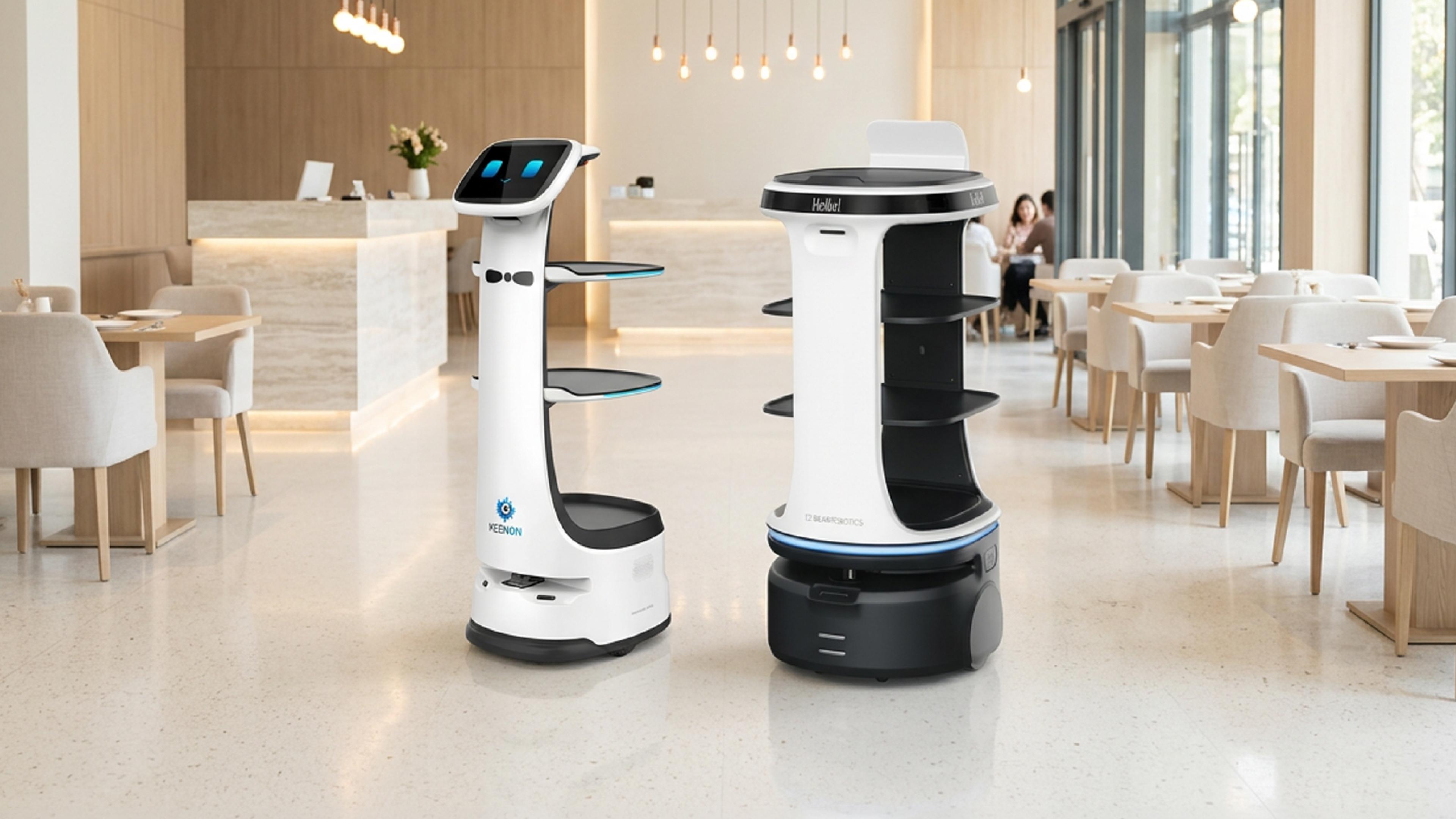
KEENON DINERBOT T8 and Bear Robotics Servi Q are both autonomous restaurant delivery robots compared here on mobility, narrow-passage navigation, payload capacity, multi-robot coordination, customer interaction and operating endurance.

November 10, 2026 by Business Desk Team
Introduction
KEENON DINERBOT T8 and Bear Robotics Servi Q are small autonomous mobile robots intended to assist with food delivery and other repetitive service duties in business settings. The two robots are built to move through tight spaces, work alongside other robots and carry items back and forth between kitchens, service stations and guests.
The key difference is how they are designed to be used DINERBOT T8 is for compact navigation and tray-level detection, along with multimodal pickup notifications and a customer-facing touchscreen. Bear Robotics Servi Q is designed for restaurants with much tighter layouts to it by offering backwards mobility, tray configuration flexibility and integration into the Bear Robotics fleet.
The more suitable platform depends on passage width, payload requirements, delivery workflow and the operating environment rather than maximum speed or runtime alone.
At a Glance
| Metric | KEENON DINERBOT T8 | Bear Robotics Servi Q |
|---|---|---|
| Robot type | Compact multi-tray restaurant delivery AMR | Compact restaurant delivery AMR |
| Best-fit use cases | Restaurant delivery, self-pickup, retail and commercial service workflows | Restaurants with narrow aisles, bar areas and compact service layouts |
| Dimensions (W × D × H) | 384 × 468 × 1,111 mm | 350 × 466 × 1,060 mm |
| Weight | 34 kg (T8 LS; other editions may differ) | 45 kg |
| Payload capacity | 20 kg total; 5 kg per upper tray and up to 10 kg on the bottom tray | 30 kg total; 10 kg per tray or bottom shelf |
| Runtime | Up to 15 hours (T8 LS specification) | ≥12 hours, depending on usage |
| Charging time | Approximately 4 hours | 4–6 hours, depending on settings |
| Maximum speed | 1.0 m/s (listed specification; version-dependent) | 0.7 m/s |
| Minimum passage width | 55 cm | 45 cm (18 inches) |
| Navigation / sensing | SLAM-based navigation; stereo vision and multi-sensor obstacle detection | Autonomous navigation with obstacle detection and backward bump detection |
| Tray configuration | Three tiers; approximately 300° open-tray access | Configurable 1-, 2- or 3-tray arrangements, depending on setup |
| Customer interaction | 10.1-inch touchscreen, voice, lighting and visual pickup notifications | 8-inch touchscreen and 18.5-inch advertising display |
| Multi-robot coordination | Supported | Supported through peer-to-peer Bear ecosystem communication |
| Autonomous charging | Supported, configuration-dependent | Not specified on the current product specification reviewed |
| Key limitation / caveat | 20 kg payload and 55 cm passage requirement should be checked against the actual restaurant layout | Lower maximum speed and longer stated charging range; confirm the required charging and fleet configuratio |
How They Compare
Operational role: KEENON DINERBOT T8 is designed for structured delivery and self-pickup workflows. Its tray-detection sensors, 300° open-tray design and touchscreen-based voice and visual notifications help guide customers through item collection. Bear Robotics Servi Q is designed around compact restaurant operations, particularly narrow bar areas, kitchen corridors and crowded pickup zones. Its configurable tray arrangements allow operators to adapt the robot to different service requirements.
Mobility and passage clearance: DINERBOT T8 specifies a minimum passage width of 55 cm, while Servi Q is designed to navigate passages as narrow as 45 cm. This gives Servi Q an advantage where existing layouts have particularly tight corridors or limited turning space. Its backward movement capability also allows it to reverse when a corridor is too narrow to turn around. DINERBOT T8, meanwhile, publishes a maximum moving speed of 1.0 m/s compared with Servi Q's 0.7 m/s. Actual throughput depends on route complexity, pedestrian traffic, load and speed settings.
Payload and physical configuration: DINERBOT T8 weighs approximately 34 kg in its LS configuration and supports a total payload of 20 kg, distributed across three trays. Bear Robotics Servi Q weighs 45 kg and specifies a total load capacity of 30 kg, with up to 10 kg per tray or bottom shelf. Servi Q therefore offers a higher published payload capacity, while T8 has a lower listed operating weight. The difference matters when assessing load requirements, floor conditions and the number of delivery trips needed during service.
Navigation and fleet coordination: DINERBOT T8 uses SLAM-based positioning, stereo vision and multi-sensor obstacle detection. Its manufacturer also describes multi-robot dispatching and coordinated route planning. Servi Q uses autonomous navigation with obstacle detection and backward bump detection, while communicating peer-to-peer with other robots in the Bear ecosystem. The latter is particularly relevant for operators deploying different Bear models across separate restaurant zones. Both systems should be tested in busy environments to assess route planning, congestion handling, pedestrian interaction and fleet reliability.
Interaction and service experience: DINERBOT T8 uses a 10.1-inch touchscreen, voice prompts, lighting and visual notifications to support customer pickup. Its tray-detection system can help identify item collection and reduce pickup errors. Servi Q offers an 8-inch touchscreen and a larger 18.5-inch advertising display, turning delivery journeys into opportunities to show promotions, branded content and daily specials. The distinction is between T8's guided pickup workflow and Servi Q's combination of compact delivery and promotional display capability.
Battery and operating endurance: DINERBOT T8 lists up to 15 hours of battery life and approximately four hours of charging for the specified LS configuration. Servi Q specifies at least 12 hours of battery life, with charging taking approximately four to six hours depending on settings. These are manufacturer-published figures, not guaranteed operating durations under identical conditions. Actual endurance will depend on payload, route length, traffic, interaction frequency and charging schedules.
Important Qualification
KEENON DINERBOT T8: Specifications vary by edition. Published materials distinguish LS and LB configurations, with differences in weight, battery life and charging time. The 34 kg weight, 15-hour runtime and four-hour charging figure should therefore be associated with the relevant configuration rather than treated as universal T8 specifications.
Bear Robotics Servi Q: The current manufacturer specification lists a 45 kg weight, 45 cm minimum aisle width, 0.7 m/s drive speed, 30 kg total load capacity and at least 12 hours of battery life. Charging is listed as four to six hours, depending on robot settings.
Payload: T8 specifies 20 kg total capacity, while Servi Q specifies 30 kg. These figures should be evaluated alongside tray-level limits and load distribution rather than treated as interchangeable maximums.
Multi-robot coordination: Both manufacturers describe coordinated operation. However, T8's multi-robot dispatching and Servi Q's peer-to-peer Bear ecosystem communication are different fleet architectures. Confirm cross-model compatibility, network requirements and software licensing before deployment.
Safety and navigation: Obstacle detection, backward bump detection and autonomous navigation do not independently establish certified collaborative safety. Validate emergency-stop functions, collision response, pedestrian detection and relevant safety documentation before deployment.
Application scope: DINERBOT T8 is documented for several commercial service environments, while Servi Q is primarily positioned around restaurant operations. Suitability for healthcare or other specialised environments should be verified against the specific workflow and manufacturer-supported integrations.
Summary
Choose KEENON DINERBOT T8 when a restaurant needs structured food delivery, guided self-pickup, tray-level detection and coordinated service operations. Its 1.0 m/s listed speed, 20 kg payload and multimodal pickup notifications make it relevant to restaurants seeking an organised delivery workflow.
Consider Bear Robotics Servi Q when narrow passage clearance, flexible tray arrangements and higher payload capacity are more important. Its 45 cm minimum passage width, 30 kg total load capacity, backward movement capability and integration with the Bear Robotics fleet make it particularly relevant to compact restaurant layouts.
This is a fit-for-purpose comparison, not a controlled performance ranking. Confirm the exact T8 edition, tray-level payload limits, minimum aisle clearance, charging arrangements and fleet compatibility before procurement. On-site trials under representative service loads are recommended before making superiority claims.
This comparison is based on ROBOT24.com market-research data records and manufacturer-reported specifications rather than controlled performance testing.
More articles on this topic
144 articles ReportRichtech DUST-E S vs. Gausium Phantas
 ReportEngineAI SE01 vs. AGIBOT RAISE A1ReportRichtech DUST-E S vs. KEENON KLEENBOT C20
 ReportPUDU PuduBot 2 vs. OrionStar LuckiBot Pro
 ReportUnitree G1 vs. EngineAI PM01
 ReportKEENON DINERBOT T11 vs. PUDU KettyBot Pro
 ReportAGIBOT D1 Pro vs. Unitree Go2 Pro
 ReportKEYi Tech Loona vs. WEILAN BabyAlpha A2
 ReportPUDU BellaBot Pro vs. KEENON DINERBOT T11
 ReportBear Robotics Servi Plus vs PUDU BellaBot Pro
 ReportUnitree G1 vs. AGIBOT X2
 ReportPUDU KettyBot Pro vs. Bear Robotics Servi Q
BUSINESS NEWS WEEKLY LETTER
The Weekly Letter for Robotics Professionals, Summarizing the Most Important Industry Moves, Launches, Deals and Signals.