KEENON DINERBOT T5 vs. OrionStar LuckiBot
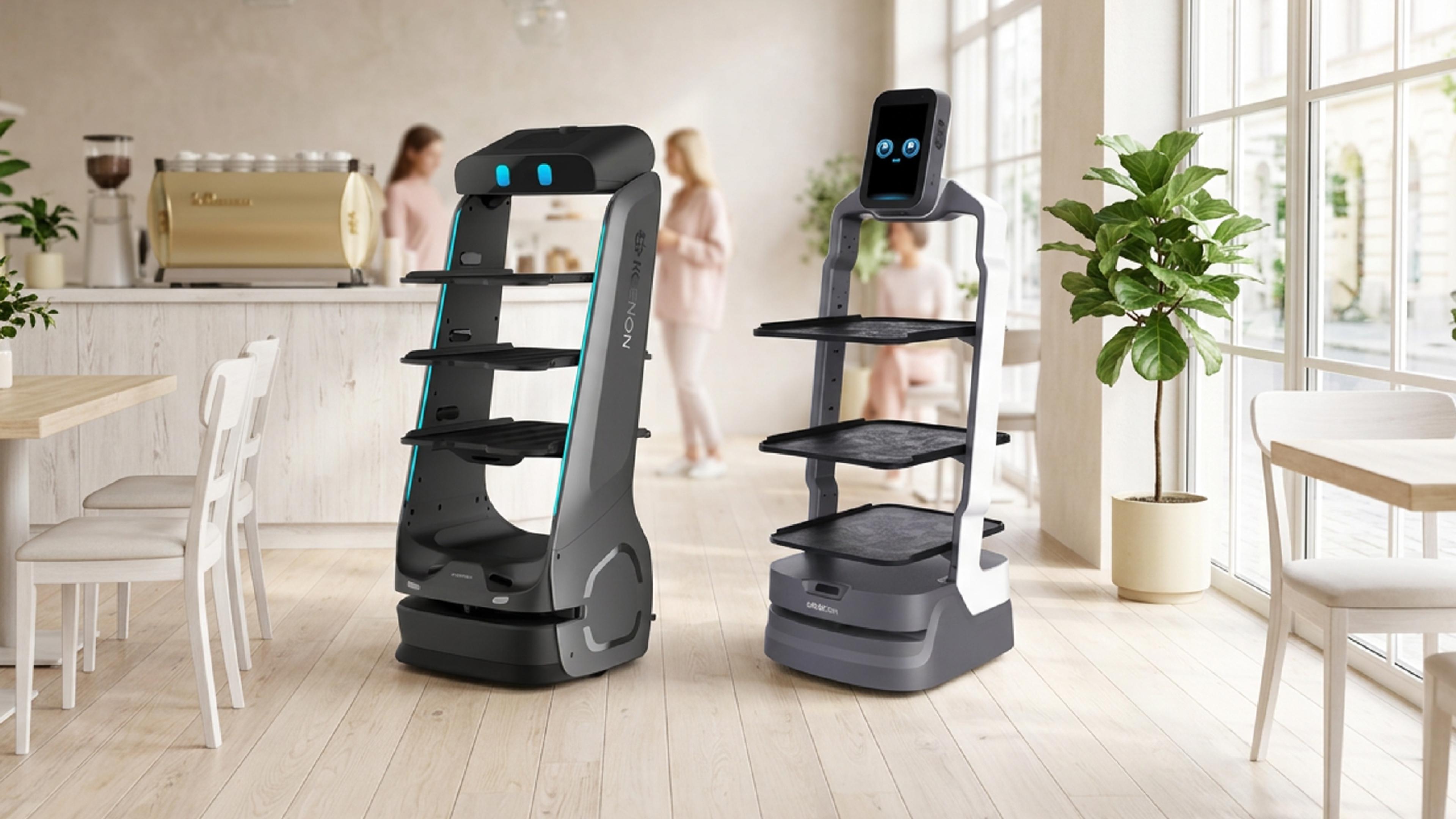
KEENON DINERBOT T5 and OrionStar LuckiBot are both autonomous indoor delivery robots compared here on mobility, tray configuration, payload capacity, navigation and obstacle detection, fleet coordination and operating endurance.

November 9, 2026 by Business Desk Team
Introduction
KEENON DINERBOT T5 & OrionStar LuckiBot are compared for autonomous indoor delivery in food service and healthcare settings. Commercially available autonomous mobile robot (AMR) systems using LiDAR and IMU sensing, autonomous navigation and fleet-management functions for near-field delivery.
The main differences concern tray configuration, physical footprint and operating endurance. DINERBOT T5 has four stacked, adjustable trays at 10 kg each, and the product has a published run time of 12-15 hours. Meanwhile the LuckiBot has three or four adjustable trays and a stated run time of 10-12 hours. The practical choice depends on payload requirements, route conditions and the service workflow.
At a Glance
| Metric | KEENON DINERBOT T5 | OrionStar LuckiBot |
|---|---|---|
| Robot type | Autonomous tray-delivery AMR | Autonomous indoor delivery AMR |
| Best-fit use cases | Food service and healthcare | Food service and healthcare |
| Dimensions | 506 × 502 × 1,205 mm | 526 × 493 × 1,320 mm |
| Weight | 50 kg | 37 kg |
| Tray configuration | 4 adjustable trays; 10 kg per tray (listed) | 3 or 4 adjustable trays |
| Runtime | 12–15 h | 10–12 h |
| Charging time | Approximately 5 h | 3.5–4.5 h |
| Navigation / sensing | Autonomous navigation, LiDAR and gyroscope | Autonomous navigation, 210° LiDAR and IMU |
| Fleet management | Supported | Supported |
| Multi-robot coordination | Supported | Supported |
| Operating environment | Indoor only | Indoor only |
| Connectivity | Wi-Fi | Wi-Fi |
| Nationality | Chinese | Chinese |
| Commercial availability | Commercially available | Commercially available |
| Key distinction | Four-tray configuration with a stated 10 kg capacity per tray | Lighter chassis and shorter listed charging time |
| Key limitation / caveat | 50 kg platform weight; confirm total payload and runtime conditions | Tray payload rating is not specified in the supplied record |
How They Compare
Operational role and tray configuration: The robots are both intended for indoor food service and healthcare delivery workflows. DINERBOT T5: 4 adjustable trays rated at 10 kg each as stated in the supplied datasheet. LuckiBot: 3 or 4 adjustable trays but without any specified payload limit per tray (tray load carrying capacity in terms of number of goods will vary depending on individual size and weight). The four-tray payload capacity of the T5 is therefore better specified but not the overall payload and load distribution-check with the manufacturer.
Physical size and accessibility: DINERBOT T5 dimensions are 506 × 502 × 1205mm, 50kg. LuckiBot dimensions are 526 × 493 × 1320mm, 37kg. Weight is 13kg lighter for the LuckiBot, whereas T5 is shorter vertically and marginally narrower in its listed dimensions. Availability for transportation and storage, or movement through service areas may be impacted by the relative sizes and weight of the systems (including clearance needed for turning, tray overhangs, width of doors, and robot behaviour regarding obstacles).
Runtime and charging: DINERBOT T5 is rated at 12-15 hours of runtime and 5 hours of charging. LuckiBot: 10-12 hours rated runtime, 3.5-4.5 hours charging runtime. The T5 has longer stated runtime, and the LT has less stated charge time. These can be expected to be the stated and supplied-record specifications, not guaranteed shift figures. The long runtime rating does not necessarily mean better endurance; if the robot must work a full shift, route length, traffic and its recharging cycle will determine its endurance.
Navigation and obstacle sensing: Autonomous navigation is provided by both bots using LiDAR sensing along with an IMU or gyroscope. Official LuckiBot specs list 210 deg. Of LiDAR sensing, but this is unspecified for the T5. Field of view alone does not determine more effective navigation. Mapping precision, obstacle detection, re-routing with moving people, working with others should all be tested individually.
Fleet coordination and connectivity: Both platforms include fleet management, multi-robot coordination, and Wi-Fi connectivity. These are applicable for facilities managing multiple delivery robots. The specifications provided do not specify any fleet size limits, whether multi-model robots are compatible, if they can be integrated with a hospital or restaurant system, or if the cloud-management features require a new subscription. Verify these particulars before deploying multiple robots.
Indoor operating environment: Both these devices are indicated for indoor use only, and they do not support outdoor use. They should be considered according to indoor flooring, widths of corridors, lift access, coverage in terms of connectivity and how people and equipment are moving. In healthcare settings, revalidation of hygiene, safe handover and what the robot is used for must be considered.
Important Qualification
The data provided does not verify the maximum speed, total payload capacity, battery capacity, sensor range, navigation accuracy, obstacle-detection capabilities or integration of an autonomous lift.
DINERBOT T5: 10kg per tray valuation should not be standard seen as a sure shot 40kg payload unless we get the manufacturer's total load capacity. Additionally, the tray payload rating for LuckiBot is not specified which makes it difficult for a pallet-to-pallet cargo comparison.
For the declared usage model, validate runtime and charge figures with precise commercial configuration and test conditions. LiDAR coverage does not only define navigation ground truth nor ensure certified people safety.
Summary
Choose KEENON DINERBOT T5 with four adjustable trays, supposedly 10 kg each and the longer listed runtime of 12-15 hours to match your delivery volume.
Consider OrionStar LuckiBot if a lighter 37 kg platform, three- or four-tray flexibility and a shorter listed charging time more suited to the facility's needs.
This is a real-world comparison, not a sequential performance ranking. Validated total payload and total tray capacity, exact flight duration, navigation accuracy and fleet-management integration. Test on-site with real delivery payloads and routes before you order or publish bragging rights.
This comparison is based on ROBOT24.com market-research data records and manufacturer-reported specifications rather than controlled performance testing.
More articles on this topic
144 articles ReportRichtech DUST-E S vs. Gausium Phantas
 ReportEngineAI SE01 vs. AGIBOT RAISE A1ReportRichtech DUST-E S vs. KEENON KLEENBOT C20
 ReportPUDU PuduBot 2 vs. OrionStar LuckiBot Pro
 ReportUnitree G1 vs. EngineAI PM01
 ReportKEENON DINERBOT T11 vs. PUDU KettyBot Pro
 ReportAGIBOT D1 Pro vs. Unitree Go2 Pro
 ReportKEYi Tech Loona vs. WEILAN BabyAlpha A2
 ReportPUDU BellaBot Pro vs. KEENON DINERBOT T11
 ReportBear Robotics Servi Plus vs PUDU BellaBot Pro
 ReportUnitree G1 vs. AGIBOT X2
 ReportPUDU KettyBot Pro vs. Bear Robotics Servi Q
BUSINESS NEWS WEEKLY LETTER
The Weekly Letter for Robotics Professionals, Summarizing the Most Important Industry Moves, Launches, Deals and Signals.