KEENON DINERBOT T10 vs. PUDU PuduBot 2
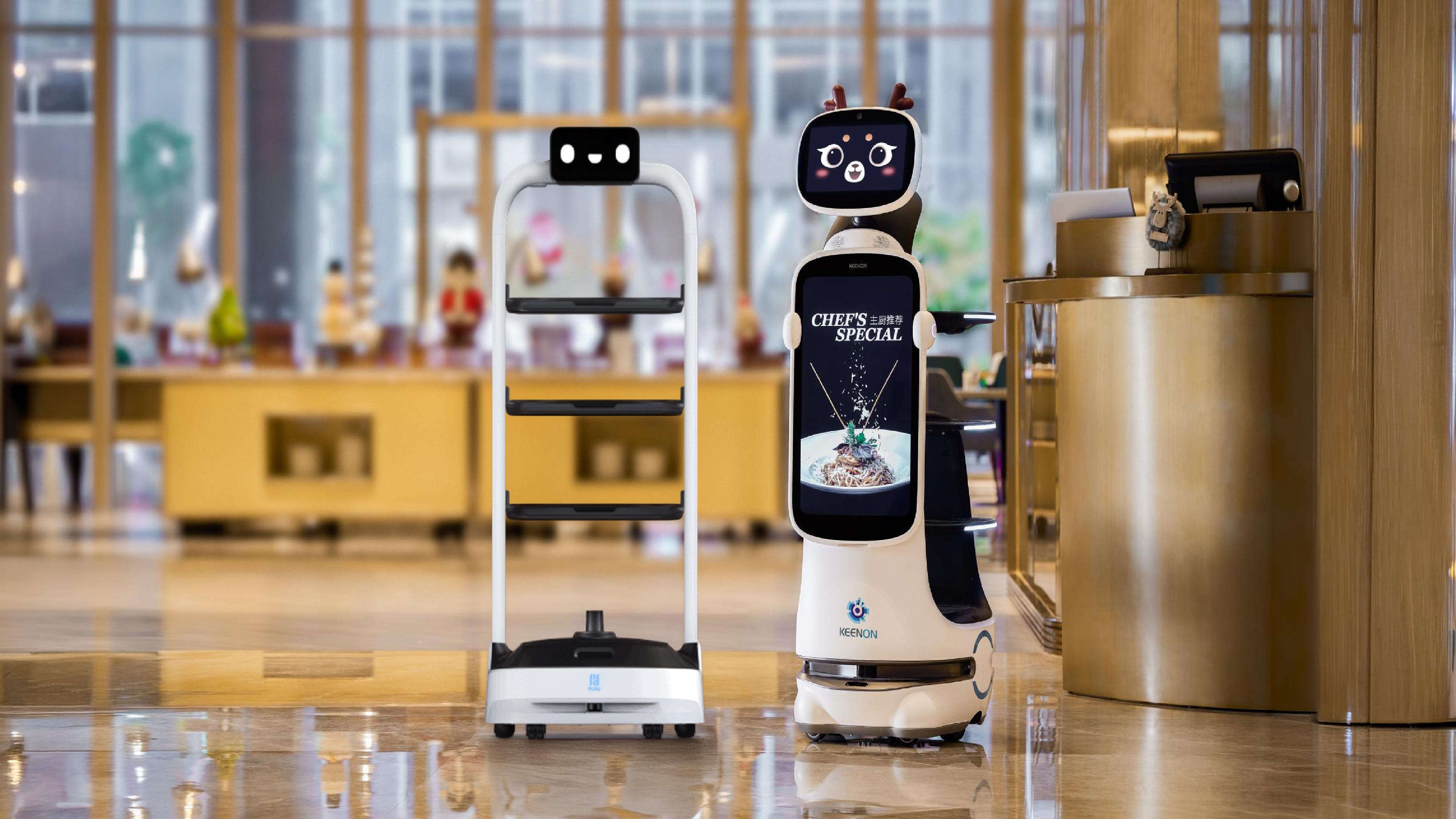
KEENON DINERBOT T10 and PUDU PuduBot 2 are both autonomous service robots compared here on delivery capacity, navigation technology, customer interaction, configurable workflows and deployment requirements.

October 31, 2026 by Business Desk Team
Introduction
KEENON DINERBOT T10 and PUDU PuduBot 2 are compared for autonomous delivery in restaurants and other indoor service environments. The question is whether you need a customer-oriented restaurant robot with touchscreen and other interactive capabilities, or a flexible platform for sending out various delivery workflows.
KEENON DINERBOT T10 integrates autonomous food delivery with a 23.8-inch advertising screen, head movement interaction, AI tray-sensing, customer interaction and guidance. PUDU Bot 2 offers a more flexible load-carrying solution that can deliver multiple trays, perform dish return, coordinate multiple robots, and be deployed in restaurants, hotels, hospitals, retail outlets and office buildings.
At a Glance
| Metric | KEENON DINERBOT T10 | PUDU PuduBot 2 |
|---|---|---|
| Robot type | Interactive restaurant delivery and advertising AMR | Multi-purpose autonomous delivery AMR |
| Best-fit use cases | Restaurant meal delivery, customer engagement and advertising | Restaurant delivery, dish return, hotel logistics and indoor item transportation |
| Dimensions (W × D × H) | 486 × 555 × 1,399 mm | 580 × 535 × 1,290 mm |
| Robot weight | 58 kg | 39 kg |
| Total load capacity | 40 kg | 40 kg |
| Tray configuration | Open-access delivery trays with AI tray detection | 3 standard trays; configurable up to 7 |
| Runtime / charging | 9–12.5 h; 5.5 h charging | Official claims vary: 12 h unloaded / 15 h fully loaded in the product overview; up to 24 h also advertised; approximately 4 h charging |
| Navigation / sensing | VSLAM, 4 stereo vision sensors and 1 RGB camera; 360° recognition | PUDU VSLAM+, dual LiDAR and 360° environmental sensing |
| Maximum speed | 1 m/s | 0.5–1.2 m/s |
| Minimum passage width | 59 cm | 80 cm |
| Distinctive capabilities | 23.8-inch display, movable head, interactive buttons, AI tray detection and voice prompts | Marker-less mapping, multiple delivery modes, automatic charging, multi-robot coordination and configurable accessories |
| Key limitation / caveat | 5° maximum slope; charging takes 5.5 hours | Requires approximately 80 cm passage clearance; battery-life claims need configuration-specific confirmation |
How They Compare
Operational role: KEENON DINERBOT T10, mainly working as a food delivery system equipped with advertising and interaction, has a movable head, large screen, and interactive pickup guidance, providing a more interesting dining experience. PUDU Bot 2 is a multi-purpose delivery robot suitable for food delivery, dish return, cruise, and other customizable workflows. Its broader application range makes it relevant to restaurants, hotels, hospitals, retail and office environments.
Hardware and carrying capacity: Both T10 and Pudu Bot 2 are rated for a combined payload of 40 kg. T10 weighs 58 kg and is 486 × 555 × 1,399 mm. Pudu Bot 2 weighs around 39 kg and is 580 × 535 × 1,290 mm. Pudu Bot 2 has 3 standard trays, while T10 has open-access trays with visual detection and pickup guidance, and can have up to 7. As a result, the differences in payload are reflected in how their payload is distributed, its accessibility, and the amount of floor space needed to maneuver around.
Navigation & deployment: DINERBOT T10 uses VSLAM with four stereo vision sensors and an RGB camera for environment detection and navigation. Pudu Bot 2 offers PUDU VSLAM+ (PUDU's visual SLAM algorithm), dual LiDAR and 360° sensing, with marker-less mapping enabling quick deployment. Key difference in practice is passage clearance: KEENON quotes minimum passage width of 59cm (23.2in), versus around 80cm (31.5in) for Pudu Bot 2. Check these against actual aisle widths, doorways, turning spaces and the service routes prior to implementation.
Customer interaction and delivery workflow: The DINERBOT T10 has a focus on customer face interaction that comes with 23.8-inch screen, movable head, buttons, tray lighting, voice menu and tray detecting based on AI. The Pudu Bot 2 is designed for more versatile delivery operation such as delivery, birthday, cruise and dish return. Pudu Bot 2 has PUDU Watch, PUDU Pager and PUDU Link to distribute the tasks and inform the arrival. The difference is the more interactive restaurant-service versus the configurable delivery operation.
Runtime and operational endurance: KEENON reports 9-12.5 hours of battery life with a 5.5 hour charge. PUDU's own product page claims up to 24 hours with a four-hour charge, but its overview says 12 hours unloaded and 15 hours loaded. These figures are not interchangeable without checking the same battery model, operating conditions and test procedure. For both robots, endurance will vary with payload, range, operating cycle and charge levels.
Important Qualification
KEENON DINERBOT T10: The 40 kg capacity is a total load rating, not a per-tray rating. Its 5° slope limit and 59 cm minimum passage specification should be considered during site planning.
PUDU Bot 2: The manufacturer states a range of batteries on the product page. Check the battery option and stated range with the seller before purchasing. Its 80cm clearance height may be too much for some narrow restaurant arrangements.
Deployment: Navigation capability will vary based on floor surfaces, lighting, obstacles, mapping and network conditions. Make sure you know what is included and what extras are needed for elevator, door-control and POS integrations.
Performance claims: Manufacturer's specs are not independently tested and are not performance claims. During a site visit, validate navigation, accuracy of delivery, obstacle handling, parking/charging performance and multi-robot performance.
Summary
Choose KEENON DINERBOT T10 for restaurant delivery, customer interaction, advertising, and interactive guidance to pick up if that is the service flow. Its 59 cm minimum aisle width may also be advantageous to restaurants where the aisles are narrower.
PUDU PuduBot 2 is suitable when multi-purpose delivery, flexible tray configuration, dish-return functionality and multi-indoor operation are the key requirements. Powered by PUDU VSLAM+ navigation, dual LiDAR sensors and multi-robot coordination, it caters to a wider scope of delivery use cases.
This is a performance fit-for purpose conclusion, not a controlled performance ranking. Verify the exact ordered configurations, batteries, passages and integrations, and have site trials before publishing superiority statements.
This comparison is based on ROBOT24.com market-research data records and manufacturer-reported specifications rather than controlled performance testing.
More articles on this topic
144 articles ReportRichtech DUST-E S vs. Gausium Phantas
 ReportEngineAI SE01 vs. AGIBOT RAISE A1ReportRichtech DUST-E S vs. KEENON KLEENBOT C20
 ReportPUDU PuduBot 2 vs. OrionStar LuckiBot Pro
 ReportUnitree G1 vs. EngineAI PM01
 ReportKEENON DINERBOT T11 vs. PUDU KettyBot Pro
 ReportAGIBOT D1 Pro vs. Unitree Go2 Pro
 ReportKEYi Tech Loona vs. WEILAN BabyAlpha A2
 ReportPUDU BellaBot Pro vs. KEENON DINERBOT T11
 ReportBear Robotics Servi Plus vs PUDU BellaBot Pro
 ReportUnitree G1 vs. AGIBOT X2
 ReportPUDU KettyBot Pro vs. Bear Robotics Servi Q
BUSINESS NEWS WEEKLY LETTER
The Weekly Letter for Robotics Professionals, Summarizing the Most Important Industry Moves, Launches, Deals and Signals.