Double Robotics Double 3 vs. PadBot P2
Double Robotics Double 3 and PadBot P2 are both autonomous telepresence robots compared here on remote mobility, audiovisual communication, navigation and obstacle avoidance, connectivity, operating endurance and deployment versatility.

November 9, 2026 by Business Desk Team
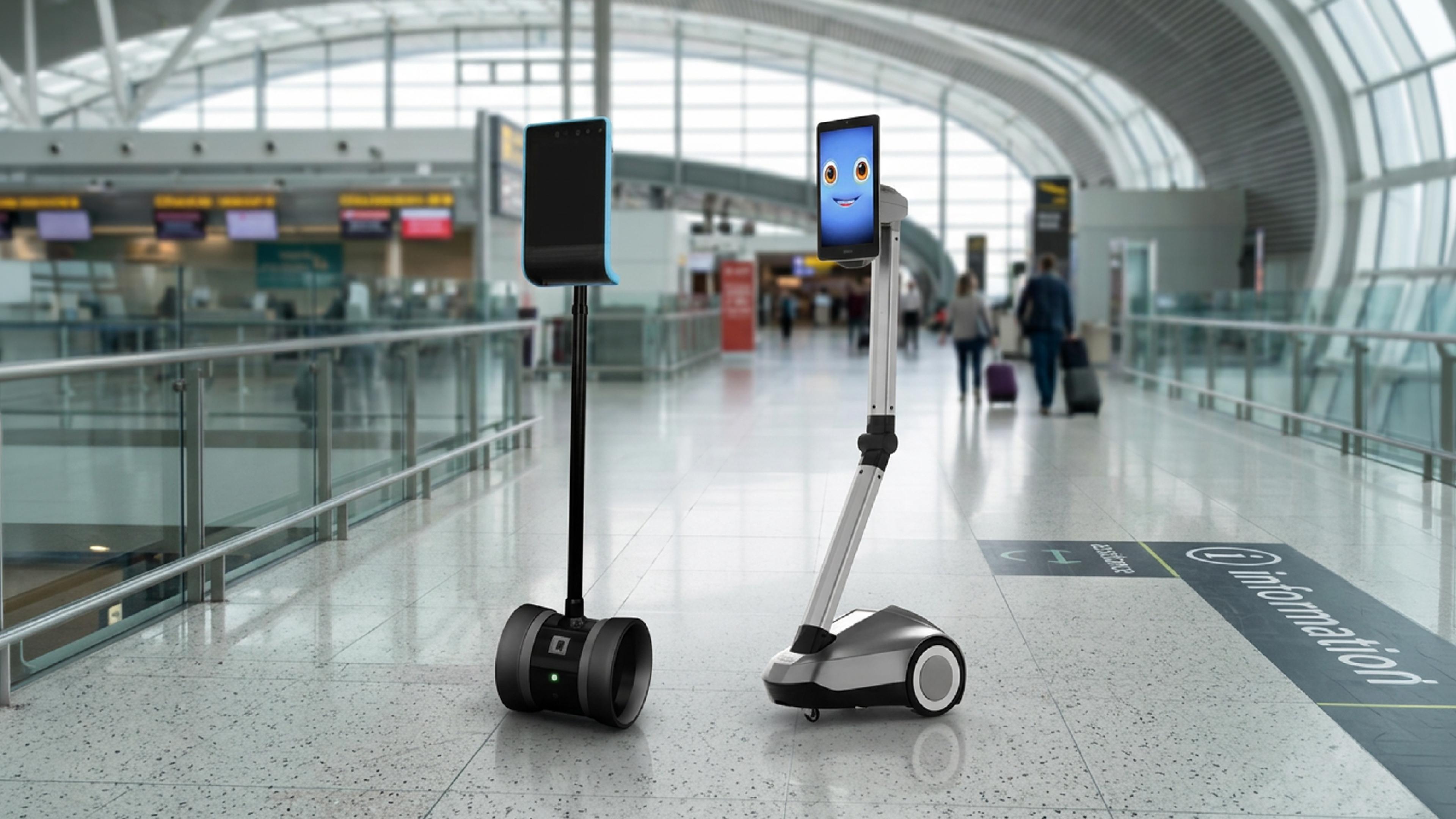
Introduction
Double Robotics Double 3 and PadBot P2 are compared as mobile telepresence platforms that allow remote users to move through physical environments and communicate with people on-site. Rather than functioning as independent service or delivery robots, both act as remotely operated physical extensions of a person, supporting meetings, virtual visits, inspections and collaborative activities.
Double 3 is built for workplace telepresence. Equipped with two 13-megapixel pan-tilt-zoom cameras, six beamforming microphones, depth sensing hardware, and assisted autonomous driving, the adjustable-height display and click-to-drive interface enable more natural participation at work, school, and in healthcare environments.
PadBot P2 is dedicated to easy remote communication and mobile video conferencing. It is powered by a 10.1-inch touch screen, Wi-Fi and 4G, remote driving and obstacle avoidance and auto-charging. It also leverages its cellular network when no Wi-Fi network is available.
The main difference lies in Double 3's leaning towards sophisticated remote driving assistance and the audiovisual hardware, while PadBot P2 sticks to cellular connection and a simpler remote presence structure.
At a Glance
| Metric | Double Robotics Double 3 | PadBot P2 |
|---|---|---|
| Robot type | Self-balancing mobile telepresence robot | Wheeled mobile telepresence robot |
| Best-fit use cases | Remote workplace participation, education, healthcare and collaborative activities | Remote meetings, virtual tours, healthcare communication and inspections |
| Dimensions | Adjustable height: approximately 1,194–1,524 mm; base dimensions should be confirmed for the ordered configuration | 270 × 372 × 1,100 mm (W × L × H, manufacturer-listed dimensions) |
| Weight | Approximately 7.3 kg | Approximately 6.5 kg |
| Display | 9.7-inch LED-backlit multi-touch LCD | 10.1-inch touchscreen |
| Camera system | Two 13 MP cameras: ultra-wide and optical zoom, with motorised pan and tilt | Integrated camera; detailed camera resolution should be confirmed for the supplied configuration |
| Audio | Six digital beamforming microphones and an 8 W full-range speaker | Integrated microphone array and speakers |
| Navigation / sensing | Two Intel RealSense stereo depth sensors, five ultrasonic range finders, wheel encoders and a 9-axis IMU | Intelligent obstacle avoidance; detailed sensor configuration is not fully specified on the current manufacturer product page |
| Remote operation | Click-to-drive, assisted driving and browser/mobile control | Remote video control and adjustable movement speed |
| Connectivity | Dual-band Wi-Fi (2.4 GHz and 5 GHz); Bluetooth 4.2 | Wi-Fi and 4G |
| Runtime | Up to 4 hours | 4–6 hours on the current international product page; other manufacturer materials list up to 10 hours |
| Charging time | Approximately 2 hours | 2–3 hours on the current international product page; other manufacturer materials list approximately 6 hours |
| Automatic charging | Charging dock; remote driving to the dock is supported | Automatic return to charging station |
| Distinctive capabilities | Mixed-reality driving interface, motorised height adjustment, dual PTZ cameras, multi-viewer video and developer API | 4G connectivity, remote video calls, adjustable movement speed and automatic docking |
| Key limitation / caveat | Wi-Fi dependent; up to 4-hour runtime limits continuous operation without recharging | Runtime and charging figures vary across manufacturer materials; detailed camera and sensor specifications require confirmation |
How They Compare
Operational role: Double Robotics Double 3 is marketed mainly for remote workplace presence and collaboration. It enables a remote worker to take "inter-office trips", attend meetings, to see and communicate with co-workers and see offices through its camera system. PadBot P2 also supports remote collaboration and video conferencing but its use cases mentioned on the product website include virtual tours, healthcare communications and remote presence at labs. Both need an off-site operator, or "remote user" to use the telepresence functionality.
Audiovisual hardware: Double 3 has more detailed specification on camera and audio hardware. Double 3's two 13-megapixel cameras have both an ultra-wide and zoom camera, with motorised pan and tilt. Six beamforming microphones and an 8 W speaker enable full-duplex communication, where both sides can hear and talk simultaneously. PadBot P2's camera has a 10.1-inch touchscreen and the microphone and speaker array. Its product page currently puts video calling as the main advertised feature but does not go into the resolution of its cameras or details of its microphone array. Double 3 has the more detailed documented specification of its audiovisual hardware.
Navigation and remote control: Double 3 pairs remote driving with autonomous navigation. It uses stereo depth sensors and ultrasonic range finders to identify obstacles and open space. The click-to-drive interface enables a user to choose the destination by clicking on the video view, and the robot navigates around obstacles to reach the specified destination. PadBot P2 provides remote video control, four-step adjustable travel speed, and intelligent obstacle avoidance. It is claimed to detect obstacles in real time and change directions accordingly, while the "list of sensor architecture and autonomous navigation functions" is not fully available on the current product webpage; it would be unwise to treat it as the same as Double 3 without hands-on testing.
Connectivity and deployment: Connectivity is another major factor. Double 3 feature dual-band Wi-Fi, Bluetooth 4.2 and a telepresence service which works through the internet. PadBot P2 can operate via Wi-Fi and 4G, making it more adaptable to areas with limited wireless network coverage. Cellular connectivity is reliant on available SIMs, coverage, data plans and geographies. For organizations like the office, hospital and learning center, take into account network reliability, permission and security issues before deployment.
Mobility and physical configuration: Double 3 is equipped with a self-balancing mobile base and remote height adjustment (ranging from about 47-60 inches). The remote presence user can adjust the height of the screen and camera position to be at eye level for conversation with both seated and standing people. PadBot P2 has traditional wheeled form factor, 1.1 m tall, weight of 6.5 kg and adjustable body angle to position the display during interaction. The two designs address different physical interaction needs, and the user should consider doorway clearance, floor transitions, turning space and stability during a site trial.
Operating endurance and charging: Double 3 gives 4 hours of operation and about 2 hours of recharge time as per Double Robotics. PadBot P2's existing worldwide product page mentions 4-6 hours of operation and a 2–3-hour recharge time, however it has been mentioned in other PadBot manufacturer literature that both are about 10 hours of operation and around 6 hours of charging time. Hence, in order to be able to use runtime as a feature benchmark while sourcing this, an estimate of the actual battery arrangement and the country-specific sheet must be clarified. Both the platforms will support charging-dock operation; however, the frequency of recharging might vary depending upon driving activity, screen time, and time spent on video-call.
Software and integration: Double 3 has a developer API, browser and smartphone control, multi-viewer video for up to 5 simultaneous viewers, visitor passes and fleet-management tools. These may be of interest to organisations hosting multiple remote users or seeking to provide telepresence as part of existing work processes. PadBot P2 offers remote control, remote meeting invitations, video calls and auto-charging. The distributor material refers to a much more basic remote-presence process, so check what these advanced integrations and fleet-management tools do with the supplier.
Important Qualification
Double Robotics Double 3: Battery life is specified by the manufacturer as up to 4 hours with a charge time of 2 hours. The unit only offers Wi-Fi standard connectivity; cellular connectivity is not built into the unit. The adjustable height measures the whole robot and not just the display.
PadBot P2: Factory specifications are inconsistent on runtime and charging. The existing official international product page states 4-6 hours runtime and 2-3 hours charge. Other official PadBot materials state up to 10 hours and approximately 6 hours charging. The final factory specification sheet should be considered authoritative.
Both platforms: Remote control requires good quality network connection, software accessibility and level of security. Obstacle avoidance does not mean certified collision protection or autonomous drone operation without human presence. Check camera quality and sound, data security, licensed software and support offerings before buying.
Summary
Select Double Robotics Double 3 when the game is high-quality remote collaboration, premium AV hardware and assisted navigation. Featuring dual 13-megapixel cameras, six beamforming microphones, stereo depth sensors, an adjustable-height display and click-to-drive interaction, this model is well suited for office settings, schools and healthcare facilities where remote participants want to roam and engage.
If cellular connectivity, easy remote video calling and autonomous charging are key factors, then the PadBot P2 might be the more suitable of the two. With Wi-Fi and 4G connectivity, 10.1-inch touchscreen, remote driving and the ability to change movement speed, this robot can help facilitate remote meetings, tours and interaction across different locations.
This is a purpose-built comparison and is not an apples-to-apples performance ordering. Get the specifications for all three: Confirm PadBot P2's specific batteries, camera builds, sensor packages and for Double 3, Wi-Fi needs and software set-up. Demand demonstrations in a real-world environment before claiming superiority or operational readiness.
This comparison is based on ROBOT24.com market-research data records and manufacturer-reported specifications rather than controlled performance testing.
More articles on this topic
144 articles ReportRichtech DUST-E S vs. Gausium Phantas
 ReportEngineAI SE01 vs. AGIBOT RAISE A1ReportRichtech DUST-E S vs. KEENON KLEENBOT C20
 ReportPUDU PuduBot 2 vs. OrionStar LuckiBot Pro
 ReportUnitree G1 vs. EngineAI PM01
 ReportKEENON DINERBOT T11 vs. PUDU KettyBot Pro
 ReportAGIBOT D1 Pro vs. Unitree Go2 Pro
 ReportKEYi Tech Loona vs. WEILAN BabyAlpha A2
 ReportPUDU BellaBot Pro vs. KEENON DINERBOT T11
 ReportBear Robotics Servi Plus vs PUDU BellaBot Pro
 ReportUnitree G1 vs. AGIBOT X2
 ReportPUDU KettyBot Pro vs. Bear Robotics Servi Q
BUSINESS NEWS WEEKLY LETTER
The Weekly Letter for Robotics Professionals, Summarizing the Most Important Industry Moves, Launches, Deals and Signals.