Can Humanoid Robots Replace Industrial Robots?
Industrial robots dominate factories with speed and precision, but humanoid robots offer flexibility. The future likely combines both technologies rather than choosing one.

August 21, 2026 by Carl
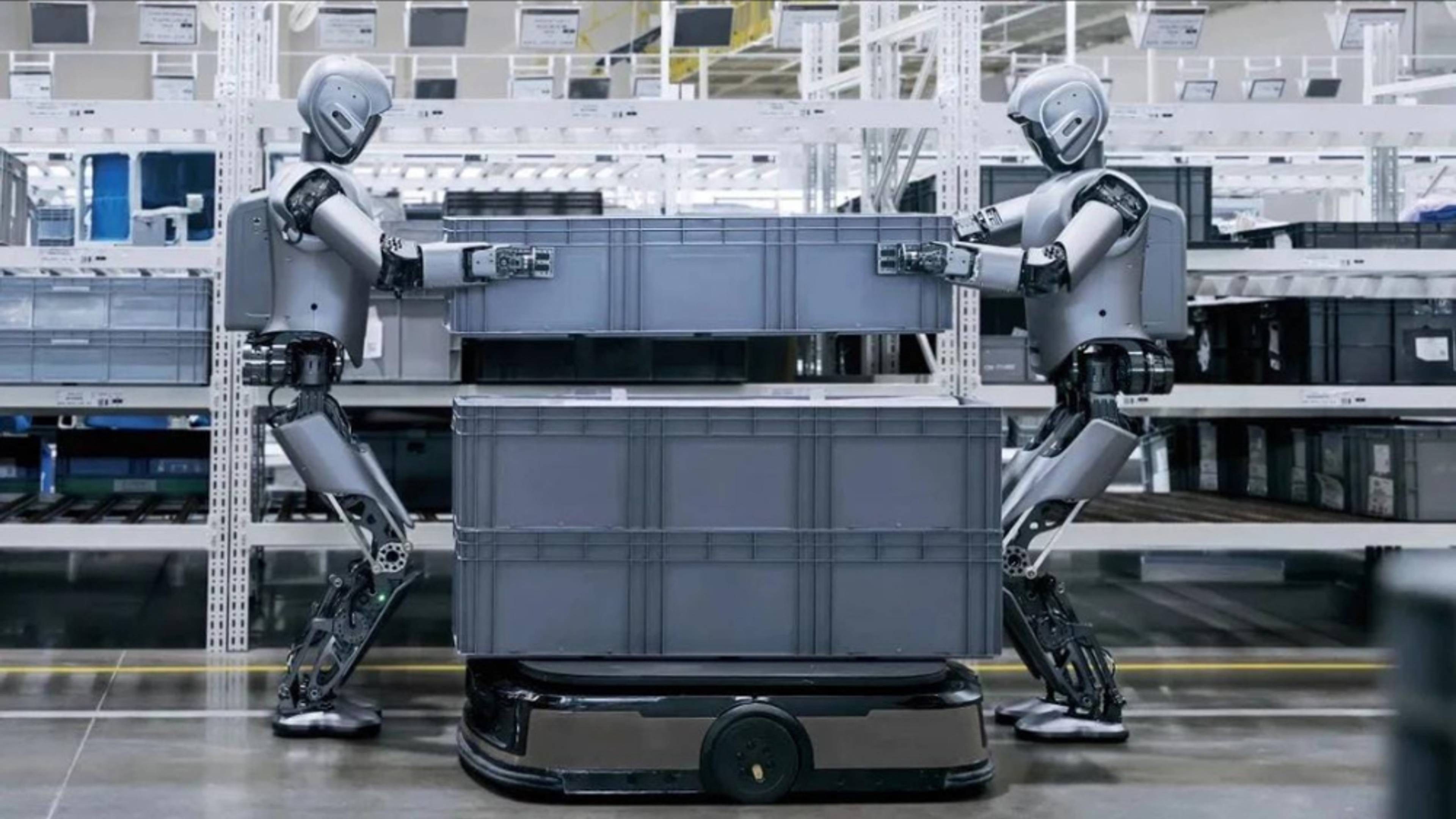
Industrial robots have been serving as a foundation of industrial automation for decades. Robotic arms weld car bodies and paint components. These machines can also move heavy parts, assemble electronics and perform thousands of repetitive operations with commendable consistency. But recently, over the past couple of years, a new type of machine is gaining popularity. Wondering what that is? Well, that’s a humanoid robot.
A number of tech giants and robotic companies are developing humanoid robots that can walk and talk just like us humans. These robots can use tools that are specifically made for humans and handle objects, too. Not only that, but humanoid robots can also learn to perform a variety of tasks with the help of AI.
Big companies like BMW and Mercedes-Benz have already deployed humanoid robots in their factories. Now this raises an important question: is it possible that humanoid robots will replace the industrial robots already operating in factories?
The simple answer is no, at least for now. Humanoids can definitely take over some tasks that are currently performed by industrial robots. But that doesn’t mean humanoids can replace industrial robots completely. Traditional industrial robots have major advantages in speed, precision, reliability and repeatability. The more likely future is a factory where humanoids and conventional robots work alongside each other.
Industrial Robots Already Have a Huge Advantage
According to the International Federation of Robotics (IFR), manufacturers installed 542,000 industrial robots worldwide in 2024, more than twice the number installed a decade earlier. And by the end of 2024, about 4.66 million industrial robots were in operation in factories around the world.
These machines are designed for specific jobs. A robotic arm on a car production line does not need to walk around, understand a changing environment or figure out what to do next. It simply performs the same movement thousands or millions of times.
That specialization is a major strength. A robot designed specifically for welding can be optimized for welding. A robot designed for painting can be optimized for painting. A high-speed pick-and-place robot can repeatedly move components along a carefully engineered path.
The IFR notes that traditional industrial robots generally outperform humanoids when manufacturing requires high speed, precision, reliability and repeatability. Their simpler mechanical structures and task-specific designs can make them faster and easier to control.
This creates a difficult challenge for humanoids. Being able to perform many different tasks does not automatically make a robot better at any particular task.
What Makes Humanoids Different?
Humanoid robots are being developed for a different purpose. Instead of designing the entire factory around a machine, the idea is to create a machine that can operate within environments already designed for humans. A humanoid can potentially walk through existing workspaces, reach shelves, use tools, manipulate objects and perform tasks intended for human workers.
That flexibility could be extremely valuable. Imagine a factory where a worker spends part of the day loading components into machines, then walks to another workstation to move boxes and later uses a hand tool. A conventional robot might require three separate automated systems, each engineered for a particular task. A sufficiently capable humanoid could potentially perform all three jobs.
The IFR identifies this general-purpose flexibility as one of the main potential advantages of humanoids. Advances in artificial intelligence and machine learning could also allow these robots to learn tasks from demonstrations rather than requiring every movement to be programmed manually. That does not mean humanoids are automatically superior. It means they are trying to solve a different problem.
Humanoids are Already Entering Factories
BMW has been testing humanoid robots from Figure AI in production. At BMW’s Spartanburg plant in the United States, Figure 02 was used for a task involving the precise removal and positioning of sheet-metal parts for welding. BMW says the robot supported production of more than 30,000 BMW X3 vehicles, moved more than 90,000 components and completed about 1,250 operating hours during the pilot.
The example is important because it demonstrates where humanoids could initially fit into manufacturing: not necessarily by replacing an entire production line, but by taking over particular tasks that are physically demanding, repetitive or difficult to automate using conventional systems.
Humanoid robots are also being tested in logistics and material handling. Agility Robotics says its Digit humanoid has moved more than 100,000 totes during a commercial deployment at GXO’s facility.
These deployments show that humanoids are beginning to move beyond demonstrations. However, commercial deployment should not be confused with widespread replacement of industrial automation.
Why Replacement is Still Difficult
The biggest problem is performance. Factories often operate on tight production cycles. A robot may have only a few seconds to complete a movement before the next component arrives. Even a small increase in cycle time can reduce production output.
Traditional industrial robots are exceptionally good at this kind of work because their movements are predictable and optimized for a narrow purpose.
Humanoids, by comparison, have to solve much harder problems. They must maintain balance, interpret their surroundings, control many joints and manipulate objects while moving through an environment. A humanoid also carries its own battery and computing hardware.
The IFR highlights several current limitations, including battery life, safety, standardization and the lack of mass production at sufficient scale. Its analysis also concludes that humanoids are not expected to replace existing types of robots but rather to complement and expand current automation.
There is also a basic engineering idea that the design of the machine should match the job. A human body is remarkably versatile, but it is not necessarily the most efficient design for every industrial task. If a machine only needs to move along one axis and repeatedly place components, giving it two legs, two arms and a torso adds complexity without necessarily adding value.
The Cost of Humanoid Automation
Factories do not buy robots simply because they are impressive. They buy them when automation improves productivity or reduces costs. This is where humanoids still have something to prove.
Traditional industrial robots have decades of commercial development behind them. Manufacturers understand their maintenance requirements, safety systems, programming methods and operating costs.
Humanoids are comparatively new. They are still moving toward mass production, and their economics are developing alongside the technology. For a factory manager, therefore, replacing a proven robotic arm with an expensive humanoid would make little sense if the arm can perform the same job faster, more reliably and at lower cost.
Where Humanoids Could Win
Humanoids could become particularly valuable in areas where conventional automation is difficult or expensive to install. Consider an existing factory designed around human workers. Its doors, shelves, workbenches, tools and machines are already positioned for people. Converting everything for a specialized robot can require significant infrastructure changes.
A humanoid could potentially enter that environment without requiring the same level of redesign. This is also useful for factories with high product variety and frequent changes. Traditional automation works extremely well when the same task is repeated for long periods. But if production changes frequently, reprogramming and physically reconfiguring specialized systems can become expensive.
A general-purpose humanoid could offer more flexibility. That is one reason AI is becoming important. AI can help robots learn tasks more quickly and adapt automation to changing production requirements, although safety and predictability remain major considerations in industrial environments.
The Future May Be a Hybrid Factory
The most realistic future is not humanoids versus industrial robots. It is humanoids plus industrial robots. A factory could use conventional robotic arms for welding, painting and high-speed assembly while humanoids handle material movement, machine loading, inspection or other tasks that require greater flexibility.
Mobile robots could transport components. Fixed robots could perform precision operations. Humans could supervise systems and handle complex decisions. Humanoids could fill gaps between these different forms of automation. This approach makes more sense than trying to force one robot design to perform every job.
The industrial robotics market remains strong, particularly in the United States. IFR data shows that U.S. factories installed about 38,000 industrial robots in 2025, an 11% increase from the previous year. The automotive industry remained the largest adopter, accounting for 13,500 installations. Those numbers suggest that manufacturers are not abandoning conventional automation as humanoids emerge.
That growth has continued. According to the IFR’s preliminary 2025 figures, factories around the world installed 621,000 industrial robots, a 15% increase from the previous year. Asia accounted for 79% of these new installations, followed by Europe with 13% and the Americas with 9%. These numbers show that traditional industrial robots are still in strong demand. Rather than being replaced by humanoid robots, conventional automation continues to grow alongside them.
So, Will Humanoids Take Over Factories?
Humanoid robots may replace some industrial robots in the future, but they are unlikely to replace most of them. Humanoid robots have a compelling advantage: versatility. They could work in spaces designed for humans, perform multiple tasks and potentially learn new jobs with less traditional programming.
Industrial robots have a different advantage: specialization. When a factory needs a machine to perform one operation thousands of times with extreme speed and precision, a specialized robot is difficult to beat. And this type of automation continues to grow, with manufacturers still investing heavily in traditional robots despite the growing attention around humanoids.
The International Federation of Robotics reaches a similar conclusion: humanoids are likely to complement rather than replace existing robot technologies. The real change, therefore, may not be the arrival of humanoids as replacements for industrial robots. It may be the creation of factories where there are different types of robots, each performing the jobs they are best suited for.
Humanoids could become the flexible workers of the automated factory. Traditional industrial robots will remain its precision specialists. And for manufacturers, that combination may ultimately be far more useful than choosing one technology over the other.
More articles on this topic
59 articles ReportCounterpoint Expects Work Applications to Drive 90% of Humanoid Shipments by 2030
 ReportUnitree’s 'Superman' Robot Claims to Outrun Usain Bolt
 ReportForeign Investors And Tech Executives Pay Up To $15,000 To Tour China’s Factories
 ReportCan Certified Robots Compete With China's Cheap Patrol Bots?
 ReportQuadruped Robots Are Becoming Big Business: Here’s Why The US Is Targeting Chinese Makers
 ReportHumanoid Robots Hit Mass Production
 ReportHow Robots Are Learning to Read Minds?
 ReportAre Humanoid Robot Videos Misleading Us?
 ReportHow Do Collaborative Robots Increase Workplace Safety?
 ReportHow to Train a Humanoid Robot for Hard Work
 ReportCollaborative Robots in Hospitals
 ReportHow Humanoid Robots Can Transform Disaster Response
BUSINESS NEWS WEEKLY LETTER
The Weekly Letter for Robotics Professionals, Summarizing the Most Important Industry Moves, Launches, Deals and Signals.