Counterpoint Expects Work Applications to Drive 90% of Humanoid Shipments by 2030
The research firm expects manufacturing, services and warehousing to replace entertainment and research as the industry’s main sources of demand.

September 11, 2026 by Artem
Counterpoint Expects Work Applications to Drive 90% of Humanoid Shipments by 2030
The research firm expects manufacturing, services and warehousing to replace entertainment and research as the industry’s main sources of demand.
BEIJING — The global population of deployed humanoid robots will reach the million-unit range by 2030, Counterpoint Research forecasts, but getting there would require a substantial shift from machines used for performances and research toward robots doing regular work.
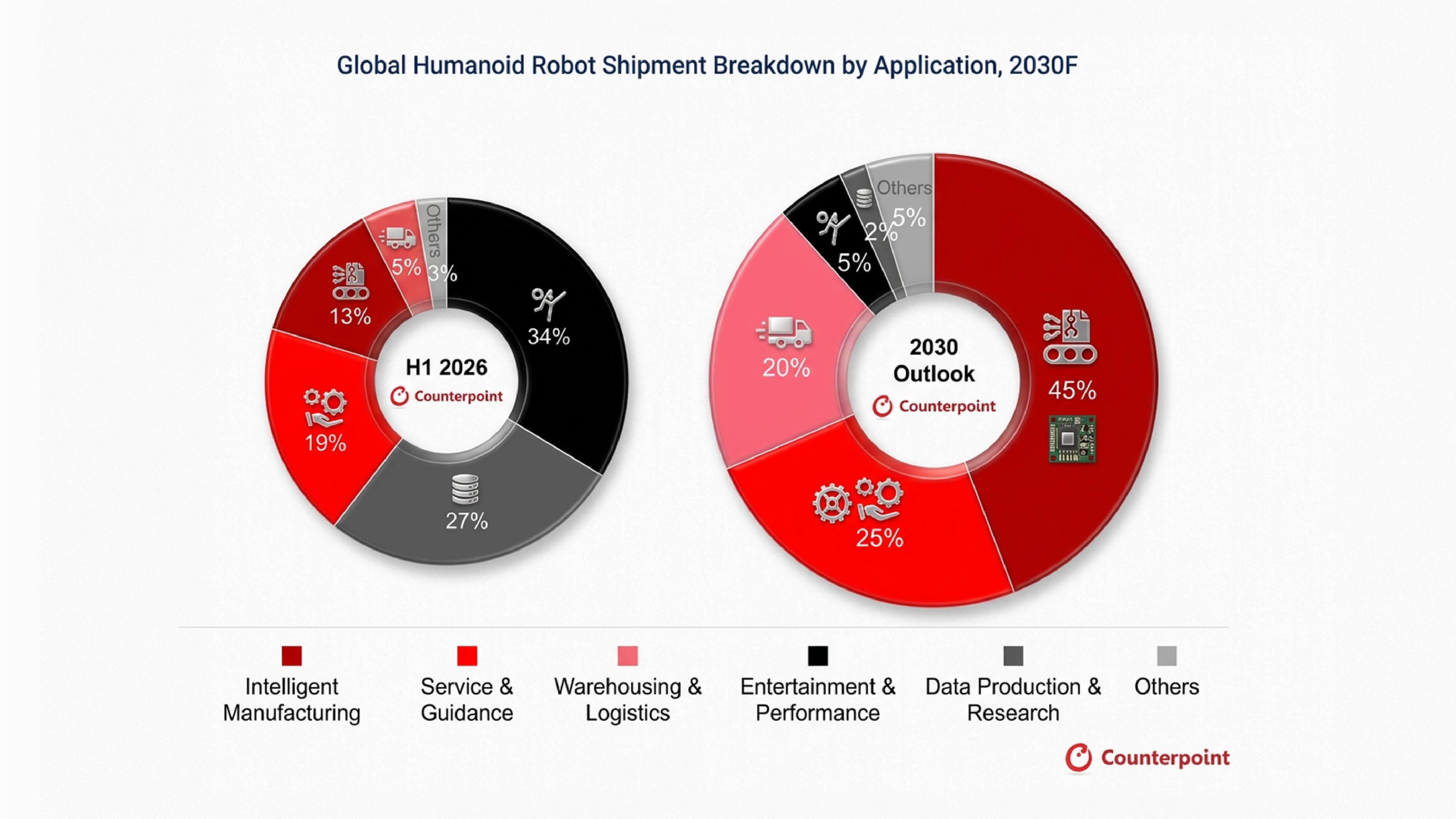
The research firm expects intelligent manufacturing to account for 45% of humanoid robot shipments in 2030, followed by commercial and household services at 25% and warehousing at 20%, according to a report published Sept. 8. Combined, those three categories would represent 90% of shipments.
In the first half of 2026, entertainment and performance combined with data production and research accounted for more than 60% of global humanoid robot shipments, Counterpoint’s author Ethan Qi wrote. Service and guidance applications represented about 19%, intelligent manufacturing 13% and warehousing and logistics 5%.
The figures show how much the market would need to change for work applications to reach the forecast 90% share in 2030. Counterpoint did not provide a precise 2030 installed-base figure or detailed methodology in the publicly available report.
The application mix is the more useful part of the forecast. It describes an industry that would depend primarily on companies buying robots to perform productive tasks rather than on research institutions, data-collection centers and entertainment operators.
That would be a sharp change from the present market. Counterpoint estimated that global humanoid shipments exceeded 22,000 units during the first half of 2026 and projected more than 50,000 for the full year. Entertainment and performance combined with data production and research still represented more than 60% of first-half shipments. Manufacturing accounted for 13%, while warehousing and logistics took 5%.
Those figures measure shipped machines, not necessarily robots performing routine work for paying customers. They also include smaller humanoids used for research and entertainment alongside larger systems intended for factories.
Independent reporting points to the same gap between output and practical use. Many humanoids remain expensive, fragile and restricted to structured environments, experts told The Associated Press. Some researchers and investors also question whether demand can keep pace with manufacturing capacity.
The International Federation of Robotics has taken a similarly cautious view. Its position paper on humanoid robots said the machines could complement existing automation but were not expected to replace conventional industrial robots. The organization also said last year mass adoption of universal household assistants may not occur in the near or medium term.
A Forecast Built Around Connected Robots
Counterpoint’s 2030 scenario assumes that humanoids will rely increasingly on edge and cloud computing rather than processing every task on board. Its report argues that 5G-Advanced networks could carry sensor data, distribute software updates, coordinate robot fleets and allow human operators to intervene when autonomous systems encounter unusual conditions.
For manufacturing, the firm envisions robots sharing skills and operating as coordinated groups. It says such systems could require stable uplink speeds of 100 megabits per second and deterministic latency below one millisecond. Those are proposed requirements for future deployments, not performance levels established across operating factories.
Counterpoint based part of its case on the World Humanoid Robot Games, held in Beijing in August. Huawei and China Unicom Beijing supplied a 5G-Advanced network for the event, which involved 2,056 robots. The report said average end-to-end latency was below 30 milliseconds and robot-related latency fell as low as 18 milliseconds during the opening ceremony.
Those figures originated with the network providers and were not independently verified. A controlled competition venue also cannot establish whether comparable performance, reliability and security can be maintained continuously in factories, warehouses or homes.
Counterpoint’s forecast therefore depends on more than producing additional hardware. Manufacturers must improve reliability and task performance, while customers would need to invest in communications, computing, safety systems and workflow integration.
The public report does not estimate what that infrastructure would cost or how many current trials will become sustained commercial deployments.
More articles on this topic
12 articles ReportViabot Raises $24 Million to Expand Outdoor Cleaning Robots
 ReportGeek+ Opens Düsseldorf Lab for Live Warehouse Robot Demonstrations
 ReportMatter Venture Partners Closes $450 Million Fund for Robotics and Hard Technology
 ReportExein Raises $270 Million to Secure Robots and Connected Devices
 ReportJungheinrich Expands Automation Range, Challenging Linde and Toyota
 ReportGoogle's DeepMind AI Can Switch Robot Bodies
 ReportAgility’s Digit 5 Humanoid Can Work Alongside People
 ReportUniversal Robots Launches Gen 7 Platform With Three New Cobot Arms
 ReportDriverless Tractors Driving Force for Farming Industry
 ReportRobot Works Night Shift at Australian Coffee Shop
 ReportFlexiv Expands Into Europe and India With Adaptive Robots
 ReportChina Raises Scrutiny of Humanoid Robot IPOs, Reports Say
BUSINESS NEWS WEEKLY LETTER
The Weekly Letter for Robotics Professionals, Summarizing the Most Important Industry Moves, Launches, Deals and Signals.