Quadruped Robots Are Becoming Big Business: Here’s Why The US Is Targeting Chinese Makers
Quadruped robots now run paid inspection contracts for oil, gas, and utility operators. A new US rule just decided which country's robots get to keep doing that.

September 1, 2026 by Siyanne
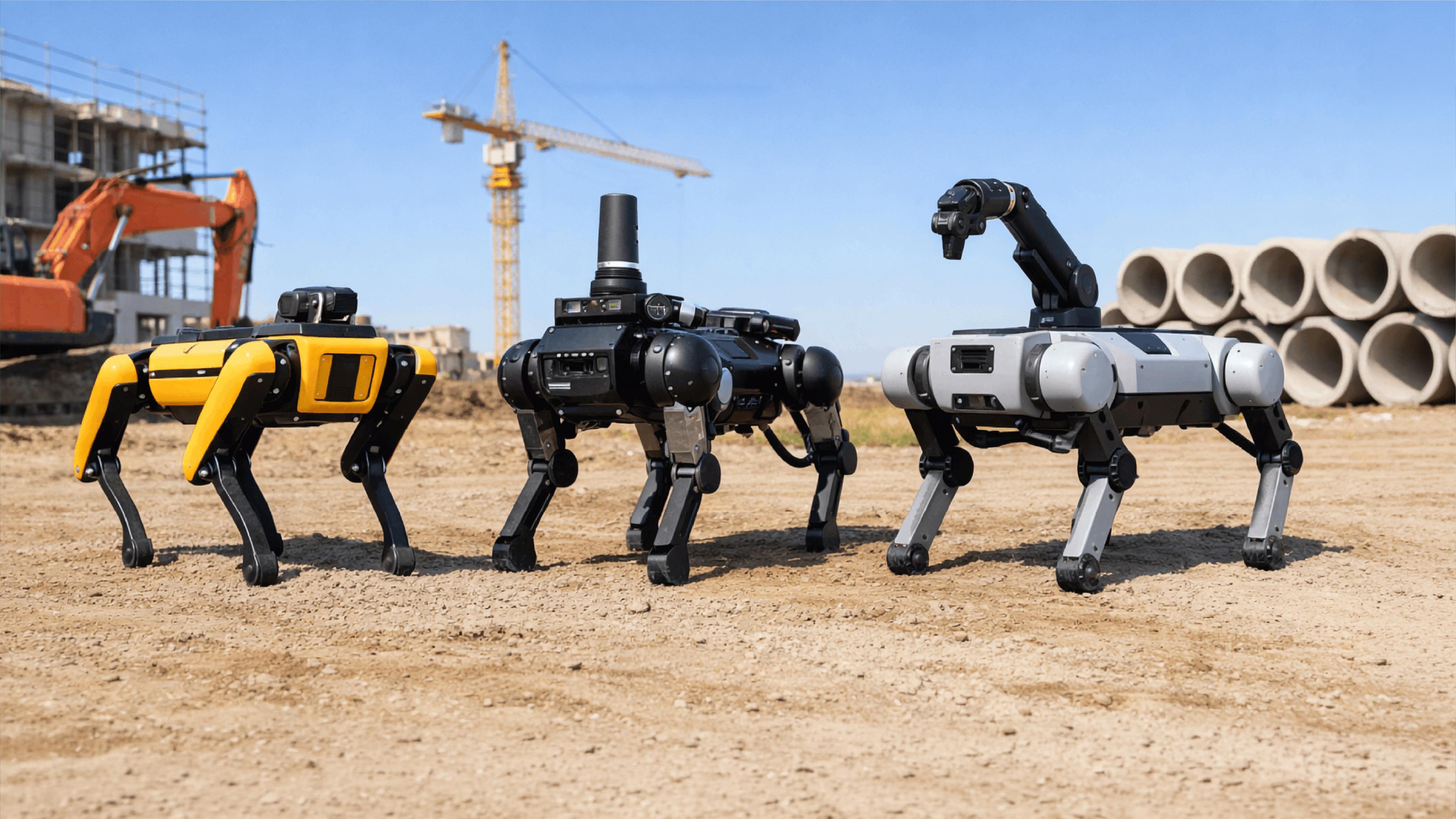
Boston Dynamics, Switzerland's ANYbotics and China's Unitree have turned four-legged robots into paid inspection tools for oil and gas platforms, mines and power grids, but a new US security crackdown on Chinese hardware is now redrawing who can actually sell into that infrastructure.
On 28 July, the US Federal Communications Commission added "foreign-produced advanced robotic devices" to its Covered List. Trade press and law firm analysis say the action chiefly targets Chinese quadrupeds and humanoids, including Unitree's Go2 and B2 lines.
Two weeks earlier, Hyundai Motor Group had completed its purchase of SoftBank's remaining 9.65% stake in Boston Dynamics for $325 million, giving the Korean carmaker full ownership of the quadruped pioneer for the first time since 2021.
Quadruped robots have spent a decade generating viral fame — Unitree's Go2 units performing backflips on social media, alongside its sibling H1 humanoids' dance routines at China's CCTV Spring Festival Gala — while the actual revenue has quietly moved into hazardous-site inspection contracts for energy, mining and utility operators.
Taken together, those two events reframe the central question for the sector: not whether robot dogs can earn money, but which country's supply chain gets to supply the robots that do it.
How big is the inspection business doing?
State Grid Corporation of China plans to spend 6.8 billion yuan ($1 billion) on roughly 8,500 AI-enabled robots in 2026, including about 5,000 quadrupeds for substation and transmission-line patrols, according to an internal plan reported by the South China Morning Post.
State Grid's single order—5,000 quadrupeds in one year—is roughly 25 times the size of ANYbotics' entire global fleet of more than 200 ANYmal units shipped to date across all of its energy, mining, and utility customers combined.
DEEP Robotics, a Hangzhou-based manufacturer, already runs substation inspections with its X30, and a partner utility says it cut a full inspection round from roughly two hours to under 35 minutes.
Outside China, ANYbotics has built the clearest business case around hazardous energy inspection. The Zurich-based manufacturer's ANYmal robots run thousands of inspections weekly for BP, Equinor, Eni, and Petrobras. In September 2025 it raised over €127 million from Climate Investment—a vehicle backed by the Oil & Gas Climate Initiative—taking total funding past $150 million to fund its Ex-certified ANYmal X, built for explosive atmospheres.
Boston Dynamics has followed a similar path with Spot, which inspected offshore platforms for BP roughly 200 miles out and logged over a million data captures for industrial customers by 2023.
Neither company's public disclosures, ANYbotics' funding announcements, nor Boston Dynamics' own retrospective on Spot break out quadruped-specific revenue. ANYbotics cites BP, Equinor, Eni and Petrobras by name, and Boston Dynamics' own retrospective tallies over a million automated data captures.
How big is China's price advantage?
Unitree's own numbers changed dramatically on 18 August 2026. The company's 2025 revenue reached 1.7 billion yuan, more than four times the prior year. That day, Unitree priced its Shanghai STAR Market IPO at roughly $9 billion, raising about $905 million, and shares jumped more than 600% on their trading debut.
Its Go2 sells from around $1,600, against roughly $74,500 for Boston Dynamics' Spot at its 2020 commercial launch price.
Genisom, a newer Chinese entrant, had already hit 10,000 mass-production deliveries by late May 2026—a milestone it reached only five months after passing 5,000 units—and has booked over 800 million yuan in signed cooperation agreements, per its own disclosure. Those remain producer-reported figures rather than audited revenue.
Chery, the Chinese carmaker, has taken the consumer-price approach further still. Its robotics unit AiMOGA sells quadrupeds for 15,800 yuan (about $2,200) and had shipped 2,000 units to 60-plus countries by July 2026.
Why do security flaws matter now?
Researchers Andreas Makris and Kevin Finisterre disclosed in March 2025 that Unitree's Go1 shipped with an undocumented remote-access tunnel connecting to a Chinese cloud service. The flaw, tracked as CVE-2025-2894, let unauthorised users view cameras and access onboard systems on nearly 1,900 units, including ones at MIT and Princeton.
The FCC's July 2026 order cites that vulnerability, alongside a separate Bluetooth exploit disclosed in September 2025, as supporting evidence for its national-security determination.
Unitree's board secretary told investors during the IPO process that its current best-selling models, including the Go2 and B2, received FCC authorization before the rule took effect. The company's prospectus also disclosed that US sales now account for only 13.3% of revenue, down from 19.5% in the prior reporting period.
Price or provenance: which decides the next contract?
The quadruped robot market is splitting into distinct business models, with Unitree's profitability, the FCC's exemption process, and the survival of specialized European players such as ANYbotics and MAB Robotics acting as key indicators. The industry's near-term trajectory hinges on how trade restrictions on Chinese hardware play out.
More articles on this topic
59 articles ReportNauticus Robotics Seeks Up to $50M in Strategic Investment
 ReportAMD to Buy World Labs for $8.2B in Push Beyond AI Chips
 ReportSharpa Unveils Three Tactile Robotics Systems at IROS 2026
 ReportAGIBOT’s 300-Robot Theme Park Moves From Plan to Operation
 ReportRealset AI, Flatkey Raise $10M to Expand Real-World Robot Training Data
 ReportRLWRLD Expands Physical AI Push for Industrial Robots
 ReportHanson Urges Clearer Disclosure as Social Humanoid Market Expands
 ReportRobot Vacuum Shipment Growth Nears 30% for Second Straight Quarter After Acceleration
 ReportCognex Strikes $500 Million Deal for Robot Vision Company RealSense
 ReportUnity Opens Simulation Pro Early Access for Robotics Developers
 ReportCircus SE Partners With Royal Prestige for UAE Food-Robot Launch
 ReportGenisom AI Raises ’Hundreds of Millions’ of Yuan for Embodied Robotics
BUSINESS NEWS WEEKLY LETTER
The Weekly Letter for Robotics Professionals, Summarizing the Most Important Industry Moves, Launches, Deals and Signals.