BeyondMimic Lets a Humanoid Reuse Human Motions for New Tasks
The UC Berkeley and Stanford controller guided a Unitree G1 through new objectives without retraining, but its navigation tests relied on external motion capture.

September 2, 2026 by Vismay
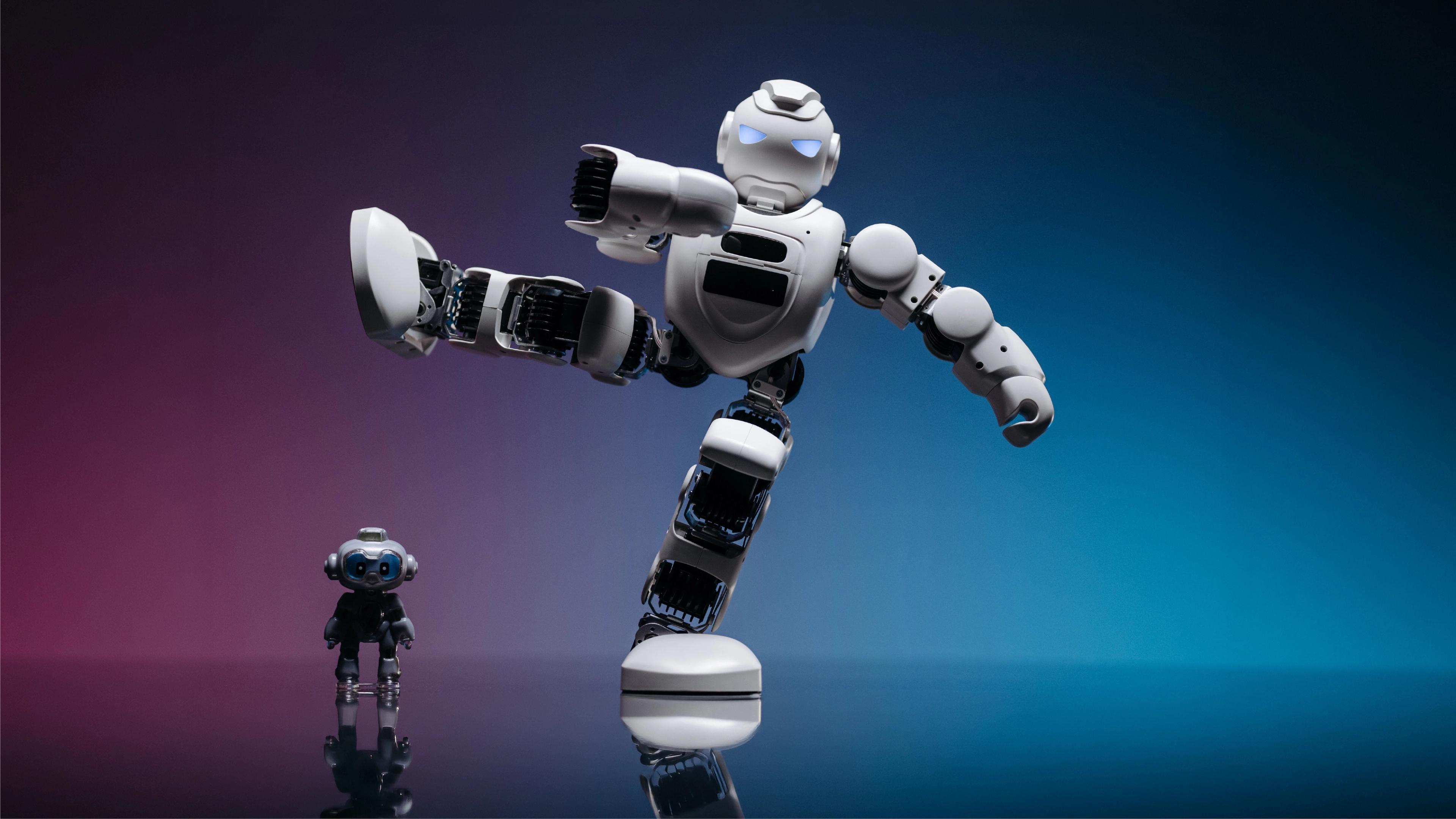
BERKELEY, Calif.: Researchers at the University of California, Berkeley, and Stanford University have developed a controller that allows a Unitree G1 humanoid to reuse movements learned from human data for new tasks.
The system, called BeyondMimic, does not require its neural network to be retrained for each objective. It was described in a peer-reviewed study published in Science Robotics that first appeared as preprint in August 2025.
BeyondMimic uses two training stages.
Motion-tracking policies first learn through reinforcement learning to reproduce human movements such as sprinting, jumping, balancing, cartwheels and martial arts motions.
The researchers then use the data from those policies to train a latent diffusion model. The model predicts short sequences of robot states and actions, allowing it to select and combine movements rather than replaying one motion-capture recording.
A developer specifies each new objective through a mathematical cost function. For waypoint navigation, the function rewards movement toward a target and slowing as the robot approaches.
Obstacle avoidance uses a separate function that penalizes movement too close to objects. Supplying those functions does not retrain the model.
The researchers reported using approximately 2.5 hours of human-motion data. They tested 30 representative clips, totaling 15 minutes, on physical Unitree G1 robots. The motions included jumps, spins, cartwheels, dances and unusual walking styles.
The project materials also show the robot following waypoints, responding to joystick commands and avoiding obstacles. These were research demonstrations, not deployments or tests of a commercially available control system.
The waypoint and obstacle-avoidance demonstrations used an external motion-capture system to locate objects and targets and to improve the robot’s position estimate. The results therefore do not show self-contained navigation using only onboard perception.
The researchers wrote that the controller’s 0.64-second prediction horizon supports reactive movement and local obstacle avoidance, but not long-horizon planning involving distant goals.
They also reported that robots can stumble when beginning, ending or switching between movements under diffusion-based control.
The study does not show BeyondMimic manipulating objects, selecting tasks from language or operating routinely in the workplace.
Its navigation demonstrations still depend on external equipment for environmental information and localization.
More articles on this topic
43 articles ReportRobots vs. Drones: What Is the Real Difference?
 ReportHow Animals Inspire Better Robots
 ReportFrom Toys to Tools: The Coolest Robots in Schools Today
 ReportThis Tiny Robot Hops Like a Frog And Swims Using Elastic Limbs
 ReportJapan Tests Robot Bins at Tokyo’s Busiest Railway Station
 ReportRobot Makers Collaborate with Universities in Race to Advance Humanoids
 ReportMitsubishi Electric Develops AI-Controlled Humanoid Machining System
 ReportDream Labs Raises $90M, Offers Robot AI by the Hour
 ReportOpenAI Veteran Launches Factory Automation Startup With $232M
 ReportU.S. Leads in Robotics AI but Trails China in Deployment, Commission Says
 ReportArchon Robotics Presents Whole-Body AI Control Across Humanoids
 ReportGoogle DeepMind Plans Robotics Hardware Lab in Massachusetts
BUSINESS NEWS WEEKLY LETTER
The Weekly Letter for Robotics Professionals, Summarizing the Most Important Industry Moves, Launches, Deals and Signals.