From Toys to Tools: The Coolest Robots in Schools Today
From science labs to language lessons, classroom robots are proving to be powerful teaching tools.

By Jeremy
Schools and academies have used robots as teaching tools for many years, enhancing the learning experience for children who are just dipping their toes into the world of science and technology. Cynthia Breazeal, an associate professor of media arts and sciences at the MIT Media Lab, said she was “starting to see some exciting and significant learning gains” among children learning English with robots.
Today, educational robots come in many forms, ranging from simple miniature vehicles to AI-powered humanoid robot tutors. Let’s take a look at some of the coolest examples.
LEGO SPIKE Prime Kit
LEGO introduced the SPIKE Prime kit in 2020 for children ages 10 and up. This robotics kit comes with LEGO pieces, motors, sensors, and a large “Technic Hub.” Students can program the Technic Hub to perform various actions using proprietary software or Python.
There’s also the LEGO SPIKE Essential kit for children ages six to 10. This kit is smaller, has fewer components, and doesn’t support Python code. Instead, it uses LEGO’s Icon Blocks and Word Blocks drag-and-drop programming languages.
Icon Blocks and Word Blocks are incredibly user-friendly because students don’t need to write traditional code. They simply place blocks in a particular order to make the robot perform an action. For example, students can program a tiny bus to move on its own without writing a single line of code.
These LEGO kits are great for students who want to learn the basics of robotics because they come with lesson plans. Teachers can easily integrate them into their classes with relatively little effort.
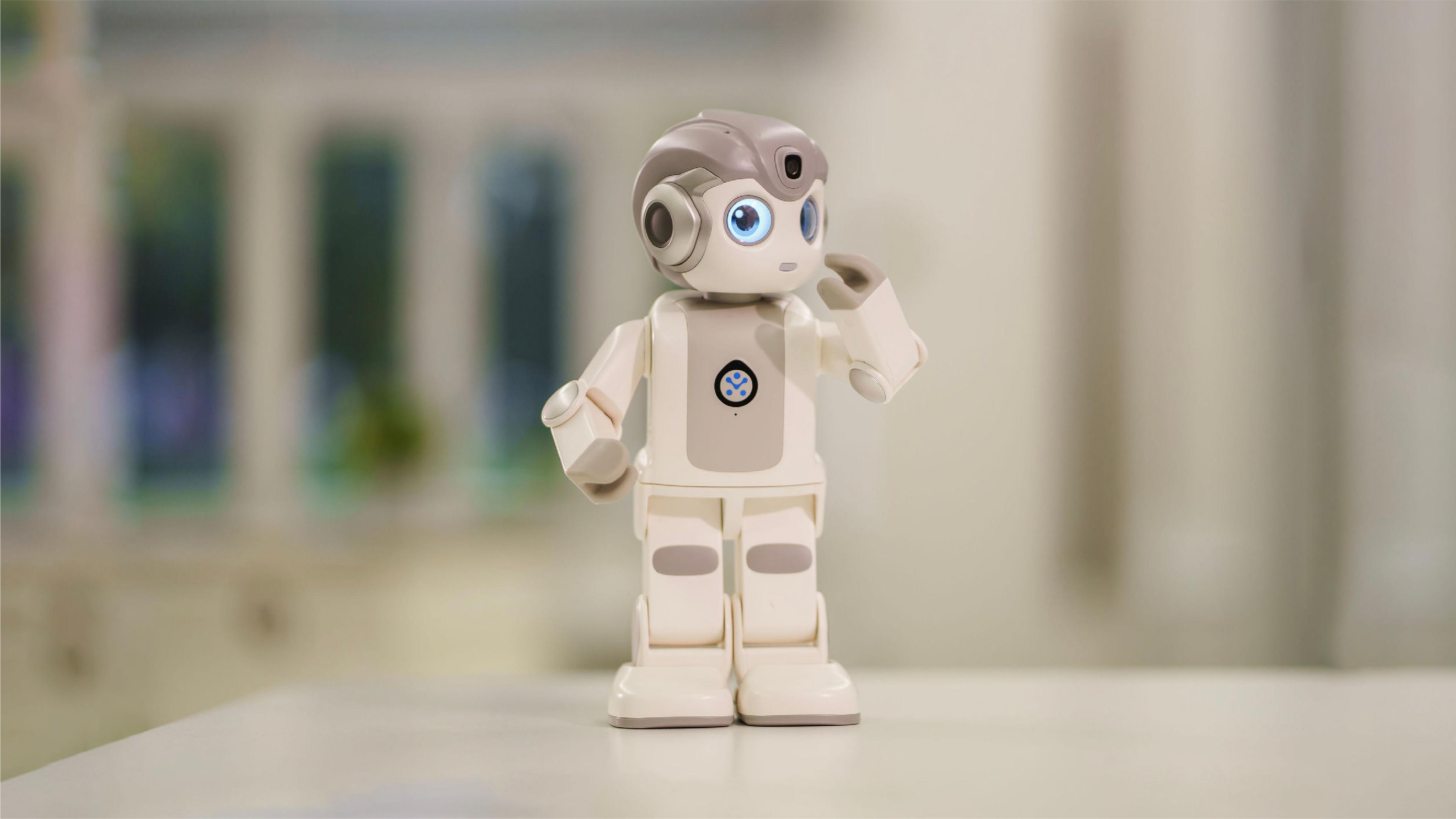
UBTECH Alpha Mini
This small, programmable humanoid robot is about 24 centimeters tall, 14 centimeters wide, and 11 centimeters deep. It weighs only 700 grams, including its battery. Students can program an Alpha Mini after pairing it with their smartphones.
Alpha Mini can sing, do push-ups, perform kung fu moves, and more. Students can even talk to it by saying, “Hey Mini.” Like the LEGO SPIKE kits, Alpha Mini accepts block-based commands similar to Icon Blocks. Older students can also program Alpha Mini using the company’s UCode software.
Compared with older educational robots, Alpha Mini is more responsive and can even display simple emotions through its eyes.
SoftBank Robotics Pepper
SoftBank Robotics’ Pepper is a well-known robot for businesses, but did you know that some schools also have units? The company partnered with Boston Public Schools and the San Francisco Unified School District to develop a short curriculum introducing students to robotics. Ninth- and 10th-grade students also had the opportunity to build programs for Pepper.
Unlike the older NAO robot from SoftBank Robotics, Pepper moves on wheels while interacting with people. It can deliver presentations and then answer questions based on those presentations. Pepper can also lead engaging classroom activities, including quizzes and discussions.
According to SoftBank Robotics, Pepper can tailor its teaching style by analyzing facial expressions and interactions. This also makes the robot useful for language learning, as it can correct grammatical and pronunciation mistakes.
Makeblock mBot
Makeblock’s mBot robotic coding kits are compact packages, but don’t let their small size fool you. They can provide hours of fun for younger students and even high school seniors. Makeblock makes the kits easy to assemble and includes the necessary tools.
According to the official website, more than 20 million teachers and students use Makeblock’s open-source mBlock software. It supports color-coded block coding and Python, allowing students to program their mBot units in different ways.
The company’s newer product, mBot2, offers even more functionality. It supports voice, touch, and environmental interaction. With official courses available, students can learn the basics of robotics and coding without getting bored. Many educators find mBot accessible and fun.
Mainbot Winky
French company Mainbot designed its Winky educational robot specifically for children ages five to 12. It was also designed to align with France’s education curriculum as an introductory tool for STEM programming. While Winky is made for schoolchildren, it can also be a good fit for families who want to enrich their children’s learning at home.
Winky is small, measuring 15 centimeters tall and 12 centimeters in diameter and weighing one kilogram. Its cute appearance is sure to make it appealing to children.
Using the Winky Code application, students can program actions for Winky to perform. The robot also supports several educational games that teach reading, science, and mathematics. For even more fun, there’s the Winky Play app, which turns the robot into a controller for an avatar in a mobile game.
Learning Should Be Fun
Children shouldn’t be bored while learning science, which is one reason educational robots have become popular with students. These robots are much simpler than their industrial counterparts, thanks to color-coded programming blocks and straightforward designs. Students can get these machines up and running in no time.
If many institutions and parents trust educational robots as useful tools, there are plenty of opportunities to integrate them into classrooms and homes. Omar Mubin and Muneeb Imtiaz Ahmad found that students “were much more enthusiastic about a robot in their classroom, enjoying the human-like interaction.”
Educational robots may not replace teachers, but they can make lessons more interactive and give students a hands-on way to explore programming, robotics, science, and technology. Sometimes, the best way to learn about the future is to build a little piece of it yourself.
More articles on this topic
36 articles ReportRobots vs. Drones: What Is the Real Difference?
 ReportHow Animals Inspire Better Robots
 ReportJapan Tests Robot Bins at Tokyo’s Busiest Railway Station
 ReportFive Extreme Sports Where Robots Are Competing
 ReportUnitree Adds $6,500 Dex5-S to Dexterous Hand Lineup
 ReportHow Do Robots See the World?
 ReportChina Raises Scrutiny of Humanoid Robot IPOs After Unitree Shares Fall 55%
 ReportViam Debuts Box-Opening Robot at IROS 2026
 ReportBoston Dynamics Opens New Home For Training Robots
 ReportHuman Gets in the Ring With a Six-Foot Humanoid Robot
 ReportBatteries Included: Why Staying Powered is Hard for Robots
 ReportGeek+ Opens Düsseldorf Lab for Live Warehouse Robot Demonstrations
BUSINESS NEWS WEEKLY LETTER
The Weekly Letter for Robotics Professionals, Summarizing the Most Important Industry Moves, Launches, Deals and Signals.