This Tiny Robot Hops Like a Frog And Swims Using Elastic Limbs
Researchers at UCLA and the University of Michigan have built an untethered robot that stores energy in twisted elastic limbs before releasing it in a rapid snap. The 98.2-gram prototype reached 3.21 body lengths per second and averaged 2.46 body lengths per second across six tested surfaces, compared with 0.79 body lengths per second for a rigid-legged comparison robot.

By Vaishnavi
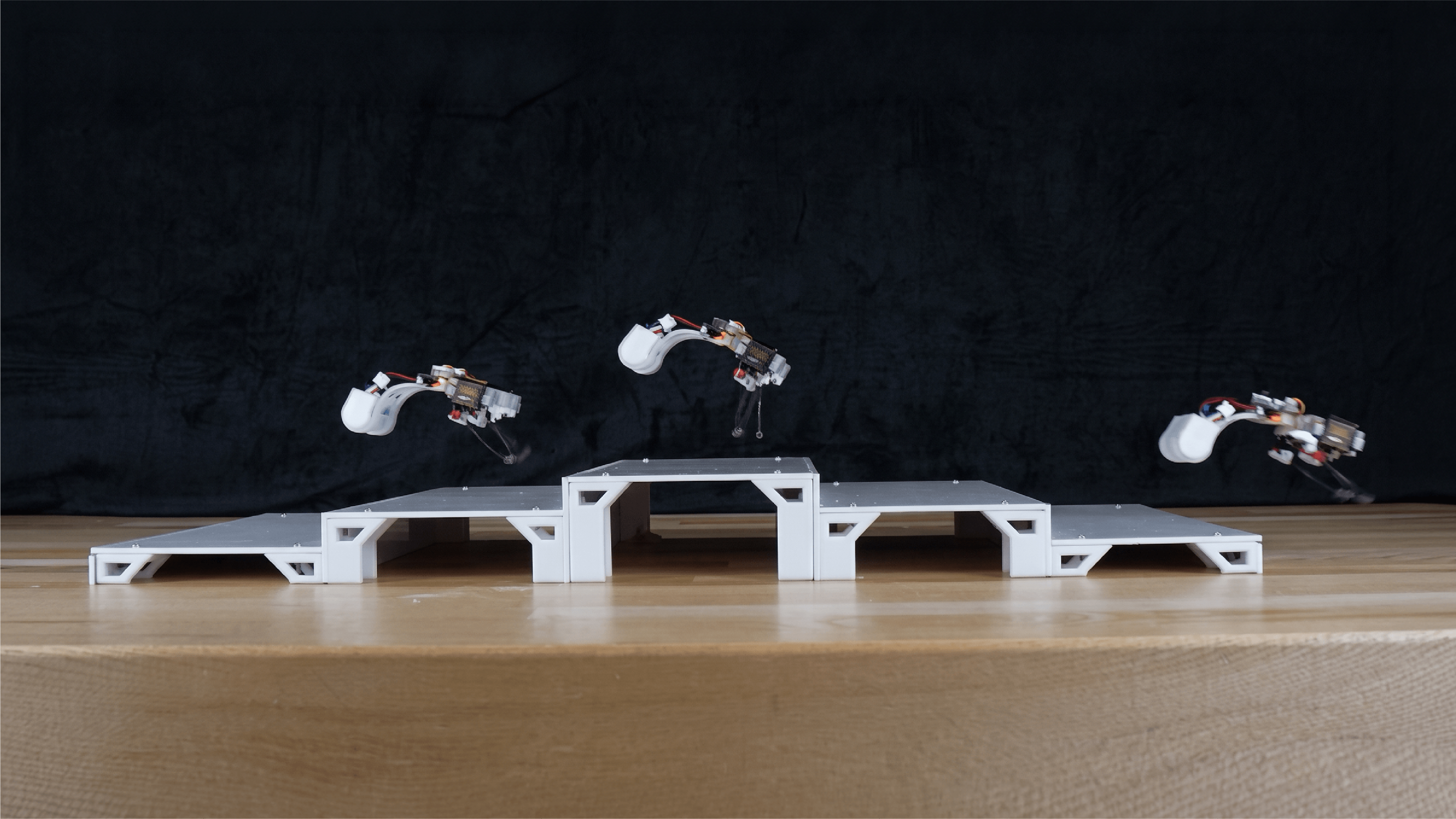
Scientists from the University of California, Los Angeles and University of Michigan have developed a palm-size robot with twisted elastic limbs. The design makes the robot capable of hopping on various surfaces, overcoming small obstacles and swimming using paddles.
The research, described in a paper published Sept. 18 in Science Advances, focuses on a mechanical phenomenon known as the snap-through effect. Unlike a regular mechanism that moves by using an electric motor, the robot twists elastic rods to a specific position, after which the rods suddenly change shape as they release stored elastic energy, according to the published study.
The prototype has a length of 11 centimeters and weighs 98.2 grams. During tests, the robot reached a top speed of 3.21 body lengths per second on surfaces including wood, cloth, acrylic, leather, grass and sand, according to the University of Michigan.
The researchers also built a comparable robot with rigid legs. The elastic-legged version averaged 2.46 body lengths per second across the tested surfaces, compared with 0.79 body lengths per second for the rigid-legged robot, according to the research paper.
The difference was particularly pronounced on cloth and grass, where the rigid-legged robot nearly stalled, according to the University of Michigan. The snapping mechanism also allowed the prototype to perform repeated backflips and move up and down small steps. Researchers remotely controlled it through a sandbox containing rocks and used light sensors for a simple autonomous steering demonstration.
The same basic mechanism can also be used in water. Researchers fitted flexible paddles to the rear limbs and tested the robot swimming at about 0.5 body lengths per second. The study says the swimming configuration was not specifically optimized, making the water tests more of a demonstration of the mechanism's versatility than a finished amphibious locomotion system, according to ScienceAlert's report.
The work began with computer models and experiments designed to determine when bent elastic rods would gradually deform and when they would suddenly snap. The researchers found that the geometry of the rods and the way their ends were loaded could determine which behavior occurred. They then used those results to design helical elastic limbs for the robot, according to the University of Michigan.
That approach shifts part of the robot's power requirements from the motor to its mechanical structure. The motor slowly winds the elastic limb, while the rod stores energy and releases it during the snap. M. Khalid Jawed, an associate professor of mechanical and aerospace engineering at UCLA, said the mechanism can produce a larger burst of mechanical power than the motor supplies directly at that moment, according to UCLA's report.
The researchers say the design could be useful for small robots, where motors, batteries and transmissions are constrained by size and weight. The study's results suggest that the same geometric principles could potentially be applied at different scales, including robots only a few millimeters wide. That remains a research direction rather than a demonstrated product application, according to the published study.
The robot is still a research prototype. Its motion is produced in discrete bursts, the elastic limbs must reset after each snap and the timing between the mechanism and the robot's interaction with its environment has to be controlled. The researchers also have not presented the system as a commercial product or deployment.
The study was co-led by Jawed and Xiaonan (Sean) Huang, an assistant professor of robotics at Michigan. Dezhong Tong and Jiaqi Wang were co-first authors, according to the University of Michigan.
More articles on this topic
40 articles ReportRobots vs. Drones: What Is the Real Difference?
 ReportHow Animals Inspire Better Robots
 ReportFrom Toys to Tools: The Coolest Robots in Schools Today
 ReportJapan Tests Robot Bins at Tokyo’s Busiest Railway Station
 ReportStanford, Caltech Give Humanoid Spatial Memory for Household Tasks
 ReportHow Do Robots See the World?
 ReportFive Extreme Sports Where Robots Are Competing
 ReportChina’s Wall-Climbing Robots Take On Rust, Paint And Inspection Work
 ReportHow Do Robots See the World?
 ReportChina Raises Scrutiny of Humanoid Robot IPOs After Unitree Shares Fall 55%
 ReportViam Debuts Box-Opening Robot at IROS 2026
 ReportBoston Dynamics Opens New Home For Training Robots
BUSINESS NEWS WEEKLY LETTER
The Weekly Letter for Robotics Professionals, Summarizing the Most Important Industry Moves, Launches, Deals and Signals.