AGIBOT X2 vs. UBTECH Walker X
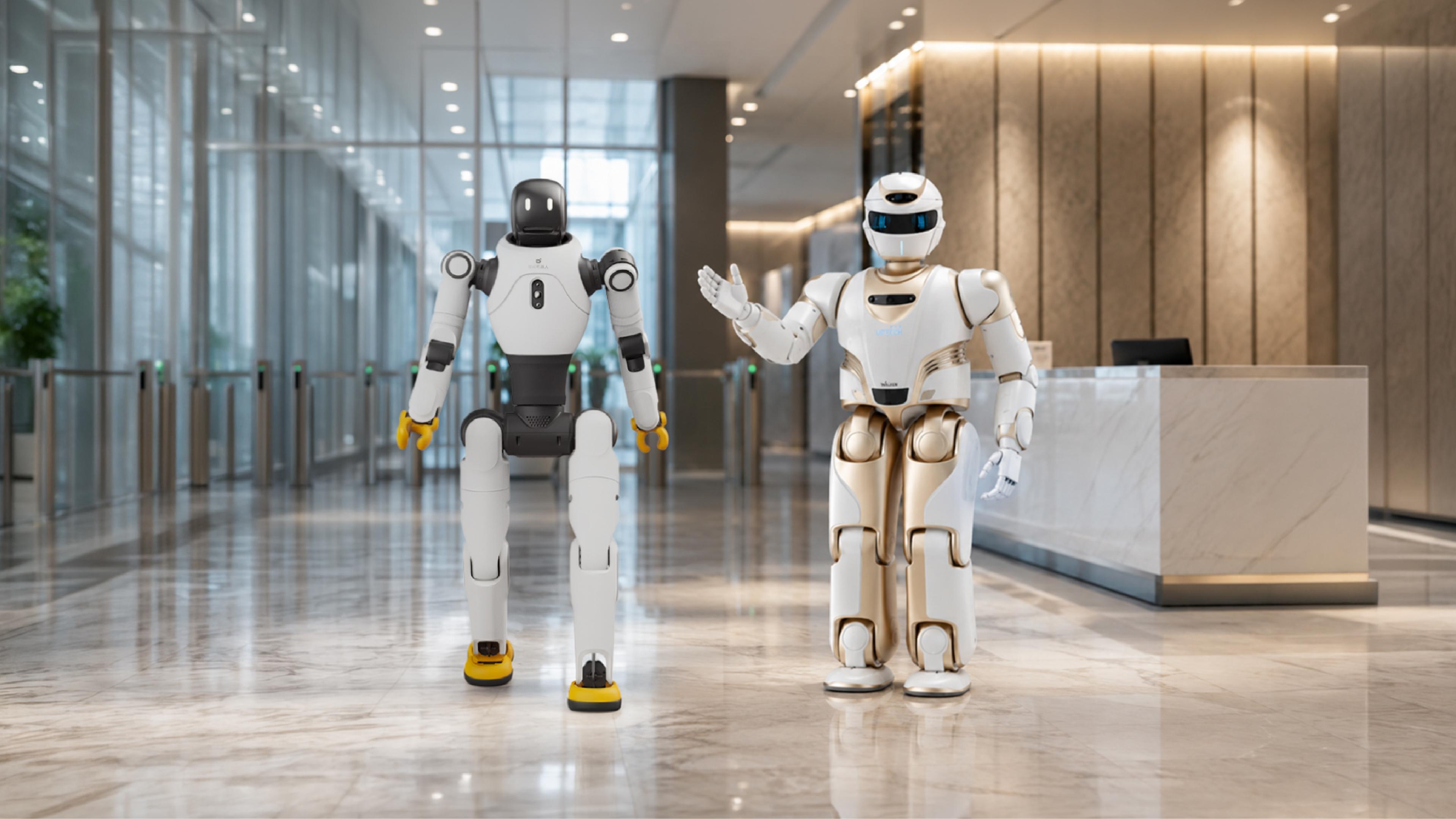
AGIBOT X2 and UBTECH Walker X are bipedal humanoid robots developed for research, education and human-robot interaction. We compare their physical specifications, walking speeds, degrees of freedom, battery configurations, terrain adaptation and intended applications to examine how the two platforms differ.

November 9, 2026 by Business Desk Team
Introduction
Humanoid robots are also playing a growing role in research and education as developers seek to improve their bipedal movement, physical interaction and autonomous behavior.
AGIBOT X2 and UBTECH Walker X are both Chinese humanoid robots which are capable of moving and interacting intelligently.
AGIBOT X2 is a research, education and humanoid motion development platform. It is a small-sized biped robot with minimal weight and walking speed, thus relevant to robot developers interested in developing mobile humanoids.
UBTECH Walker X is built for research in humanoid robotics, education and in-home assistance development. Its articulated body and interaction capabilities enable experiments in coordinated movement and interaction with humans.
While both robots are 130 cm tall in the measurement records, the advertised specs indicate some discrepancies in weight, walking speeds, joint arrangement, and battery details.
Based on ROBOT24.com market-research data, this comparison highlights their physical form, locomotion, articulation, operational endurance and application required.
At A Glance
| Height | 130 cm | 130 cm |
|---|---|---|
| Walking Speed | 5.4 km/h | 3 km/h (0.83 m/s) |
| Weight | 35–37 kg depending on variant kg | 63 kg |
| Availability | In production | Commercially Available |
| Battery | Integrated | 54.6V / 10Ah Lithium Battery |
| Degrees of Freedom | Estimated 40+ | 41 |
| Mobility Type | Bipedal Humanoid | Humanoid |
| Nationality | China | Chinese |
| Runtime | Not Publicly Disclosed | ~2 Hours |
| Terrain Adaptation | Yes | Yes |
| Wi-Fi | Yes | Yes |
| Typical use | Education & Training, Research & Development | Research & Development, Education & Training, Home Assistance |
| Status | Commercial | Commercial |
How They Compare
Research, education and intended applications
AGIBOT X2 and UBTECH Walker X are both designed for humanoid robotics development, with overlapping applications in research and education. AGIBOT X2 is intended for education, training and research and development. The small size and bipedal capabilities of AGIBOT X2 could facilitate the use for demonstration purposes, walking experiments and studies of humanoid functioning.
Physical dimensions and design
Based on the supplied figures, Walker X is approximately 26–28 kg heavier. The difference may influence transportation, handling and the physical requirements of a research environment. The weight by itself does not necessarily indicate better stability, longer service or handling characteristics. The joints, weight sharing and control software affect how a humanoid moves and reacts to external forces.
Degrees of freedom and articulation
AGIBOT X2 has an estimated 40 or more degrees of freedom in the supplied records. UBTECH Walker X has 41 degrees of freedom. Degrees of freedom describe the independently controllable movements available through a robot's joints.
These movements may include articulation in the arms, legs, waist, neck and hands, depending on the configuration. Both robots therefore have recorded joint counts that suggest substantial articulation.
However, AGIBOT X2's figure is identified as an estimate rather than a confirmed configuration-specific specification. The figures should not be interpreted as establishing identical mechanical capabilities.
Different manufacturers may count joints and actuated movements differently, particularly when dexterous hands are included. Joint torque, range of motion, control precision and mechanical design also influence the complexity of movements a robot can perform.
Terrain adaptation and balance
Both AGIBOT X2 and UBTECH Walker X have terrain adaptation recorded among their capabilities. Terrain adaptation refers to a robot's ability to adjust its movement when encountering changes in the walking surface.
For bipedal humanoids, this can involve coordinating leg movements, adjusting posture and maintaining balance. AGIBOT X2's terrain adaptation may be relevant to locomotion research and demonstrations involving different indoor surfaces. Walker X's bipedal design also supports research into movement through environments built for people.
However, the supplied records do not establish directly comparable terrain limits, slope-handling capabilities or obstacle-negotiation performance. Terrain adaptation should not automatically be interpreted as the ability to navigate stairs, uneven outdoor ground or complex obstacles without assistance. Those capabilities require separate, task-specific verification.
Battery configuration
AGIBOT X2 is listed as having an integrated battery. UBTECH Walker X has a recorded 54.6V, 10Ah lithium battery. The Walker X figures correspond to a nominal energy capacity of approximately 546 Wh, calculated from the supplied voltage and amp-hour rating.
However, the battery information is not directly comparable. X2's integrated battery description identifies its general configuration but does not provide a capacity figure. Walker X's specification provides electrical characteristics, but these do not independently establish its operating endurance under different workloads.
Battery configuration can influence charging arrangements, maintenance and how easily a robot can be prepared for repeated demonstrations. Developers should confirm charging procedures, battery accessibility and replacement requirements for the exact hardware configuration.
Operating runtime
Walker X has a recorded operating runtime of approximately two hours. AGIBOT X2's runtime is not publicly disclosed in the supplied comparison records. This means the available information does not support a direct comparison of operating endurance.
Walker X's stated runtime may be relevant to research sessions, demonstrations and development activities. However, actual endurance can vary depending on walking frequency, arm movement, computing workload and periods of inactivity.
The absence of a published X2 runtime in the supplied data should not be interpreted as evidence of shorter or longer endurance. Organizations evaluating either robot should request operating-time measurements for their intended workloads.
Connectivity and software development
Both AGIBOT X2 and UBTECH Walker X have Wi-Fi connectivity recorded among their capabilities. Wireless connectivity may support communication with development systems, data exchange and other connected functions, depending on the available software.
For research and education, connectivity can be relevant to monitoring experiments and managing robot applications.
However, Wi-Fi support does not establish equivalent programming access or software integration capabilities. The supplied comparison records do not provide directly comparable information about SDKs, APIs, supported programming languages or low-level actuator access.
Developers should verify the available development tools and the extent to which each platform allows customization. These details may be particularly important for projects involving motion control, perception or embodied AI research.
Human-robot interaction and home assistance
Walker X has home assistance listed among its intended applications. UBTECH has demonstrated the Walker series performing household-oriented activities and interacting with people.
These demonstrations illustrate the platform's research direction, particularly the development of robots capable of operating in domestic environments. AGIBOT X2 is positioned primarily for education, training and research in the supplied records.
Its humanoid form and articulated body may support experiments involving interaction and movement. However, the listed applications do not establish the same home-assistance positioning as Walker X. Demonstrated household activities should also be distinguished from independently verified, fully autonomous operation in ordinary homes. The suitability of either robot for domestic tasks depends on its software, manipulation capabilities, safety systems and operating environment.
Commercial availability and deployment
AGIBOT X2 is recorded as being in production, while Walker X is listed as commercially available. Both have commercial status in the supplied comparison records. However, production status and commercial availability are not identical measures.
A robot may be in production without every configuration being available for immediate purchase. Similarly, a commercially positioned platform may have purchasing restrictions, limited distribution or configuration-specific availability. Organizations should confirm current ordering arrangements, hardware variants, software access and technical support directly with the manufacturers. For research deployments, access to documentation, replacement parts and development tools may be as important as the robot's physical specifications.
Summary
AGIBOT X2 and UBTECH Walker X are compact bipedal humanoid robots designed for research, education and intelligent interaction. AGIBOT X2 is worth considering for developers exploring humanoid locomotion and educational robotics. Its recorded weight of 35–37 kg and walking speed of 5.4 km/h distinguish it from Walker X in the supplied comparison data.
UBTECH Walker X may appeal to researchers studying humanoid interaction and home-assistance applications. Its 41 degrees of freedom, recorded two-hour runtime and documented household-oriented demonstrations reflect a different development focus.
Both robots stand approximately 130 cm tall and support terrain adaptation and Wi-Fi connectivity. The choice depends on the intended research application, movement requirements, software access, operating endurance and available hardware configuration.
This comparison is based on ROBOT24.com market-research data records rather than controlled performance testing. Walking speed, joint configuration, terrain adaptation, battery endurance and commercial availability should be verified against official manufacturer documentation before drawing conclusions about overall performance.
More articles on this topic
144 articles ReportRichtech DUST-E S vs. Gausium Phantas
 ReportEngineAI SE01 vs. AGIBOT RAISE A1ReportRichtech DUST-E S vs. KEENON KLEENBOT C20
 ReportPUDU PuduBot 2 vs. OrionStar LuckiBot Pro
 ReportUnitree G1 vs. EngineAI PM01
 ReportKEENON DINERBOT T11 vs. PUDU KettyBot Pro
 ReportAGIBOT D1 Pro vs. Unitree Go2 Pro
 ReportKEYi Tech Loona vs. WEILAN BabyAlpha A2
 ReportPUDU BellaBot Pro vs. KEENON DINERBOT T11
 ReportBear Robotics Servi Plus vs PUDU BellaBot Pro
 ReportUnitree G1 vs. AGIBOT X2
 ReportPUDU KettyBot Pro vs. Bear Robotics Servi Q
BUSINESS NEWS WEEKLY LETTER
The Weekly Letter for Robotics Professionals, Summarizing the Most Important Industry Moves, Launches, Deals and Signals.