AGIBOT X2 vs. EngineAI PM01
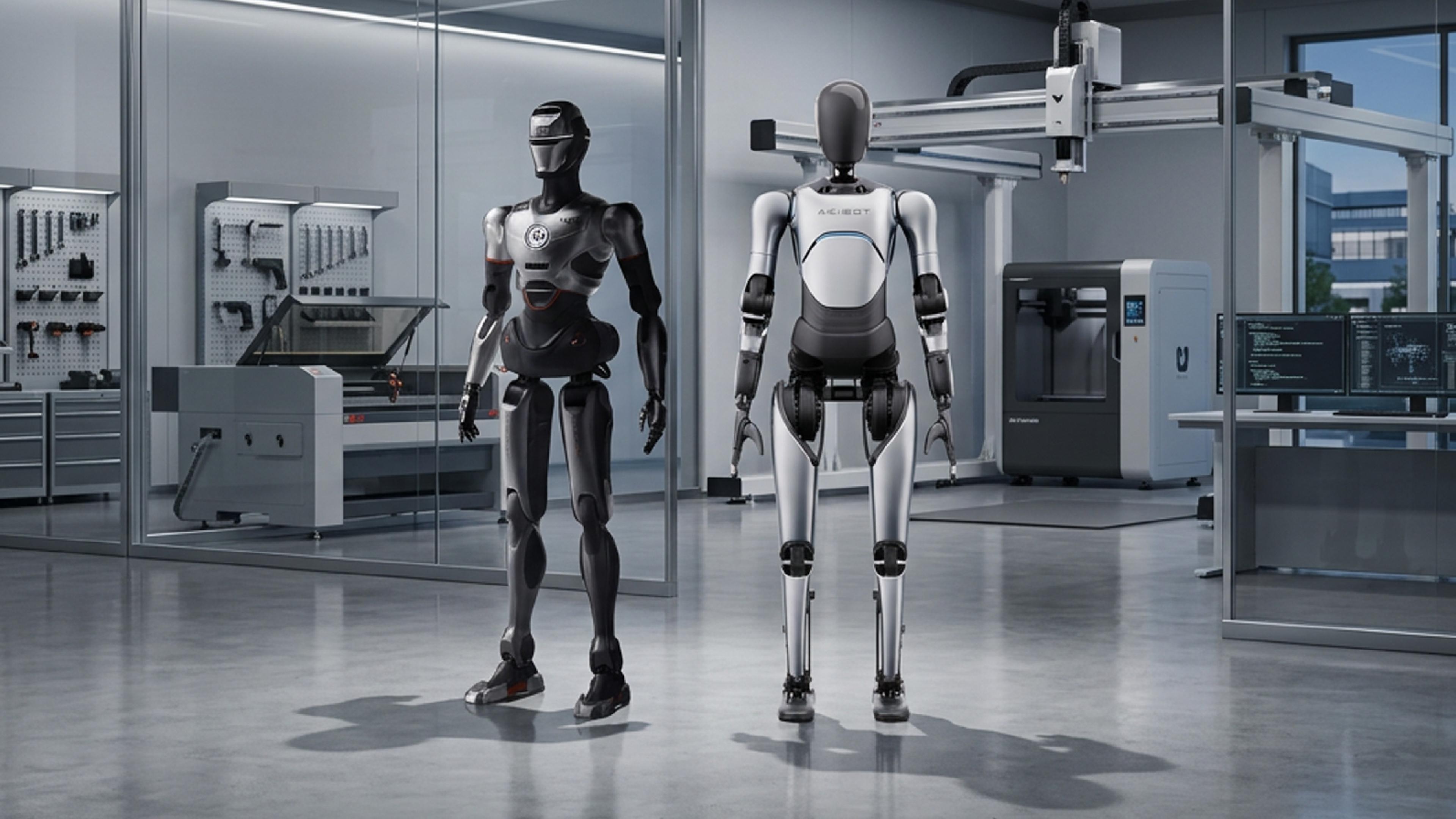
AGIBOT X2 and EngineAI PM01 are both compact bipedal humanoid robots compared here on locomotion, manipulation capabilities, perception systems, computing architecture, operating endurance and research-oriented deployment.

November 7, 2026 by Business Desk Team
Introduction
AGIBOT X2 and EngineAI PM01 are ultracompact bipedal humanoid research and education robots and development platforms for embodied-intelligence applications. These platforms feature bipedal locomotion, multi-joint upper bodies, integrated onboard perception and computing, and are suitable for use within robotics research labs, developer programs and for use in interactive demos.
Difference is just in their hardware setups and development direction AGIBOT X2 is a configuration-based platform, the X2 Ultra has a greater perception hardware and computing power; EngineAI PM01 is an open humanoid development platform, it supports secondary development, quick-release battery architecture and higher published joint-torque numbers.
At a Glance
| Metric | AGIBOT X2 | EngineAI PM01 |
|---|---|---|
| Robot type | Compact bipedal humanoid robot | Bipedal humanoid development robot |
| Best-fit use cases | Human-robot interaction, education, research, performances and service-oriented demonstrations | Robotics research, education, embodied-AI development and industrial application prototyping |
| Height | Approximately 1,310 mm | Approximately 1,400 mm (Education Edition) |
| Weight | Approximately 35 kg (X2); 39 kg (X2 Ultra) | Approximately 43 kg (Education Edition, including battery) |
| Degrees of freedom | 25 (X2); 30 (X2 Ultra, according to current product specifications) | 24 (Education Edition) |
| Walking speed | Up to 1.8 m/s; typical speed ≤0.8 m/s | Greater than 2 m/s hardware-supported; not a guaranteed sustained operating speed |
| Payload / strength | Maximum 3 kg in specific postures; ≤1 kg across the full range, excluding end-effector | A directly comparable payload rating was not confirmed in the reviewed specifications |
| Joint torque | Peak joint torque: 120 N·m | 145 N·m stated for the Education Edition |
| Runtime / charging | Approximately 2 hours at 0.5 m/s; charging time ≤1.5 hours | Approximately 2 hours; approximately 2 hours to full charge |
| Battery | Approximately 500 Wh; swappable battery | 10,000 mAh smart quick-release battery |
| Navigation / sensing | Interactive RGB camera; X2 Ultra adds 3D LiDAR and RGB-D camera | Two depth cameras on the Education Edition; 2026 Navigation Edition adds 3D LiDAR |
| Computing | Dual RK3588 boards; X2 Ultra adds NVIDIA Orin NX (157 TOPS) | Education Edition: 4-core CPU and NVIDIA Jetson Orin NX 16GB |
| Connectivity | Wi-Fi and Bluetooth; 4G/5G module on X2 Ultra | Configuration-dependent; confirm interfaces for the ordered edition |
| Development support | Secondary development supported on X2 Ultra; not supported on the base X2 in the published specification | Secondary development supported |
| Distinctive capabilities | Multimodal interaction, interactive display, head-touch sensing and optional advanced perception | Open development architecture, quick-release battery and research-oriented computing |
| Key limitation / caveat | Perception, computing and degrees of freedom differ by X2 variant | PM01 specifications differ by edition; speed and torque figures require their stated test conditions |
How They Compare
Operational role: AGIBOT X2 has an operational role, directly integrating multimodal human-robot interaction with bipedal locomotion: this applies to public-facing showcasing, education and public-interacting service applications. EngineAI PM01 is positioned more explicitly as an open general-purpose embodied-systems intelligence platform for scientific and educational research, and industrial application development, with secondary-application support likely to be very relevant to teams developing and testing their own robotics applications.
Mechanical architecture and mobility: AGIBOT X2 has a height of about 1.31 m and mass of approximately 35 kg in the base, 39 kg for X2 Ultra. Specifications published by the company shows 25 dof for X2, 30 dof for X2 Ultra, and a maximum joint torque of 120 Nm. EngineAI PM01 Education Edition has a height of about 1.4 m, mass of approximately 43 kg including battery, with 24 dof. 145 Nm joint torque is published for this edition of EngineAI. The published dof is 24. The movement speed specified is greater than 2 m/sec (hardware supported) for EngineAI and 1.8 m/sec (maximum) for AGIBOT, with typical speed at 0.8 m/sec or less. These published maximum speeds should not be interpreted as comparable continuous walking speeds.
Perception and autonomous operation: AGIBOT X2 is equipped with interactive RGB camera and head-touch sensor; AGIBOT X2 Ultra is equipped with 3D LiDAR sensor and RGB-D camera and extra RGB camera; EngineAI PM01 Education Edition is equipped with 2 depth cameras at the head and waist; and 2026 Navigation Edition is equipped with 3D LiDAR, with a different perception configuration from the Education Edition. These are independently demonstrated for auto or intelligent operation, but the navigation performance is dependent on the software version, sensor configuration and operation environment.
Computing & development: AGIBOT X2 doubles up on the number of RK3588 computing boards and runs on a dual-board system. Its 2 Ultra configuration has a Nvidia Jetson Orin NX module capable of 157 TOPS plus the ability to develop on the platform. The base specification of AGIBOT X2 does not feature the higher-performance module or the ability to develop on the system. EngineAI PM01 Education Edition features a 4-core high-performance CPU and an Nvidia Jetson Orin NX 16GB computing board, as well as the ability to develop on the system. For research teams, access to the development interface, SDK documentation, control API and software permissions might be more important than the specification of the processor.
Battery and operational endurance: Battery about 500 Wh, about 2 hours under the condition of 0.5m/s walk, about 1.5 hours of charging time. EngineAI PM01: about 2 hours of battery life and about 2 hours of full charging time. The above data is the time data published by the manufacturer and cannot be guaranteed to be based on all types of loads. The actual battery life depends on the intensity of the locomotive, the manipulation task, the computing load and the environment.
Important Qualification
AGIBOT X2: The X2, and X2 Ultra are not interchangeable configurations. Their degrees of freedom, perception sensors, computational hardware and development capabilities are different. The existing manufacturer specification states 25 DOF for the base X2, and 30 DOF for X2 Ultra, while some other literature may state the series in a different way. The payload capacity is also pose dependent: up to 3kg in certain postures, but no more than 1kg in the whole DOF, not including the endeffector.
EngineAI PM01: The company sells varying specifications for Education, Business and 2026 Navigation. The Education Edition was disclosed at 1,400 mm and 43 Kg. The Navigation Edition has different sensor installation and physical package. 145 Nm is specified torque, do not mistake this as a 15 Kg payload rating, although a directly comparable arm payload spec was not verified in the reviewed official documentation.
Performance claims: Maximum or hardware supported speed is not representative of safe, repeatable locomotion speed when carrying payload or in continuous operation. Ask for test conditions and demonstration results prior to comparing locomotion performance.
Human safety: Human detection, obstacle avoidance and dynamic balance alone do not constitute certified collaborative safety. Confirm emergency-stop behaviour, collision responses, operating boundaries and all relevant safety documentation when implemented.
Summary
Select AGIBOT X2 if a small humanoid platform with multimodal interaction, an interactive display and selection of hardware configurations is a better match to your project. X2 Ultra is the preferred configuration when increased perception, more computing power and secondary development are needed.
Consider EngineAI PM01 in situations when an open humanoid development platform for research, education and embodied-AI experimentation is the primary consideration. Secondary-development support, quick-release battery and published joint-torque specification might be other decision factors.
This is a one-on-one comparison and not a means of comparing performance in a regulated competition. Verify the number of exact X2 and PM01 editions and have access to all payload definitions, sensor packages and software features available, prior to making purchasing decisions. Trial rides at the customer site with representative workload are encouraged.
This comparison is based on ROBOT24.com market-research data records and manufacturer-reported specifications rather than controlled performance testing.
More articles on this topic
144 articles ReportRichtech DUST-E S vs. Gausium Phantas
 ReportEngineAI SE01 vs. AGIBOT RAISE A1ReportRichtech DUST-E S vs. KEENON KLEENBOT C20
 ReportPUDU PuduBot 2 vs. OrionStar LuckiBot Pro
 ReportUnitree G1 vs. EngineAI PM01
 ReportKEENON DINERBOT T11 vs. PUDU KettyBot Pro
 ReportAGIBOT D1 Pro vs. Unitree Go2 Pro
 ReportKEYi Tech Loona vs. WEILAN BabyAlpha A2
 ReportPUDU BellaBot Pro vs. KEENON DINERBOT T11
 ReportBear Robotics Servi Plus vs PUDU BellaBot Pro
 ReportUnitree G1 vs. AGIBOT X2
 ReportPUDU KettyBot Pro vs. Bear Robotics Servi Q
BUSINESS NEWS WEEKLY LETTER
The Weekly Letter for Robotics Professionals, Summarizing the Most Important Industry Moves, Launches, Deals and Signals.