AGIBOT G2 vs Galbot G1
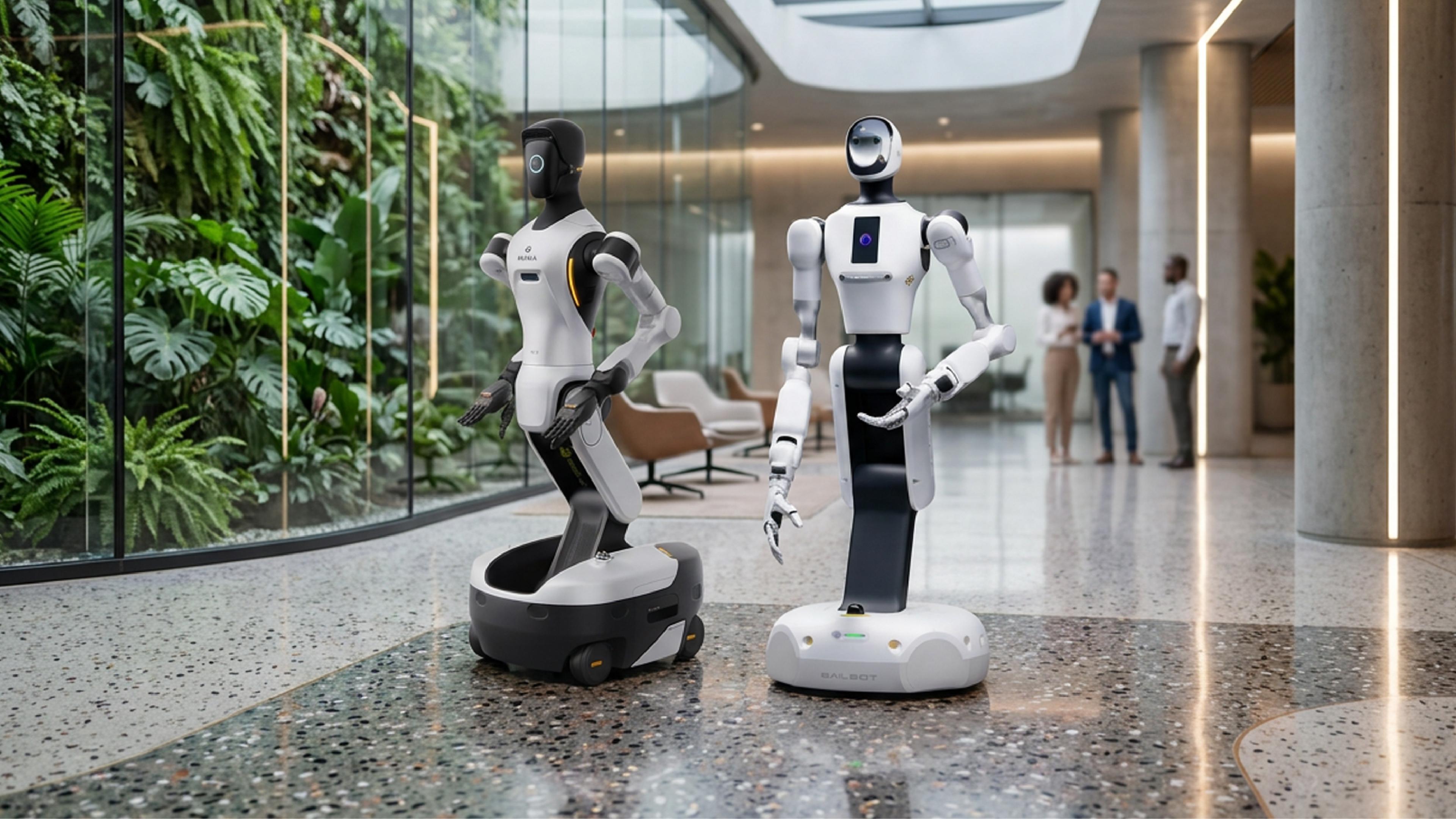
AGIBOT G2 and Galbot G1 are commercially positioned robotic platforms designed for physical tasks in industrial and service environments. We compare their physical dimensions, operating endurance, connectivity, deployment status and intended applications to examine their suitability for manufacturing, retail and other commercial operations.

November 10, 2026 by Business Desk Team
Introduction
Robots designed to perform physical tasks are becoming increasingly relevant to manufacturing, logistics and commercial service operations.
Unlike robots that primarily provide information or transport items, mobile manipulation platforms are designed to interact with objects and perform tasks within their surroundings.
However, selecting a robot for these applications requires more than comparing its size or operating runtime. Physical configuration, manipulation capabilities, mobility, software integration and deployment requirements can all influence how effectively a robot performs a particular task. AGIBOT G2 and Galbot G1 are two Chinese robotic platforms developed for physical interaction and commercial applications.
AGIBOT G2 is positioned for manufacturing and industrial operations, with a height-adjustable design intended to support tasks at different working levels.Galbot G1 is designed for mobile manipulation across commercial and research-oriented environments, with applications including retail, manufacturing and home-assistance development.
Although both platforms are intended to perform physical tasks, their recorded specifications reveal significant differences in weight, operating endurance and deployment focus.
Based on ROBOT24.com market-research data records, this comparison examines their physical design, runtime, connectivity, commercial availability and suitability for different applications.
At A Glance
| Availability | Commercially Available | Commercially Available (Pilot & Enterprise Deployments) |
|---|---|---|
| Cloud Connectivity | Yes | Supported |
| Height | 1225–1795 mm (adjustable) | 173 cm |
| Nationality | Chinese | Chinese |
| Runtime | Approximately 4 hours | Up to 10 hours |
| Weight | 185 kg | 80–85 kg |
| Wi-Fi | Yes | Yes |
| Typical use | Manufacturing & Industrial Operations | Retail & Showroom Operations, Manufacturing & Industrial Operations, Home Assistance |
| Status | Commercial | Commercial |
How They Compare
Industrial applications and operational focus
AGIBOT G2 and Galbot G1 are both designed for robotic manipulation, but their listed applications indicate different operational priorities. AGIBOT G2 focuses on manufacturing and industrial operations. Its adjustable working height and industrial positioning make it relevant to businesses exploring automation for repetitive physical tasks.
Galbot G1 has a broader range of recorded applications, including retail and showroom operations, manufacturing, industrial environments and home assistance. These applications may involve object handling, interaction with surrounding equipment and manipulation tasks in environments designed for people.
Both platforms may be relevant to industrial automation projects, but their suitability depends on the required tasks, workspace configuration and level of autonomy. The listed applications should not be interpreted as evidence that every task within those industries has been independently demonstrated or commercially deployed.
Physical dimensions and working height
One of the most notable differences between the two robots is their physical configuration. AGIBOT G2 has an adjustable height ranging from 1,225 mm to 1,795 mm, equivalent to approximately 122.5–179.5 cm.
Galbot G1 has a recorded height of 173 cm. G2's adjustable height may be relevant to industrial applications involving workstations or objects positioned at different levels. A height-adjustable structure can potentially allow a robot to operate across multiple working positions without requiring every task to be performed at a fixed height.
Galbot G1's recorded height places it within the upper portion of G2's adjustable range. However, overall robot height does not establish the actual reach of its manipulators. Arm length, joint configuration, workspace geometry and the robot's positioning relative to objects also determine its usable working area. A direct comparison of manipulation reach would require additional specifications.
Weight and deployment requirements
AGIBOT G2 has a recorded weight of 185 kg. Galbot G1 weighs approximately 80–85 kg. Based on these figures, G2 is approximately 100–105 kg heavier than Galbot G1. This is a substantial difference that may influence transportation, installation and workspace requirements.
G2's higher weight may reflect a different structural design and industrial configuration. Galbot G1's lighter recorded weight may have implications for handling and repositioning the robot during installation. However, weight alone does not establish greater payload capacity, stability or manipulation performance.
A heavier robot is not necessarily capable of lifting heavier objects, just as a lighter robot is not automatically more maneuverable. Payload ratings, base dimensions, center of gravity and actuator capabilities would be needed for a meaningful comparison of physical task performance.
Operating endurance and runtime
Operating runtime represents another significant difference in the supplied records. AGIBOT G2 has a recorded runtime of approximately four hours. Galbot G1 has a stated runtime of up to 10 hours. Based on these figures, Galbot G1 has the longer published maximum operating duration.
This may be relevant to facilities seeking robots for extended service periods or repeated tasks throughout the working day. G2's recorded four-hour runtime may be suitable for certain industrial tasks, depending on workload and charging arrangements. However, the figures should not be treated as directly comparable without confirming their measurement conditions.
Battery endurance can vary depending on the frequency of movement, manipulation workload, payload and periods of inactivity. The supplied records do not specify whether the two runtime figures were measured during equivalent activities. Charging times, battery capacities and battery replacement arrangements are also not included. These details should be verified before determining how either robot would perform across a full operating shift.
Manipulation and physical task requirements
Both robots are associated with applications that involve physical interaction with their environments. For AGIBOT G2, the primary focus is industrial work, where a robot may need to handle objects or interact with manufacturing equipment. Galbot G1 is positioned for manipulation tasks across industrial and commercial environments. Task-specific demonstrations are particularly important for activities involving precise placement, repeated handling or interaction with existing machinery.
Mobility and workspace compatibility
Both platforms are intended for applications involving physical interaction in operational environments. However, the supplied comparison records do not establish directly comparable mobility specifications. They do not provide maximum travel speeds, minimum passage widths, turning requirements or obstacle-navigation performance.
These factors can be important in manufacturing facilities where robots share space with workers, equipment and material-handling systems. A robot's ability to reach a workstation does not necessarily establish its ability to navigate safely between multiple workstations. Similarly, physical dimensions alone do not determine whether a robot can operate in a narrow aisle or crowded production area. Organizations should confirm the mobility configuration and navigation capabilities of each platform before deployment.
Cloud connectivity and Wi-Fi
Both AGIBOT G2 and Galbot G1 support cloud connectivity and Wi-Fi according to the supplied records. These capabilities may support communication with management systems, data exchange, software updates and connected operational workflows.
For industrial applications, connectivity may be relevant to monitoring robot activity and integrating automation with existing systems. For research and development, it may support experimentation, data collection and software development. However, connectivity support does not automatically establish identical software capabilities.
The supplied records do not specify directly comparable APIs, SDKs, industrial communication protocols or remote-management functions. Businesses should confirm whether each platform supports the software interfaces required for their intended applications.
Manufacturing and industrial deployment
AGIBOT G2 is specifically categorized for manufacturing and industrial operations. This positioning makes it relevant to organizations evaluating robots for production-related tasks.
Its adjustable height may be useful in applications involving different working levels, although actual task compatibility depends on the robot's manipulation capabilities and workspace requirements. Galbot G1 also has manufacturing and industrial operations listed among its typical uses.
Its broader application profile may be relevant to developers exploring mobile manipulation across different environments. However, the supplied records do not establish which platform has completed more industrial deployments or demonstrated greater reliability in continuous production. Deployment maturity should be assessed through documented customer installations, operating hours and task-specific performance data.
Retail, showroom and home-assistance applications
Galbot G1 has retail and showroom operations and home assistance included among its recorded applications. These use cases may involve object handling, product interaction and other physical tasks outside traditional manufacturing environments.
Its application range suggests a focus on developing manipulation capabilities that can be applied across different settings. AGIBOT G2's supplied application record focuses on manufacturing and industrial operations rather than retail or domestic assistance. However, the absence of these categories does not necessarily establish that G2 cannot perform tasks in other environments.
The two platforms should be evaluated according to their demonstrated capabilities rather than application labels alone. Home-assistance positioning, in particular, should not be confused with verified readiness for unsupervised household operation.
Commercial availability and deployment maturity
Both AGIBOT G2 and Galbot G1 have commercial status in the supplied records. AGIBOT G2 is listed as commercially available.Galbot G1 is described as commercially available through pilot and enterprise deployments. This distinction may be relevant to organizations evaluating purchasing and installation options.
Pilot and enterprise deployments can involve different levels of customization, technical support and operational testing compared with standard commercial purchases.
However, the supplied records do not establish current delivery lead times, regional availability or the exact configurations offered.Businesses should confirm purchasing arrangements, installation requirements, warranty coverage and after-sales support directly with the manufacturers.
Summary
AGIBOT G2 and Galbot G1 are Chinese robotic platforms designed for physical manipulation and commercial applications. AGIBOT G2 is worth considering for organizations exploring manufacturing and industrial automation. Its recorded adjustable height of 1,225–1,795 mm, weight of 185 kg and approximately four-hour runtime reflect a platform positioned for industrial working environments.
Galbot G1 may appeal to businesses and developers exploring manipulation across manufacturing, retail and other settings. Its recorded weight of 80–85 kg, height of 173 cm and runtime of up to 10 hours provide a different set of physical and operating characteristics.
Both platforms support Wi-Fi and cloud connectivity and are listed with commercial status. The choice depends on the intended tasks, required manipulation capabilities, workspace configuration, operating endurance and deployment arrangements.
This comparison is based on ROBOT24.com market-research data records rather than controlled performance testing. Runtime, mobility, payload capacity, manipulation performance and commercial availability should be verified against configuration-specific manufacturer documentation before drawing conclusions about overall performance.
More articles on this topic
144 articles ReportRichtech DUST-E S vs. Gausium Phantas
 ReportEngineAI SE01 vs. AGIBOT RAISE A1ReportRichtech DUST-E S vs. KEENON KLEENBOT C20
 ReportPUDU PuduBot 2 vs. OrionStar LuckiBot Pro
 ReportUnitree G1 vs. EngineAI PM01
 ReportKEENON DINERBOT T11 vs. PUDU KettyBot Pro
 ReportAGIBOT D1 Pro vs. Unitree Go2 Pro
 ReportKEYi Tech Loona vs. WEILAN BabyAlpha A2
 ReportPUDU BellaBot Pro vs. KEENON DINERBOT T11
 ReportBear Robotics Servi Plus vs PUDU BellaBot Pro
 ReportUnitree G1 vs. AGIBOT X2
 ReportPUDU KettyBot Pro vs. Bear Robotics Servi Q
BUSINESS NEWS WEEKLY LETTER
The Weekly Letter for Robotics Professionals, Summarizing the Most Important Industry Moves, Launches, Deals and Signals.