AGIBOT G2 vs. EngineAI SE01
Two humanoid robots for industrial automation and embodied AI — compared on how G2’s wheeled mobility and SE01’s bipedal locomotion shape their capabilities, use cases and operating focus.

September 25, 2026 by Business Desk Team
Introduction
At a Glance
| Metric | AGIBOT G2 | EngineAI SE01 |
|---|---|---|
| Robot type | Wheeled humanoid | Bipedal humanoid |
| Manufacturer | AGIBOT | EngineAI |
| Release year | 2025 | 2023 |
| Height | Adjustable 1,225– 1,795 mm | 1,700 mm |
| Weight | 185 kg | 55 kg |
| Degrees of freedom | 26 active DOF | 32 DOF |
| Arm DOF | 7 per arm | Not separately recorded |
| Arm payload | 5 kg per arm | Not publicly disclosed |
| Maximum speed | 1.5 m/s | 2 m/s walking speed |
| Runtime | Approx. 4 hours | Approx. 2 hours |
| Locomotion | Omnidirectional wheeled base | Bipedal walking |
| Zero-radius rotation | Yes | N/A |
| Autonomous navigation | Yes | Yes |
| Obstacle avoidance | Yes | Yes |
| Automatic docking | Yes | Not specifically recorded |
| Automatic charging | Yes | Not specifically recorded |
| 3D LiDAR | 2 units | 360° LiDAR |
| Depth / RGB-D cameras | Head and wrist RGB-D cameras plus additional cameras | Intel RealSense D435 plus six HD stereo cameras |
| Force / torque sensing | Yes | Supported |
| AI / planning | GO-1 embodied AI; GE-1 planning model; vision-language AI | Reinforcement learning; imitation learning; neural gait model |
| LLM integration | Yes | Not specifically recorded |
| ROS | Secondary development supported; exact ROS version not recorded | ROS-compatible SDK |
| Industrial integration | Yes | Developer/open-platform integration |
| Fleet management | Supported | Not recorded |
| Price | Not publicly disclosed | US$20,000–30,000 |
| Availability | Commercially available | Commercially available |
How They Compare
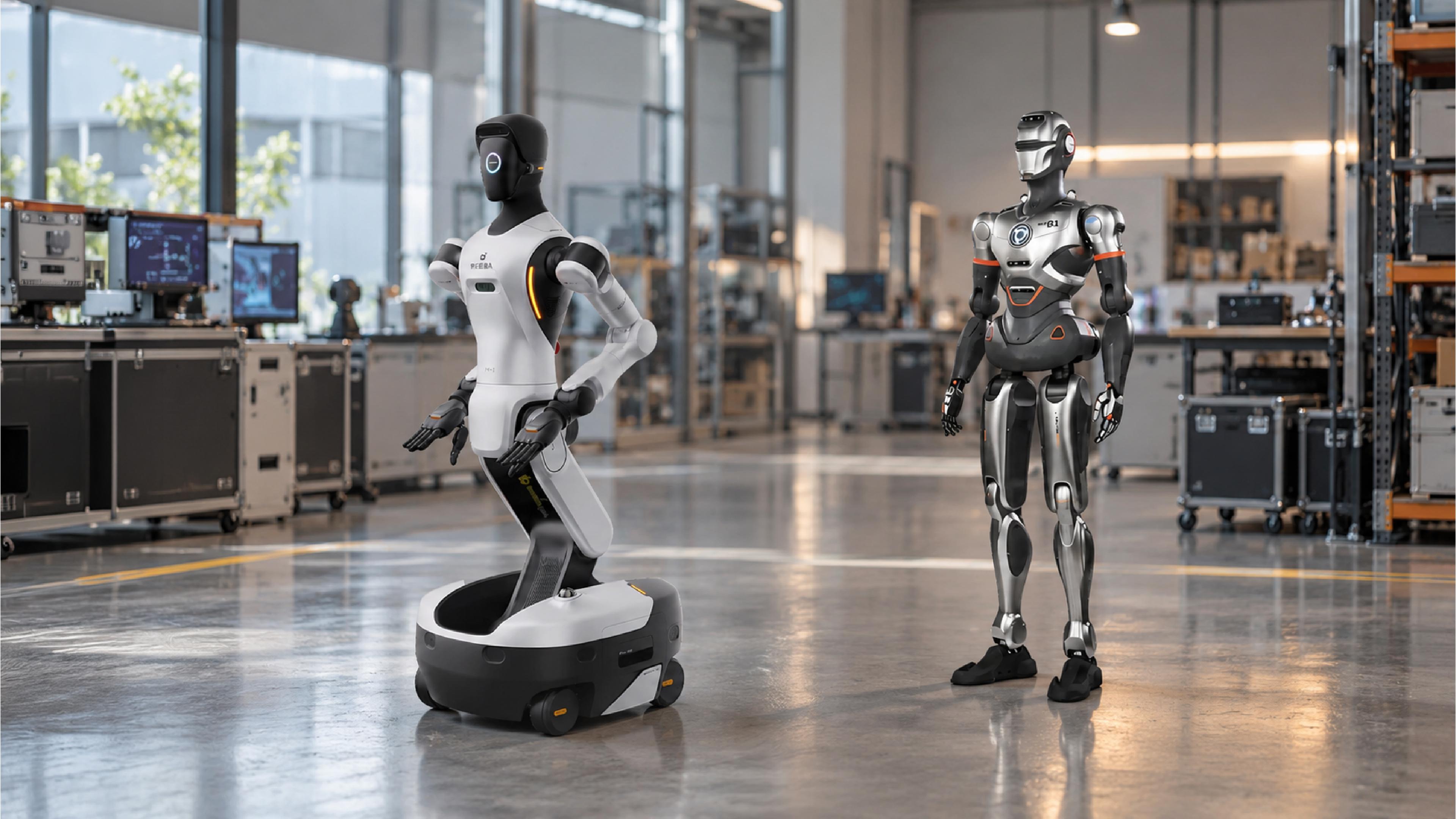
AGIBOT G2 and EngineAI SE01 are both humanoids, but they solve mobility in very different ways.
G2 is mounted on an omnidirectional wheeled platform. This allows it to move in multiple directions, rotate with zero turning radius and navigate factory or warehouse floors while maintaining a stable platform for manipulation.
The Robot24 record includes autonomous navigation, autonomous docking, automatic charging, fleet management and remote monitoring. G2 also has force-controlled manipulation, vision-language AI, autonomous task planning and industrial workflow integration.
Its 26 active degrees of freedom include seven degrees of freedom in each arm. The robot supports a payload of 5 kg per arm and has a height adjustable between approximately 1.225 and 1.795 metres.
SE01 uses true bipedal locomotion. It is 1.7 m tall and weighs approximately 55 kg, making it substantially lighter than the 185 kg G2. It has 32 degrees of freedom and can walk at approximately 2 m/s.
Its locomotion stack includes dynamic balance, reinforcement-learning locomotion, a neural gait model and real-time motion planning. It also supports imitation learning and provides a ROS-compatible SDK and open development platform.
Both incorporate sophisticated perception systems. G2 has dual 3D LiDAR, RGB-D cameras, fisheye cameras, stereo vision and force/torque sensing. SE01 includes 360° LiDAR, Intel RealSense depth sensing, six HD stereo cameras, IMU and supported force/torque sensing.
Runtime is approximately four hours for G2 versus approximately two hours for SE01.
Summary
AGIBOT G2 and EngineAI SE01 are both advanced humanoid platforms but are optimised around different mobility architectures.
G2 is a wheeled humanoid intended particularly for stable industrial manipulation and autonomous workflow execution. Its omnidirectional base, automatic charging, docking, fleet support, AI task planning and 5 kg-per-arm payload make its Robot24 record strongly oriented toward manufacturing and logistics.
SE01 is a full bipedal humanoid with a stronger emphasis on human-like locomotion, reinforcement learning and robotics development. Its 32 DOF, dynamic balance, 2 m/s walking speed and open ROS-compatible development environment support both industrial experimentation and embodied-AI research.
The central distinction is G2's stable wheeled mobile-manipulation architecture versus SE01's lighter, fully bipedal humanoid architecture.
More articles on this topic
28 articles ReportDEEPRobotics Lite3 vs. Unitree Go2 EDU
 ReportStäubli FL1500 vs. VisionNav VNE30
 ReportIDMind AIDA vs. Reeman Nurse
 ReportUBTECH Cruzr 1S vs. OrionStar GreetingBot Mini Robot: Which Retail Service Robot Fits Better?
 ReportDoog THOUZER THOUZER Standard vs. SPARQ Lift AL-450: Which Warehouse AMR Fits Better?
 ReportRobopreneur AI Security Robot (Johan & Jaguh) vs. IHMC Alex / Alexander: Who’s Better Suited to Patrol?
 ReportDonut Robotics Cinnamon Guide vs. AeiROBOT AIMY: Which Hotel Service Robot Fits Better?
 ReportBG1 (Pudu Robotics) vs. Servi Clean (Bear Robotics): Commercial Cleaning Comparison
 ReportG2 Genie (AGIBOT) vs. D7 (Pudu Robotics): Humanoid Comparison
 ReportServi (Bear Robotics) vs BellaBot (Pudu Robotics)
 ReportHolaBot (Pudu Robotics) vs. Foodie (Robint): Restaurant Service Comparison
 ReportPudu Robotics BG1 vs. VIGGO SC50 Pro Plus: Which Cleaning Robot Fits Your Facility?
BUSINESS NEWS WEEKLY LETTER
The Weekly Letter for Robotics Professionals, Summarizing the Most Important Industry Moves, Launches, Deals and Signals.