How a Tiny Robot Searches for Hidden Damage Inside the Wind Turbine Blades
Cracks in a wind turbine blade often start on the inside, where no drone or pair of binoculars can reach. A robot small enough to crawl in does the job perfectly.

October 23, 2026 by Dr Maulik Vyas
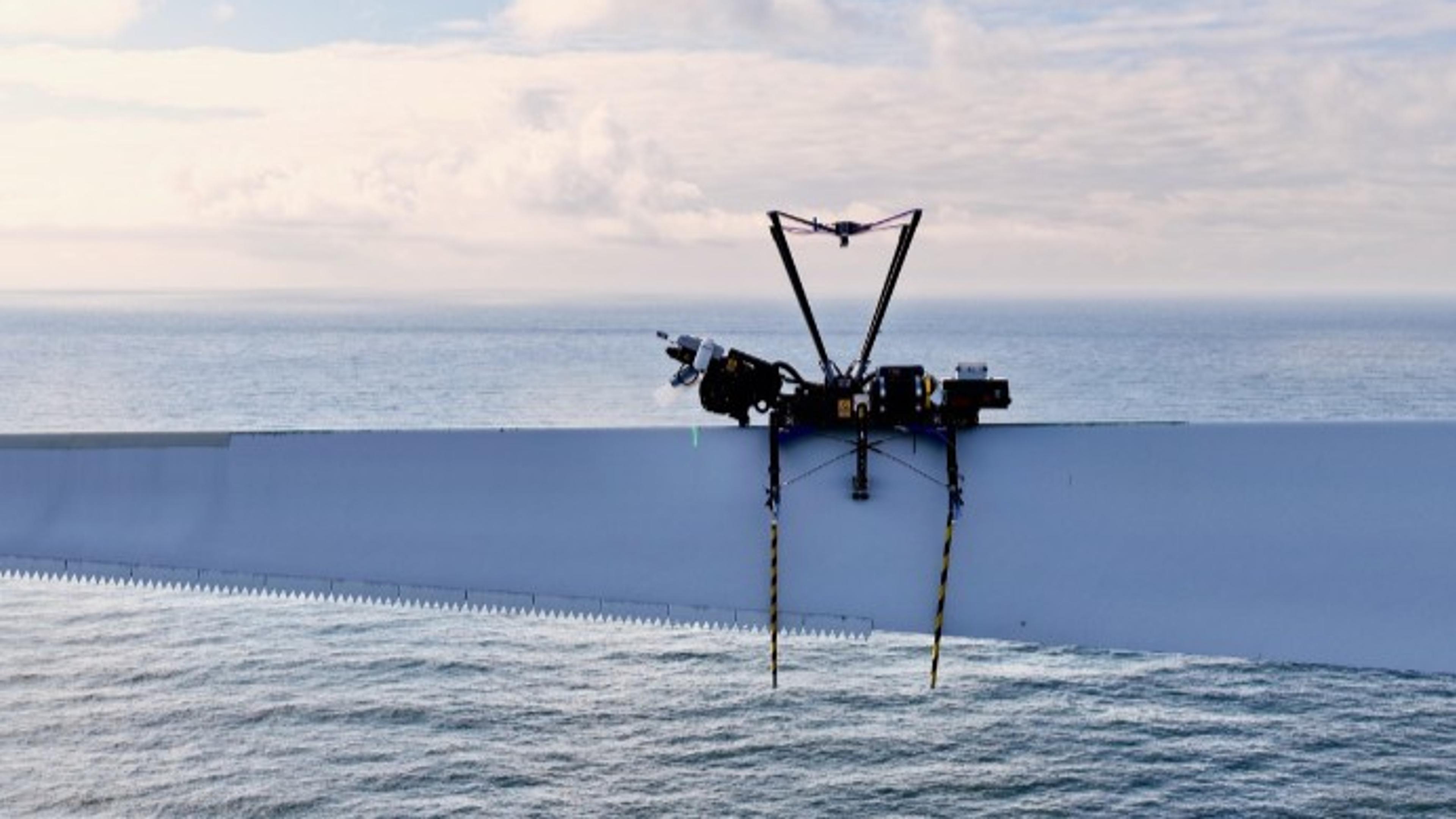
Inside a wind turbine blade it's dark, hollow and tight, a long composite shell split by structural webs. Few people enjoy spending a working day in there. A robot roughly the size of a small suitcase does it instead, carrying its own lights and cameras.
Why the worst damage hides inside
A wind blade is a thick composite shell, and the harm that matters most tends to start where nobody's looking. Stress cracks and bond line failures, where glued sections let go of each other, can develop inside the blade without leaving much of a mark on the outside. A technician on the ground with binoculars sees paint and erosion. A drone sees the skin.
Aerones, one of the companies working on this, makes the point that a blade's internal condition can differ completely from its outer look, and that missed damage turns into expensive repairs. Here, sending a human inside is possible but difficult because the space is long, dark and cramped. Further, it narrows the farther in you go. That gap is what interior crawlers were built to fill.
What the little crawler carries
Clobotics' Crawler is one of the better-documented examples. The robot weighs about 6 kilograms and measures around 50X23X28 centimeters. On board are two high dynamic range cameras, LED lighting and a tether that lets the operator pull the machine back out. The company says its 26-megapixel images cover everything the robot passes, up to two thirds of the blade's length, and that each image is pinned to within 20 centimeters of its true position.
Aerones' third-generation crawler packs in more gear. There are adaptive LED matrix lights to chase shadows out of dark corners. Plus, it has a 360-degree camera that sees all around, and a 3D LiDAR scanner that measures the space and the distance traveled. A 61-megapixel camera handles the root zone, where the blade bolts to the hub. The company says the machine can inspect up to 90 percent of a blade's interior.
How the crawler works
The routine is simple: technicians set the crawler inside the blade first. Then, it rolls along with its lights on. Further, the tether keeps it recoverable if something goes wrong. So, nobody has to squash through their hands and knees. And, this matters because there is a confined and tall structure, risky place to work.
Once the run is over, the data gets uploaded and analysts check it all through the images and video, flagging cracks and bond problems. At Aerones, technicians operate the crawler and in-house analysts process what it records. Clobotics says a team of two can inspect two entire turbines in a single day. That's a vendor's estimate, and conditions vary from site to site, but the shape of the process holds regardless: crawl, record, upload, review.
Seeing through the skin
Cameras only show what's in front of them. For damage buried within the layers of the blade itself, researchers use sound and heat.
Sandia National Laboratories built a crawling robot that moves up and down the blade surface like someone mowing a lawn. It carries a wand that scans with phased array ultrasound, which works much like the ultrasound machines doctors use. Signals go into the material, and the pattern that comes back reveals what's inside.
Dennis Roach, a crawler project lead, said that the method can detect damage at any layer of the thick composite. When the robot finds something, inspectors can have it mark the spot so the location is obvious. Sandia also worked with small businesses to put infrared cameras on drones. The approach is called thermography: it uses the heat from sunlight to learn about the damage up to about half an inch deep. A drone flags a suspicious blade, and a crawler then goes in for a closer look.
Where the robots run out of road
Every design has a limit. Clobotics' crawler covers up to two thirds of the blade length, and Aerones claims up to 90 percent. Toward the tip the hollow space tapers and becomes quite tight that you cannot fit a robot. While the tether adds safety, it also limits how far the machine can wander.
Then there's judgment. A crawler can take thousands of images, still someone has to decide which crack is significant and which is just cosmetic. Numbers on coverage, accuracy and speed are mostly from the manufacturers selling the machines; hence, independent tests would provide more information. And an inside view says little about wear on the outside, which is why operators pair crawlers with drone checks.
What wind farms do with the data
Inspection data is only useful if it helps taking the right decisions. Repeated crawls let operators watch how a damage or defect grows from one visit to the next, and this is what Aerones describes as tracking damage progression. Clobotics frames it as deciding where to focus attention and spend resources.
Its CTO has noted that the hardest part of a data-driven approach to wind maintenance is collecting good data at an affordable cost. A small robot goes straight at that problem. A hairline crack that's holding steady can wait. One that's spreading along a bond line gets scheduled for repair before the blade has to come down.
Out on the wind farm, the blade that looks fine from the ground may be cracking from within, and a small robot dragging a tether through the dark can be the first thing to notice.
More articles on this topic
218 articles ReportWhat it Really Costs to Own a Personal Assistant Robot at Home
 ReportThese Robots Are Taking Wall Repairs to New Heights
 ReportAudi Tests Agile Robots' Mobile Humanoids for Factory Logistics
 ReportFrom Flips to Dance Moves: New AI Trains Humanoid Robots in Record Time
 ReportRadioactive Mess? Better Call Spot
 ReportJapan's LOVOT Companion Robot Makes Abu Dhabi Healthcare Debut
 ReportTesla Starts Optimus Production, Targets First Commercial Deliveries in 2027
 ReportStrawberry-Harvesting Robots Learn to Pick Only Ripe Fruit
 ReportNVIDIA and Agile Robots Launch Humanoid Research Platform
 ReportThe Robots Giving Old Electric Vehicle Batteries a Second Life
 ReportUnderwater Robot Teams Take on the Problem of Seabed Waste
 ReportSmart Robotics to Boost Agriculture, Green Spaces, and Clean Tech
BUSINESS NEWS WEEKLY LETTER
The Weekly Letter for Robotics Professionals, Summarizing the Most Important Industry Moves, Launches, Deals and Signals.