Factory Robots: Who Actually Owns Industrial Automation Now?
ABB's robotics division is being sold to SoftBank but has not been finalized yet. KUKA has been wholly Chinese-owned since 2022. Chinese suppliers took 57% of their home market in 2024. The $5.375 billion sale of ABB Robotics cleared Brussels in March and still has not closed.

September 1, 2026 by Business Desk Team
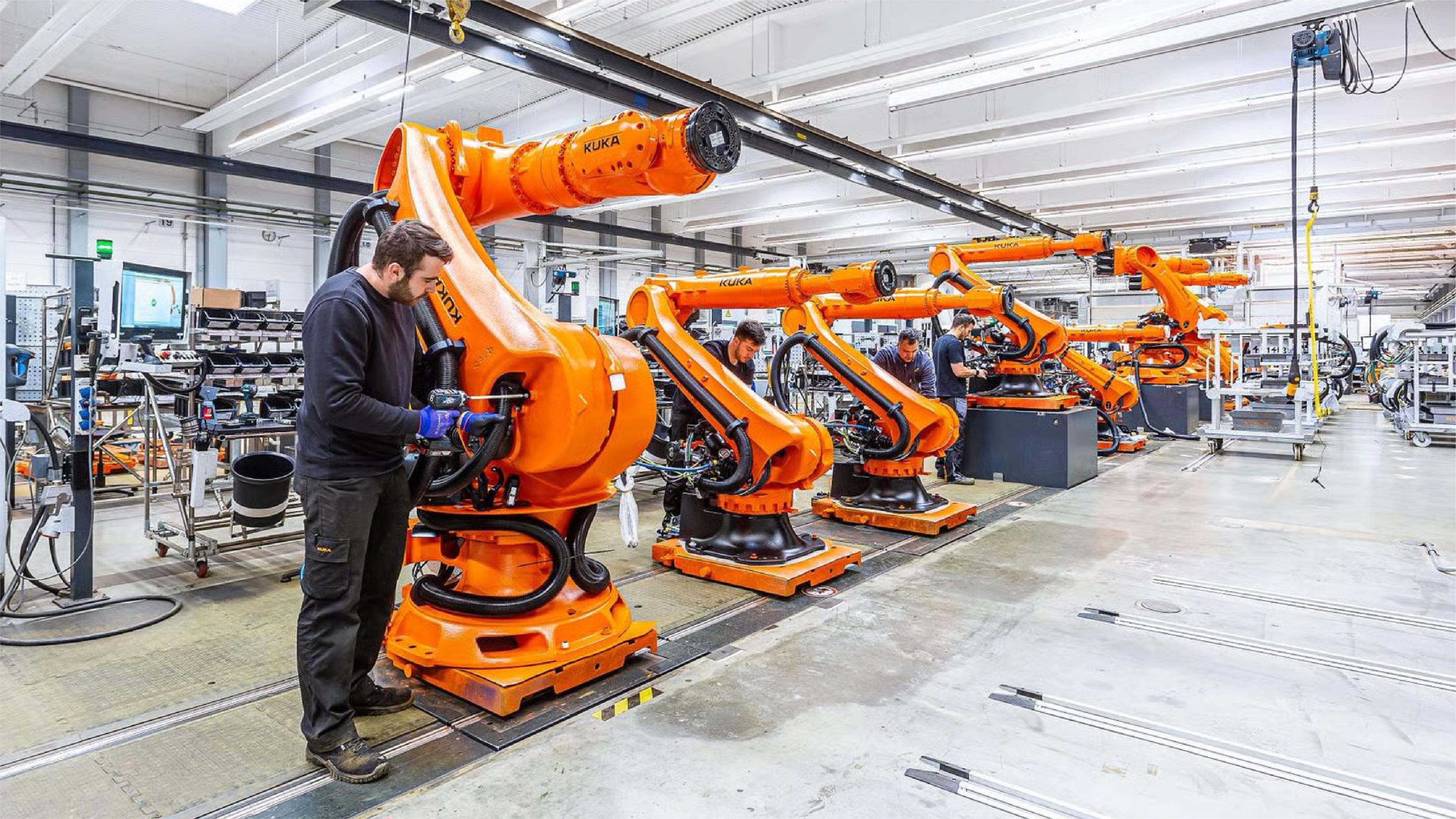
Let’s look at the movers and shakers within the manufacturing industry, one of the earliest adopters of automatons.
A four-bank syndicate, BNP Paribas, Goldman Sachs, HSBC, and Mizuho, finalized a $1.75 billion loan package for the purchase on 22 July, Bloomberg reported.
The Swedish-Swiss group agreed in October 2025 to sell the business to SoftBank at an enterprise value of $5.375 billion. The European Commission cleared it unconditionally on 11 March 2026 under its simplified procedure. In its second-quarter results on 16 July, ABB said completion was expected in the second half of 2026, subject to regulatory approvals and customary closing conditions.
Neither company has said publicly which approvals remain outstanding.
Reported as discontinued operations, robotics generated revenues of $576 million and net income of $38 million in ABB's second quarter. Divisional revenue was $2,279 million in 2024, with roughly 7,000 employees.
Masayoshi Son called physical AI "SoftBank's next frontier" in the announcement. The term was popularized by NVIDIA, which lists ABB Robotics among its physical-AI partners.
In April 2025, ABB said it would spin robotics off as a separately listed company, with trading expected in the second quarter of 2026.
Big names, big plays
Midea settled at 94.55% of KUKA's voting shares in January 2017, after a bid valuing the German company at about €4.5 billion. The remaining minority shares passed to the Chinese appliance maker when the squeeze-out was entered in the commercial register on 8 November 2022.
Bloomberg reported on 30 June that Midea is weighing a Shenzhen listing for KUKA. Neither company has confirmed it.
Comau went to private equity. One Equity Partners completed a majority investment in the Turin automation firm on 30 December 2024, Stellantis retaining a minority holding.
Is anyone actually losing?
FANUC reported net sales of ¥857.8 billion for the year to March 2026, up 7.6%, with robot-division sales up 14.9%, according to its results. China sales rose 30% in the quarter to June.
Elsewhere, results are more mixed. Yaskawa's robotics segment revenue rose 4.0% in the year to February 2026 while its segment operating profit fell 14.0%, on restructuring in Europe and China.
Kawasaki's precision machinery and robot segment posted business profit of ¥480 million for the quarter to 30 June 2026, against ¥3,663 million a year earlier. Group business profit rose 74.3% in the same quarter.
KUKA's accounts show the squeeze plainly. Revenue reached €3,897.2 million in 2025, up 4.4%, but EBIT fell 23.3% to €58.7 million, a 1.5% margin, its annual report shows.
In November 2025, it ordered 560 job cuts at Augsburg, citing an order shortfall above €100 million and Asian price competition.
Teradyne cut robotics staff twice, by 10% in January 2025 and 14% that November, the Robot Report documented. Robotics revenue has since recovered to $100 million in the second quarter, up 33%.
Who supplies China now?
Chinese manufacturers accounted for 57% of installations in their home market in 2024, up from 47% in 2023 and 30% in 2020, the International Federation of Robotics reported. China installed 295,000 industrial robots that year, 54% of a global total of 542,076 units.
Then the flow reversed. China became a net exporter of industrial robots for the first time in 2025, with exports up 48.7%, Global Times reported. Customs figures put first-half 2026 exports at 6.29 billion yuan, up 18.6%, according to CGTN.
Estun ranks first in China's industrial robot market on MIR Databank data, with a 10.5% share. It listed in Hong Kong on 9 March 2026, raising about $191 million.
The domestic field is uneven. Siasun's net loss widened to 397.88 million yuan in 2025, its annual report shows.
What is state money actually buying?
South Korea's Ministry of Trade, Industry, and Energy launched the K-Humanoid Alliance in April 2025, committing more than 1 trillion won by 2030. The goal is to land a top-three global position within the humanoid robots vertical.
The launch of the Alliance demonstrates Korea's strong determination to rise as a global powerhouse amid the humanoid robot hegemony competition led by China and the United States.
The Korean trade press covering the founding assembly recorded the alliance's own assessment that Korea lags behind the US and China in resources, infrastructure, and talent. The Ministry pledged 200 billion Korean won to its robotics budget during that year.
President Lee Jae Myung announced a package of more than $1 trillion over the next several years. Al Jazeera's breakdown shows the bulk is corporate: 800 trillion won from Samsung Electronics and SK Hynix for chip fabrication and 550 trillion won from SK Group, GS Group and Naver for data centers.
The Korean government will establish a strategic sovereign wealth fund of more than 20 trillion won, which will be deployed within strategic industries such as robotics.
Further west, India installed 9,120 industrial robots in 2024, ranking sixth, the IFR reported. Its national robotics strategy was outlined in 2023, proposing production-linked incentives with no amounts attached.
Addverb Technologies, in which Reliance Retail Ventures took a 54% stake in 2022, is seeking about $100 million, Bloomberg reported in June. The round has not closed, and its humanoid line is in development rather than on sale.
Ownership flows
Put together, ownership is moving in one direction.
The Japanese majors that built the industry, FANUC, Yaskawa, Kawasaki, are holding share but seeing margins squeezed by the same Chinese competition eating into KUKA's numbers and prompting Teradyne's layoffs. Western conglomerates are exiting outright: ABB selling to SoftBank, KUKA already under Midea since 2022 and possibly heading to a Shenzhen listing. Meanwhile the buyer of last resort in each of these deals is state or state-adjacent capital, South Korea's alliance and sovereign fund, India's incentive schemes, China's own domestic scale-up, treating robotics less as a manufacturing line item than as sovereign infrastructure.
The result is a market where the factory floor increasingly runs on hardware built, owned, or subsidized by governments betting that whoever controls automation controls the next decade of industrial output.
More articles on this topic
99 articles ReportNoetix Robotics Reportedly Files for Hong Kong IPO
 ReportHumanoid Expands Nvidia Partnership for Onboard Robot AI
 ReportEka Robotics Secures $150 Million to Advance Dexterous Automation
 ReportAgility Robotics Signs Deal to Pilot Digit at AGCO Factory
 ReportDream Labs Raises $90M, Offers Robot AI by the Hour
 ReportSchaeffler Opens China Factory Where Humanoids Build Robot Parts
 ReportPHYBOT Unveils Direct-Drive Robotic Hand With 23 Active Joints
 ReportOpenAI Expands Robotics Hiring to Develop Humanoid Hardware
 ReportFAIRINO Targets Industrial Embodied AI With New Funding
 ReportDevanthro Rebrands as Plim Robotics, Unveils Home Robot
 ReportAiMOGA to Open Preorders for Mobo Home Humanoid on Oct. 21
 ReportHyphen Taps Ricoh to Scale Robotic Kitchens Across the U.S.
BUSINESS NEWS WEEKLY LETTER
The Weekly Letter for Robotics Professionals, Summarizing the Most Important Industry Moves, Launches, Deals and Signals.