MIT Researchers Build Self-Reconfiguring Swarm of Aquatic Robots
The robotic boats assemble into floating structures, break apart and reconfigure with minimal human input.

September 14, 2026 by Nisha
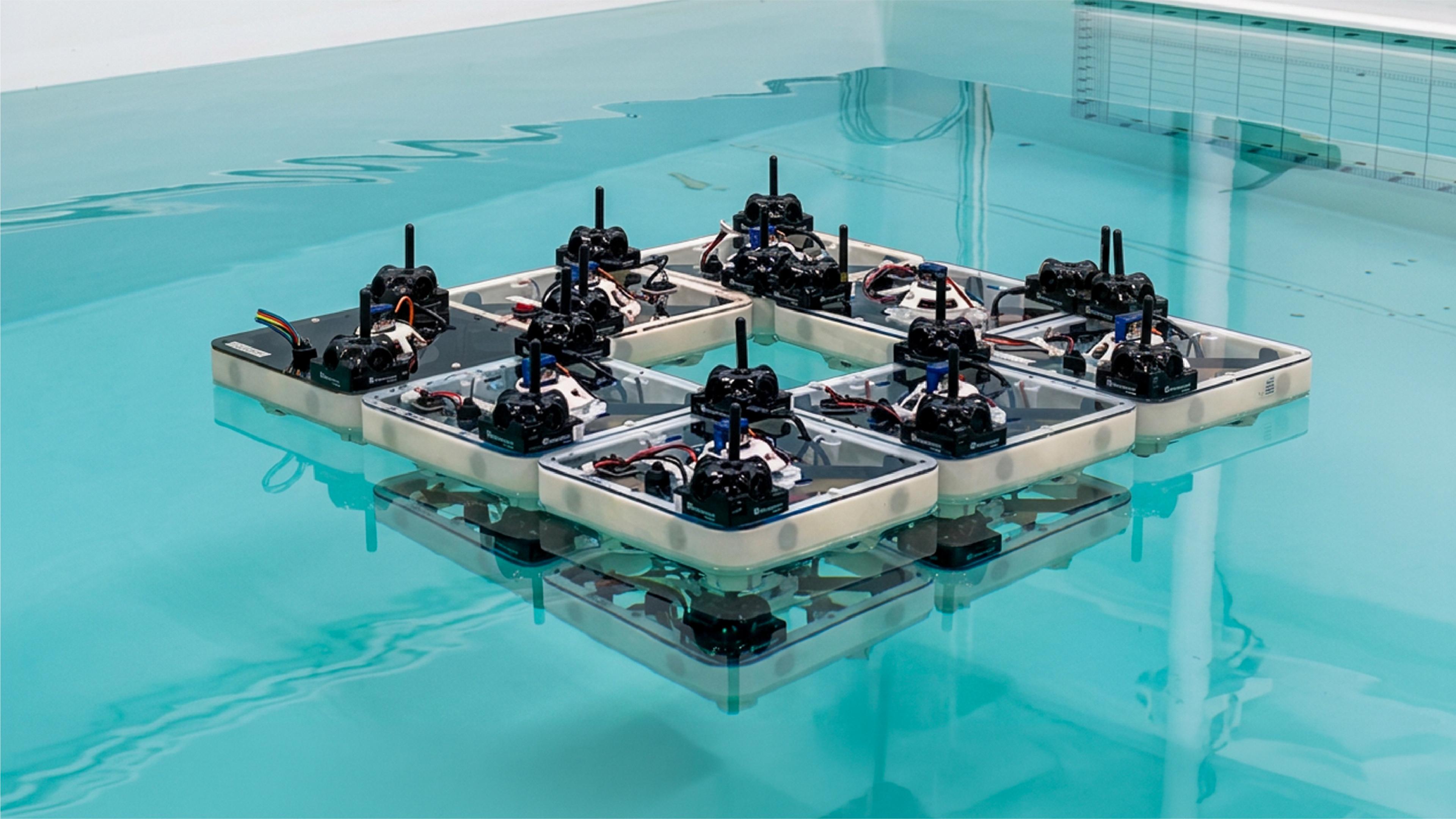
CAMBRIDGE, Mass. — Researchers at MIT have devised a team of tiny robotic boats that autonomously organize into floating formations, disassemble and reassemble into new formations with very little human guidance, according to a study published July 9 in Nature Communications.
The system, called FloatForm, comes from the labs of Daniela Rus, director of MIT's Computer Science and Artificial Intelligence Laboratory, and Carlo Ratti, director of the Senseable City Lab. Each robot is a self-contained, 21-centimeter-square vessel with its own thrusters, sensors and magnetic latches, MIT said.
In tests conducted in a tank, groups of eight boats would repeatedly rendezvous from dispersed positions, connect and lock into a target shape, break apart as needed, reconfigure into a different shape, and then move as a group as a single vessel - each iteration taking four to eight minutes, the researchers report. The team ran 10 such trials, which resulted in the group achieving their goal of locking into a target shape on 90% of trials with four boats and 70% of trials with eight, according to the paper.
Computer modeling found their decentralized coordination approach could scale to 64 boats, though this has not yet been demonstrated with hardware. Float Form's design balances the work of a centralized planner that assigns each boat a target position, with that of the boats, which coordinate on navigation, collision avoidance and latching through position exchanges with immediate neighbors, the team reports.
The system is inspired by fire ants, which form floating rafts by connecting their bodies without any central oversight. Magnetic latches on each boat are manipulated with a single servo-powered mechanism that expands or contracts with a geometry inspired by origami to release or hold onto an adjacent boat. A 3D-printed gearbox secures the latch once closed, so it only draws power during engagement and disengagement, the researchers say.
"This kind of distributed robotics opens new possibilities for mobility, emergency response, public space, and infrastructure on water," Rus said. The tests were conducted indoors, with an ultrasonic positioning system, but would need stronger latch mechanisms and a GPS or vision-based guidance system when used on open water, the researchers say.
The small size of the boats means the team would need to build larger boats to overcome wave or current disturbances, they add. Gonzalez-Garcia and others in the team have ideas for using Float Form to create temporary emergency platforms, floating markets, and reconfigurable water-based docking stations, among other things, though the system has not yet been tested outside a lab tank and there is no estimated date of availability.
More articles on this topic
12 articles ReportYoung Texas Inventor Sends Homemade Robot Underwater
 ReportDubai’s Viral Robot Newlyweds ‘Welcome’ Baby Robot Named Sinad
 ReportRobots Bring Ballet and Kung Fu moves to Prince George Library
 ReportBeijing’s ‘First Humanoid Robot Data Training Centre’ Gets Upgrade
 ReportKochi Airport Unveils Passenger Robot
 ReportEducational Robotics: Benefits and the Future of Learning
 ReportDubai Robot Cuts Surveying Costs by 90%
 ReportLG CLOi ServeBot vs Robint Joy
 ReportBoston Dynamics Spinoff Launches Robot Characters for Theme Parks, Hotels
 ReportUT Austin Wins $30 Million to Help Robots Live with Humans
 ReportChina 'Dominates Humanoid Robot Production'
 ReportRichtech Plans a Robot Double Act with DEX and Titan
BUSINESS NEWS WEEKLY LETTER
The Weekly Letter for Robotics Professionals, Summarizing the Most Important Industry Moves, Launches, Deals and Signals.