Impossible Metals Tests Autonomous Underwater Robot to Collect Minerals at 4,000-Metre Depth
A robot hovered 4,000 meters down, grabbed about 450 grams of rock and skipped the ones with life on them. It’s a small haul, and a big claim about how seabed mining could work.

November 10, 2026 by Dr Maulik Vyas
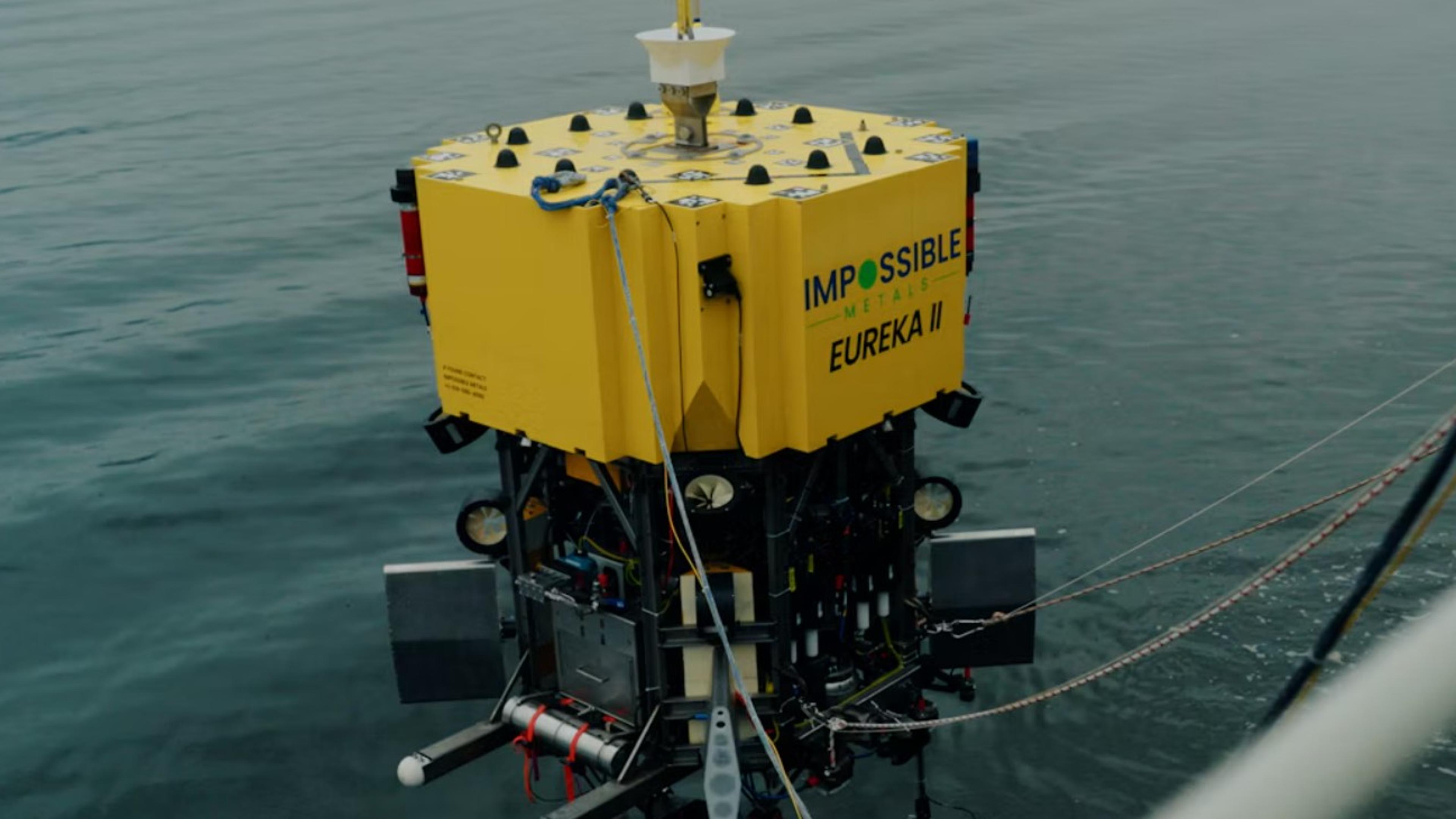
Impossible Metals says its Eureka robot has picked mineral nodules off the Pacific seabed at more than 4,000 meters without a human at the controls. The company announced the result on Monday. The dive took place during a scientific expedition in September in the Clarion-Clipperton Zone, a stretch of international waters between Hawaii and Mexico.
The haul was tiny. Eureka gathered nearly 450 grams of polymetallic nodules, the potato-shaped rocks containing copper, nickel and other metals. These metals are used in electric vehicles and electronics. The sample is sent to research partner Viridian Biometals. This research company studies bacteria living on the nodules and ways to recover metals with less water, less energy and no acid.
In this case, how it works matters more than how much it carried. Hence, Eureka hovers above the seabed rather than driving across it. A buoyancy engine lifts its load using water displacement, so no riser pipe runs up to a ship. Cameras and AI look for visible life on and around each nodule. Robotic arms leave those nodules in place and pick from the rest. The company calls it the first fully autonomous underwater robot to collect nodules selectively, a claim it makes itself.
Now that contrasts with the approach many deep-sea mining firms plan to use, a vacuum-like collector that has drawn heavy criticism from environmental groups. Impossible Metals, backed by Y Combinator, In-Q-Tel and the Smith family of FedEx, says its patented design avoids much of that disruption. One of its investors told Reuters the robot works without disturbing the environment, which is an investor’s description and not a measured result.
Plenty is still unproven. The dive was marine research, not production, and the company’s release doesn’t describe independent monitoring of its effect on seabed life. Impossible Metals still needs approval from the International Seabed Authority or the US government before it can mine commercially.
The next test is bigger. In 2027, a scaled-up Eureka III is due to be tried in front of an independent scientific team aboard the German research vessel RV Sonne, as part of an environmental impact study started by Germany’s Federal Institute for Geosciences and Natural Resources. The company says it will publish the data from this dive openly, and plans to offer robots as a service to licensed resource holders.
CEO Steve Curnutte says what remains is scaling and manufacturing, not invention. Regulators, scientists and environmental groups will have their say on that.
More articles on this topic
264 articles ReportWhat it Really Costs to Own a Personal Assistant Robot at Home
 ReportGoogle DeepMind Tests Gemini Robotics 2.5 on Mercedes-Benz Production Lines With 96 percent Success Rate
 ReportMIPS Unveils RISC-V Platform to Deliver Precise Motor Control Inside Humanoid Robot Joints
 ReportWhy Industrial Data is Becoming the New Strategic Asset in the AI Race
 ReportRobotic Systems Are Bringing Greater Precision to Veterinary Surgery
 ReportEvery Brick, Even the Curves—Monumental Shows What Its Robots Can Build
 ReportServe Robotics Launches Physical AI Services to Supply Technology to Other Robot Makers
 ReportBoston Dynamics Debuts Stretch Gen 2 to Reduce Warehouse Downtime
 ReportHumanoids report news as Xinhua Unveils New robot Anchors
 ReportNEURA Robotics teams up with E.ON and enviaM to bring robots into power grid operations
 ReportChina’s LiberAI Reports 36% Success Rate for New Robot Model
 ReportNEURA Robotics Teams Up With E.ON to Train Humanoids for Power Grid Inspections
BUSINESS NEWS WEEKLY LETTER
The Weekly Letter for Robotics Professionals, Summarizing the Most Important Industry Moves, Launches, Deals and Signals.