Robotic Systems Are Bringing Greater Precision to Veterinary Surgery
A surgeon at a console, four arms inside a dog's abdomen, and tremor filtered out of every move. Veterinary hospitals are testing what that precision can do.

November 9, 2026 by Dr Maulik Vyas
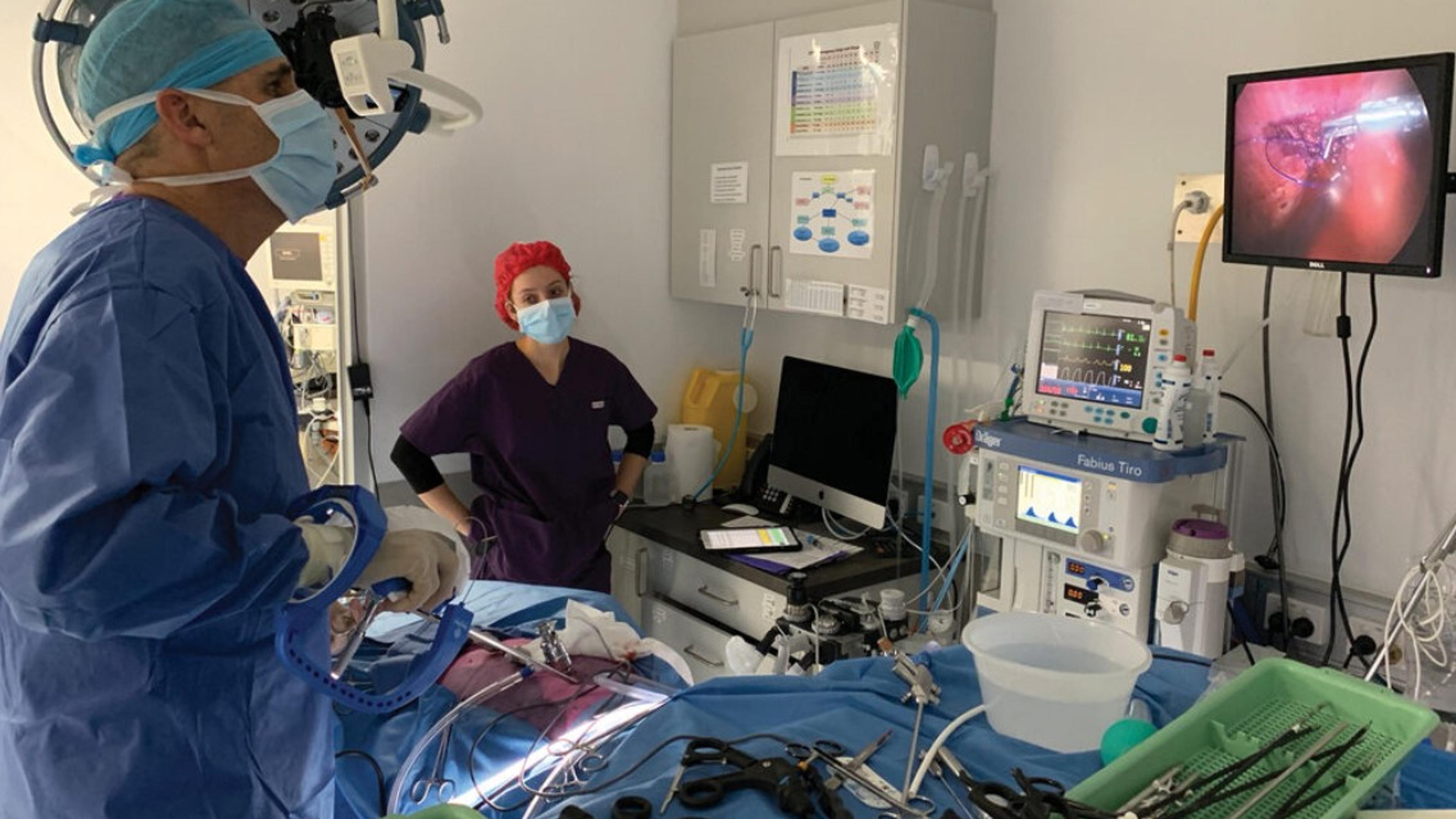
Picture a dog on the operating table and the surgeon sitting across the room at a console. Nobody's hands are near the incision. Four robotic arms are working inside the abdomen, copying the surgeon's movements on a smaller, steadier scale. Human hospitals have used this setup for years, and a handful of veterinary hospitals have started to try it.
Cornell's first robotic gastropexy
In 2023, Cornell's veterinary teaching hospital became the first in the world to buy a robotic surgical system, a da Vinci. Its first live case was a gastropexy on Finley, a Great Dane at risk of gastric torsion, a dangerous twisting of the stomach. The operation tacks the stomach to the body wall so it can't flip. Dr. Nicole Buote, a pioneer of veterinary robotics, has performed gastropexies from the console. A specialist practice in South Korea bought the second system a year later, and Colorado State's teaching hospital was reported to be next in the US.
How the robot helps the surgeon
A robotic system gives the surgeon a three-dimensional view, real depth perception and instruments that bend and rotate like a wrist. Hand movements get scaled down and filtered, so a tremor never reaches the tissue. For a small dog or cat, with tiny incisions and not much room inside, that steadiness counts.
Research has tested the idea on dogs. A 2020 study described robot-assisted prostate removal in a clinical canine case, and the surgeons reached a safe resection. Cadaver studies have tried gallbladder removal with da Vinci and Versius systems. One found docking took longer and a gallbladder tore, which shows there's a learning curve. In Tokyo, Anicom says its hospital is the first to use a robotic system with haptic feedback in veterinary medicine, so the surgeon can feel resistance through the controls.
Training matters as much as hardware. In one cadaver study, the veterinary surgeon had never used a surgical robot and got advice from human physicians with decades of combined experience. The authors suggested gallbladder removal as a good practice procedure for veterinary surgeons new to the controls.
Cost of robotic systems
A da Vinci can cost between $0.5 and $2.5 million depending on model, plus service fees of up to $190,000 a year and $600 to $3,500 in instruments per procedure. That's a steep ask for an animal hospital. Some buy used systems, and one refurbisher sells them for 50 to 90 percent below new prices. Newer makers such as Versius and Hugo could push costs down further.
Habits have to change, too. Robotic instruments have limited uses, which clashes with the old veterinary practice of resterilizing equipment indefinitely.
Robotic surgery in animals is still young, with few hospitals and mostly teaching centers leading the way. People get smaller incisions and shorter stays from it. Whether pets gain just as much is something researchers are still working out.
More articles on this topic
261 articles ReportWhat it Really Costs to Own a Personal Assistant Robot at Home
 ReportWhy Industrial Data is Becoming the New Strategic Asset in the AI Race
 ReportEvery Brick, Even the Curves—Monumental Shows What Its Robots Can Build
 ReportServe Robotics Launches Physical AI Services to Supply Technology to Other Robot Makers
 ReportBoston Dynamics Debuts Stretch Gen 2 to Reduce Warehouse Downtime
 ReportHumanoids report news as Xinhua Unveils New robot Anchors
 ReportNEURA Robotics teams up with E.ON and enviaM to bring robots into power grid operations
 ReportChina’s LiberAI Reports 36% Success Rate for New Robot Model
 ReportNEURA Robotics Teams Up With E.ON to Train Humanoids for Power Grid Inspections
 ReportRealbotix Rebrands Its Echo Humanoid Range: Series 1 Ahead of 2027 Deliveries
 ReportAeva Reports Record Revenue After Multi-Thousand Sensor Order
 ReportStarBot Launches $7,999 Spark Humanoid for Education and Robotics Development
BUSINESS NEWS WEEKLY LETTER
The Weekly Letter for Robotics Professionals, Summarizing the Most Important Industry Moves, Launches, Deals and Signals.