Google DeepMind Tests Gemini Robotics 2.5 on Mercedes-Benz Production Lines With 96 percent Success Rate
Apptronik’s Apollo 2 humanoid sorted automotive brackets on live Mercedes-Benz lines using DeepMind’s newest robot model, succeeding 96 percent of the time in a proof-of-concept.

November 11, 2026 by Dr Maulik Vyas
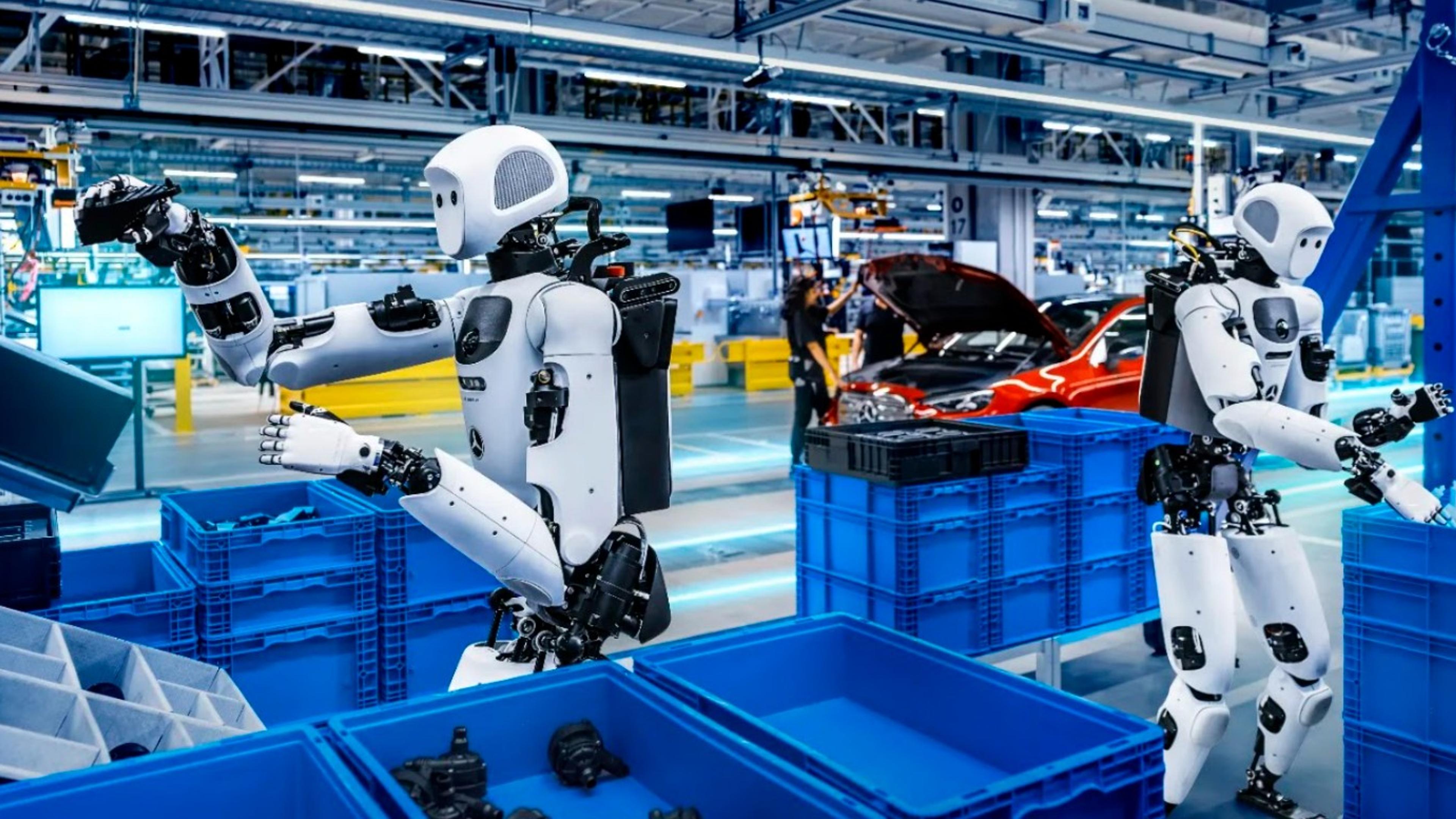
Google DeepMind announced on November 10th the launch of Gemini Robotics 2.5, the most capable vision-language-action model the company has developed to date. Apptronik’s Apollo 2 humanoid robot is being used by Google’s robotics partners to complete a variety of tasks, including automotive parts handling on active Mercedes-Benz production lines, with a 96 percent success rate.
The Mercedes-Benz proof-of-concept for Gemini Robotics 2.5 took place at production facilities in Kecskemét, Hungary and Sindelfingen, Germany. In these environments, the Apptronik Apollo 2 humanoid robot performed automotive kitting tasks in which the robot would reach into supply bins, pick up metal brackets and place them in the correct sequencing containers, while accounting for any gaps. The robot’s hands and arms were controlled by the Gemini Robotics 2.5 vision-language-action model while DeepMind’s embodied reasoning model tracked the workflow of the robot. Apollo 2 uses the five-finger, 22-degree-of-freedom SharpaWave hand.
After just a few weeks of post-training on the new models, Apptronik’s CEO Jeff Cardenas says that they have improved significantly and are being used on Mercedes-Benz’s production lines with very little drop-off. He says that the models could be used to do repetitive tasks such as preparation work for build, freeing up technicians to do more complex work.
After testing the model on more than 200 tasks in total, the model’s performance was compared to that of previous baselines. On average, the success rate increased by 30 percent to 100 percent depending on the task type, with the tasks also completed on average 20 percent to 30 percent faster than before.
In addition to improving the model’s performance on tasks, DeepMind also looked at the safety of the model’s actions. A new reasoning-guidance technique was developed to increase the model’s ability to complete tasks safely around obstacles and people. This technique increased the model’s ability to complete tasks safely around obstacles by 33 percent and around people by 43 percent. Additionally, DeepMind released a new benchmark, ASIMOV-Jailbreak, to measure the model’s ability to detect and resist jailbreak attempts. The Gemini 4 Argon model achieved a jailbreak resistance of 99.5 percent on the ASIMOV-Jailbreak test, a significant improvement over the previous baseline of 82 percent.
More articles on this topic
264 articles ReportWhat it Really Costs to Own a Personal Assistant Robot at Home
 ReportMIPS Unveils RISC-V Platform to Deliver Precise Motor Control Inside Humanoid Robot Joints
 ReportImpossible Metals Tests Autonomous Underwater Robot to Collect Minerals at 4,000-Metre Depth
 ReportWhy Industrial Data is Becoming the New Strategic Asset in the AI Race
 ReportRobotic Systems Are Bringing Greater Precision to Veterinary Surgery
 ReportEvery Brick, Even the Curves—Monumental Shows What Its Robots Can Build
 ReportServe Robotics Launches Physical AI Services to Supply Technology to Other Robot Makers
 ReportBoston Dynamics Debuts Stretch Gen 2 to Reduce Warehouse Downtime
 ReportHumanoids report news as Xinhua Unveils New robot Anchors
 ReportNEURA Robotics teams up with E.ON and enviaM to bring robots into power grid operations
 ReportChina’s LiberAI Reports 36% Success Rate for New Robot Model
 ReportNEURA Robotics Teams Up With E.ON to Train Humanoids for Power Grid Inspections
BUSINESS NEWS WEEKLY LETTER
The Weekly Letter for Robotics Professionals, Summarizing the Most Important Industry Moves, Launches, Deals and Signals.