Unitree R1 EDU vs. Booster K1
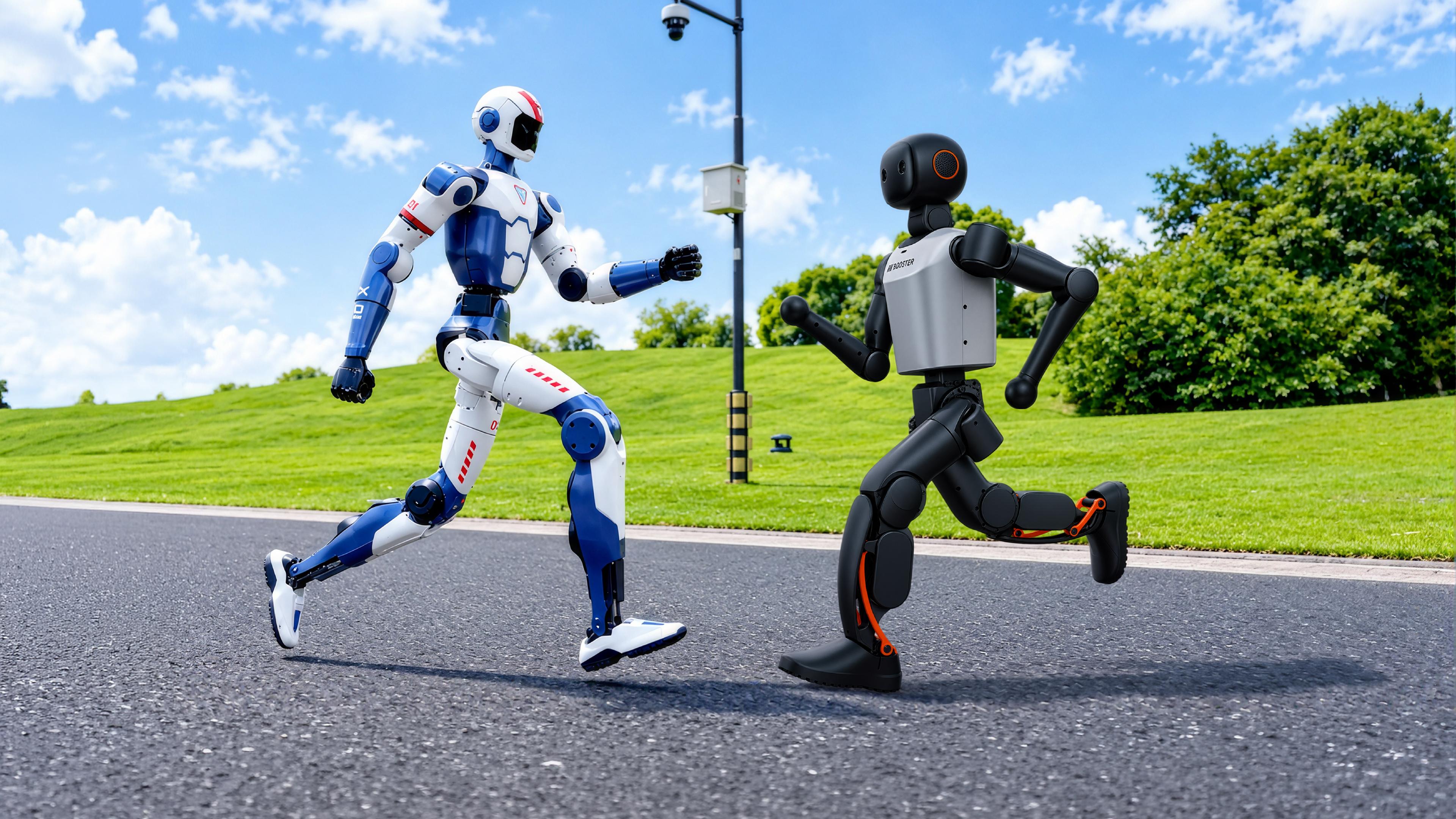
Unitree R1 EDU and Booster K1 are small humanoid robots aimed at education, robotics research and movement programming. We compare their size, degrees of freedom, battery life, development potential and target audiences to explore the implications for universities, laboratories and humanoid robot research in general.

October 21, 2026 by Business Desk Team
Introduction
Compact humanoid robots are being designed as educational and platform robotics and experimental environments for autonomous walking.
Where other robot types tend to be created for industrial purposes and commercial usage, programmable research platforms enables creators to examine robot learning, balance, sensors and locomotion.
Unitree R1 EDU and Booster K1 are both for these applications but with the differences in documented specifications and development priorities.
Unitree R1 EDU is targeted to education, robot learning, locomotion research and interaction, with support for secondary development and optional manipulation hardware.
Booster K1 is a smaller humanoid platform targeted at education, robot soccer, research and programmable locomotion.
Based on ROBOT24.com market-research data records and manufacturer-reported specifications, this comparison examines their physical design, degrees of freedom, battery endurance, development capabilities and suitability for different research environments.
At A Glance
| Metric | Unitree R1 EDU | Booster K1 |
|---|---|---|
| Robot type | Compact programmable humanoid | Compact humanoid robotics platform |
| Best-fit use cases | Education, robot learning, locomotion and interaction | Education, soccer/research and programmable locomotion |
| Dimensions | 1,230 × 357 × 190 mm (standing; Unitree R1 EDU) | Approx. 950 mm standing height; 19.5 kg body mass |
| Load / suction / capacity | Manipulation hardware optional | 22 DoF; 6 per leg, 4 per arm, 2 head |
| Runtime / charging | Approx. 1 h battery operation in Robot24 EDU record; configuration-dependent | Geek: 2 Ah / 20 min; Education/Professional: 5 Ah / 70 min (current maker page test gait) |
| Navigation / sensing | Open joint/sensor controls; simulation support | Autonomous navigation; exact sensor configuration requires confirmation |
| Distinctive capabilities | Approx. 29 kg; R1 EDU 26–40 DOF depending on selected hands/options (not the standard R1 26-DOF specification). | Compact form factor oriented toward humanoid development and demonstrations |
| Key limitation / caveat | R1 EDU must be identified by its exact hand/DOF configuration. Do not conflate R1 with Unitree R1-D, a separate dual-arm platform. | Confirm precise K1 configuration, API/software stack and variant-specific DOF with Booster documentation | Verification: Booster K1 battery and runtime depend on edition; avoid treating the Geek and Education as one configuration. |
How They Compare
Education and research applications
Unitree R1 EDU is a programmable humanoid robot for education. It is a robotics development platform for movement and interaction experiments.
Given its secondary development options this should be of interest for universities and laboratories researching locomotion, robot learning and sensor-based control.
Booster K1 is also conceived for educational and research application, with a focus on programmable locomotion and robot soccer.
Its size may be advantageous for demos and research where a smaller size humanoid robot is desirable.
While enabling humanoid formation for both robots, R1 EDU provides, a wider array of documented configuration possibilities than K1,which is more targeted toward small form-factor applications.
Physical dimensions and portability
Unitree R1 EDU stands 1,230mm high. R1 mass is 29kg.
Booster K1 is about 950 mm and the recorded body mass is 19.5 kg.
This results in K1 being approximately 28 cm shorter and 9.5kg lighter than R1 EDU with the specifications provided. Indeed, less size does not necessarily imply more stability, easier handling and compatibility with a specific experiment.
With these considerations in mind, storage and charging configuration, handling needs and volume for effective locomotion testing might be taken into account.
Degrees of freedom and mechanical configuration
Unitree R1 EDU Recorded range of 26-40 degrees of freedom, based on configuration and optional hand hardware.
Such variations might be useful for projects where different degrees of articulation are needed or where manipulation of upper-body movement is desirable.
Note: The 26-40 DoF range does not specify a single number of degrees of freedom. The precise selection needs to be specified at time of purchase.
Booster K1 recorded 22 degrees of freedom, six of each leg, four each arm, two in the head.
This configuration allows for articulated humanoid motion, and can function as a mechanical platform for locomotion-based research.
The variance between DoF numbers might influence the type of movement available to developers but even if the number is higher, this doesn't necessarily mean superior motion controls or actual world performance.
Each robot's performance is also constrained by its joint range, control software and mechanical design.
Battery endurance and charging
The actual running time depends on the mode that is been selected and the usage.
Booster K1's battery specifications vary by edition.
The Geek version appears to have a 2 Ah battery and "about 20 min." use at the manufacturer quoted test gait.
Education and Professional versions are also included with a 5 Ah battery and run time of about 70 minutes based on the quoted test conditions.
The data should not be combined into one shared K1 application specification.
While the Education and Professional editions have a more mission time declared than the Geek edition, these numbers do not seem to prove a consistent practical endurance benefit over R1 EDU.
Battery life may vary depending on walking speed, level of activity, computing load and robot configuration.
Charging time for both robots needs to be verified against their model-specific technical specs.
Locomotion and movement research
The programmable joint control and simulation capabilities of R1 EDU can be leveraged for development and testing of locomotion algorithms before deploying them onto the physical robot.
Its customizable articulation may also promote studies of "arm and leg" synchronized movement.
Booster K1 is a co-robot for programmable locomotion, robot soccer and research.
They may also include activities such as balance, walking, turning and precise coordinated movements in different environments.
This is despite the fact that the specifications mentioned above does not do not provide readily comparable measurements for walking speed, balance recovery, actuator torque or locomotion reliability.
There is no way that either robot can claim an advantage in any of these items without proper testing.
Programming & Software Development
Unitree R1 EDU has been recorded for ability of secondary development, using joints and sensors control and simulation.
These techniques could be of interest to researchers designing their own control algorithms or trying out robot learning approaches.
Booster K1 is positioned as a programmable humanoid research platform, but its exact API access, software development environment and supported functions should be confirmed for the selected edition.
Universities and laboratories are best advised to verify access to SDKs, simulation environments, documentation and low-level controls prior to selecting either platform.
Navigation and sensing
Unitree R1 EDU has joint and sensor controls suitable for developers for programming and experimentation.
Supplied records also indicate simulation support, which could assist researchers in designing and testing control strategies.
The K1 booster is natively autonomous, but the specific sensing hardware and navigation software will need to be checked out.
Research teams should confirm the configuration of sensors, onboard computing, and software interfaces of the sensor/compute/comm go-bag match their intended research projects.
Deployment and research issues
Both robots are designed for programmable humanoid use, not regular commercial service deployment.
Optional manipulation hardware and degrees of freedom of R1 EDU is flexible and may be used in projects related to interaction, robot learning and coordinated movement.
Less physical size of the booster K1 and soccer focused research target might attract the teams that are interested in locomotion and educational demonstration.
Prior to the acquisition, shops must verify the particular hardware version, available advancement tools, substitute-part availability, technical support and safety procedures.
They should further consider if the robot provides the necessary sensor configurations, software frameworks, and control interfaces to address their work.
More articles on this topic
83 articles ReportRichtech DUST-E S vs. Gausium Phantas
 ReportEngineAI SE01 vs. AGIBOT RAISE A1ReportRichtech DUST-E S vs. KEENON KLEENBOT C20
 ReportRobint Rhino vs. OrionStar CleaniBot S55 Pro
 ReportECOVACS DEEBOT X8 PRO OMNI vs. eufy X10 Pro Omni
 ReportCleanfix S170 Navi vs. OrionStar CleaniBot K1
 ReportCleanfix S170 Navi vs. Nexaro NR 1700
 ReportReeman Nurse vs. Robotise JEEVES
 ReportBear Robotics Servi Plus vs. OrionStar LuckiBot Pro
 ReportBear Robotics Servi Plus vs. KEENON DINERBOT T10
 ReportUBTECH Cruzr 1S vs. Hantewin S30
 ReportECOVACS DEEBOT X8 PRO OMNI vs. eufy X10 Pro Omni
BUSINESS NEWS WEEKLY LETTER
The Weekly Letter for Robotics Professionals, Summarizing the Most Important Industry Moves, Launches, Deals and Signals.