Five Extreme Sports Where Robots Are Competing
Autonomous machines are stepping into the arena to redefine the limits of athletic competition.

September 26, 2026 by Ope
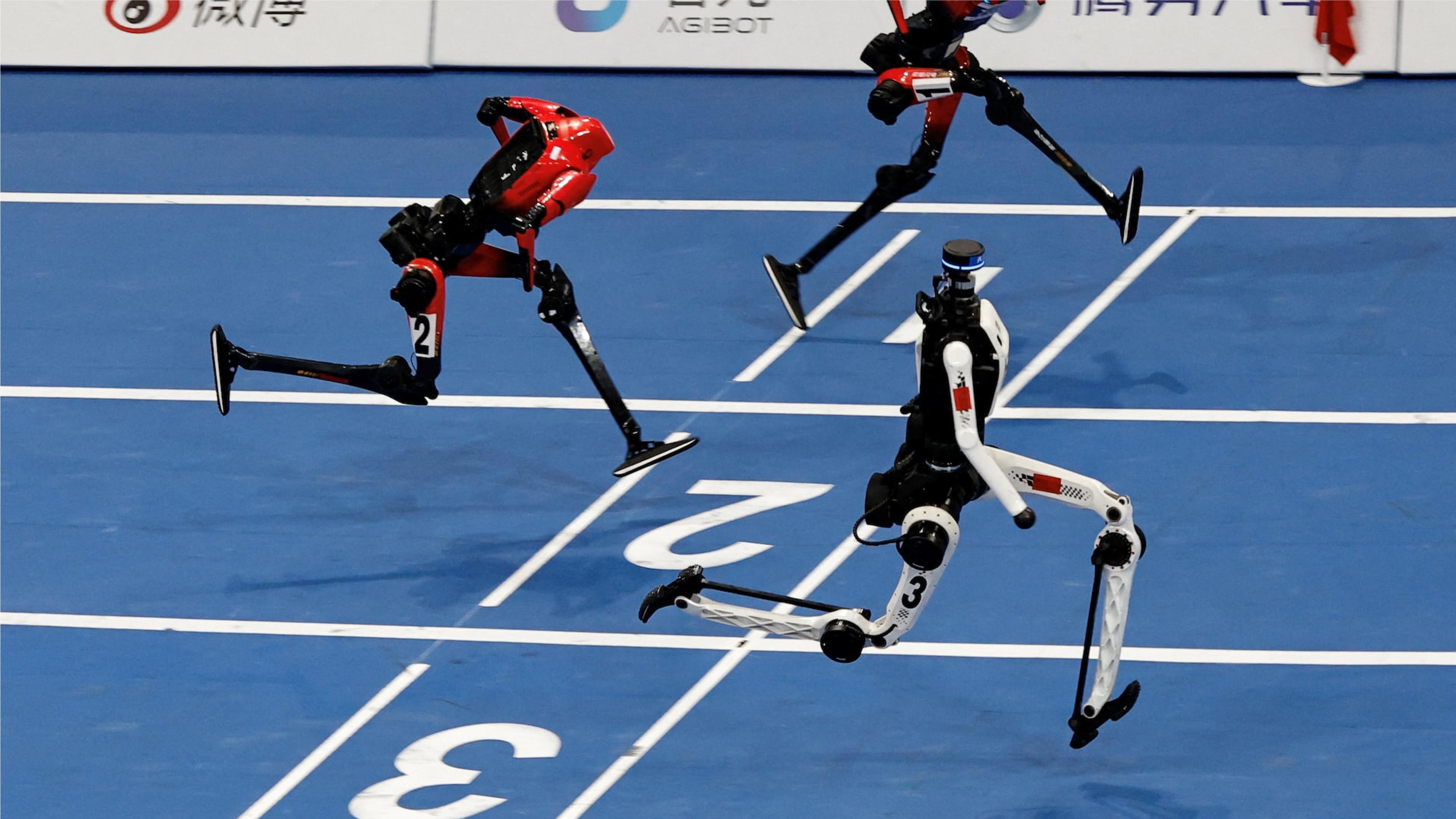
Autonomous machines are stepping into the arena to redefine the limits of athletic competition.
Jamaican sprinter Usain Bolt set a world record in the 100-metres with a time of 9.58 seconds in 2009. Two robots have now beaten that mark.
Robots are increasingly competing, and often colliding, in a variety of sporting competitions.
Here are five of the most extreme:
Humanoid Robot Combat
The Cyber Hero League is a real-life robotic version of Mortal Kombat, but with even more grit, gear and destruction.
The league, which began its first competition in Riyadh, Saudi Arabia, early this month, employs EngineAI T800 robots by EngineAI Robotics, for cage fights. The robots are about 1.73 meters high and can move without human help thanks to cameras and LiDAR sensors on them.
They kick, punch, and parry off offensive attacks. However, they cannot sustain severe structural damage without component failure. They also occasionally taunt opponents in a way that heightens entertainment and mimics human fighters.
There is a plan for an eight-city international expansion. This means more fans, more fun and more mechanical fights.
World Humanoid Robot Games
This is the Olympic Games for robots. Various traditional track and field events are contested in a battle for athletic supremacy, including the 100-metre dash, long jump, high jump and other events,such as weightlifting. The most recent tournament took place in Beijing, and it featured more than 600 teams and 2,000 robots from 16 nations, all fiercely competing in 51 events.
Autonomous Drone Racing
During an autonomous drone race, very high-performance drones fly at speeds up to 160 km/h while maneuvering complex courses. Sometimes they take place in abandoned warehouses or winding paths.
The Tiangong family of robots, which has been designed by the Beijing Humanoid Robot Innovation Center, dominates the games. The Tiangong robots have excelled in sprints and have beaten the world record for humans in the 100-meter dash. However, they also suffer from balance issues, which have caused them to fall, in some competitions.
Autonomous Drone Racing (Drone Racing League)
In this league, high-performance drones zoom past one another at speeds as fast as 160 km/h. There are several intricate courses that meander through abandoned warehouses, sinuous paths and narrow spaces.
One miscalculation can send quadcopters crashing into one another, leaving carbon-fiber and polymer components scattered across the ground. The league has eliminated the need for the human pilots wearing first-person-view (FPV) goggles who are typically associated with traditional drone racing. Instead, the racing is fully autonomous, made possible by significant onboard computing power and sophisticated algorithms. The drones used in the league are RacerAI quadcopters, developed by the league in collaboration with Lockheed Martin.
Underwater Racing
Land-based robot athletics have inspired a novel form of robotic competition: sub-surface marine racing. In this contest, several autonomous underwater vehicles (AUVs) take part in an endurance race, like a marathon. These vehicles need to possess the engineering features of a submarine, which include hydrostatic pressure resistance, underwater navigation capabilities, and buoyancy management. Some of the AUVs use thermal energy harvesting systems for power generation. The AUVs push through the resistance of the water and can occasionally use ocean currents to their strategic advantage.
Most competing AUVs are built by robotics teams of various participating universities. For instance, Mecatron is built by the Mecatron team from Nanyang Technological University, Singapore. Douglas is an AUV made by McGill Robotics from McGill University in Quebec, Canada; and Oogway is built by the Duke Robotics Club at Duke University in the United States. The AUVs cannot receive direct GPS signals or real-time manual control while submerged, because satellite communications do not penetrate seawater.
RoboCup Soccer
Popularly referred to as football in most of the world, soccer has millions of fans, with tournaments such as the World Cup drawing global audiences. Its robotic equivalent is similarly ambitious, with plans to field robots against humans in a match around 2050.
Like human soccer, RoboCup requires speed, agility, precise passing, and endurance. It also demands accurate hand, eye, and leg coordination from robotic goalkeepers. This creates a range of engineering and computational challenges for teams developing humanoid robots for the sport. Several robot models participate in RoboCup soccer, including the Unitree G1 and Unitree R1 Edu Smart.
There are also Booster T1 and Booster K1. The first two robots are manufactured by Unitree Robotics, while the latter two are made by Booster Robotics. Currently, robots tend to overheat after multiple hours of play and require frequent battery maintenance between matches. The Future of Robot Sports The future could hold an expanding assortment of robotic competitions. Each race, medal, win or loss provides another test of robotic engineering and artificial intelligence, pushing machines into increasingly demanding physical environments.
More articles on this topic
36 articles ReportRobots vs. Drones: What Is the Real Difference?
 ReportHow Animals Inspire Better Robots
 ReportFrom Toys to Tools: The Coolest Robots in Schools Today
 ReportJapan Tests Robot Bins at Tokyo’s Busiest Railway Station
 ReportUnitree Adds $6,500 Dex5-S to Dexterous Hand Lineup
 ReportHow Do Robots See the World?
 ReportChina Raises Scrutiny of Humanoid Robot IPOs After Unitree Shares Fall 55%
 ReportViam Debuts Box-Opening Robot at IROS 2026
 ReportBoston Dynamics Opens New Home For Training Robots
 ReportHuman Gets in the Ring With a Six-Foot Humanoid Robot
 ReportBatteries Included: Why Staying Powered is Hard for Robots
 ReportGeek+ Opens Düsseldorf Lab for Live Warehouse Robot Demonstrations
BUSINESS NEWS WEEKLY LETTER
The Weekly Letter for Robotics Professionals, Summarizing the Most Important Industry Moves, Launches, Deals and Signals.